
Key Takeaways
- Enterprise data platforms like BrightEdge, Conductor, and seoClarity remove the keyword coverage and cross-client reporting bottleneck, freeing strategists from rebuilding pivot tables every week 8.
- Technical crawlers and audit engines such as Screaming Frog compress portfolio-wide audit throughput, letting seniors review prioritized issue lists instead of running scans URL by URL 1.
- Content optimizers and AI writing layers cut brief-to-draft cycle time by turning coverage scoring into the drafting surface, though editor refinement remains essential to originality 11.
- GEO and AEO visibility tools close the reporting gap classic rank tracking now misses, since SEO plus AEO plus GEO defines sustainable visibility in AI-driven search 4.
- Workflow automation and white-label reporting standardize onboarding and recurring deliverables, converting reporting from a delivery cost into a background process across dozens of accounts 10.
- The AI execution layer coordinates recommendation-to-publish handoffs and can move senior strategists from one or two accounts to ten or more when approval gates stay intact 9.
The Delivery-Capacity Problem Behind Every Agency Tool Decision
Most agency Heads of SEO are not shopping for a better keyword tool. They are staring at a delivery pipeline that hires cannot keep up with. Sales closes a new account, the strategist queue grows, junior output degrades, and quality review becomes the bottleneck instead of the safeguard.
The research explains why AI tooling has stopped being optional for that math. A peer-reviewed study on AI-powered SEO workflows found that AI-enhanced SEO increased organic traffic by 35 to 70 percent, improved ranking stability, and reduced manual workload across the sites tested 1. The reduction in manual workload is the number that matters to agency operators, because manual workload is what forces headcount growth.
Tool selection at this stage is really a delivery-model decision. Each category of AI SEO tool removes a specific bottleneck between recommendation and published work. Some categories produce faster insights. One category actually converts insights into approved, shipped deliverables. Knowing the difference determines whether an agency scales client count or scales its payroll.
This piece ranks six categories against that test.
How to Read This List: Six Categories, Not Six Products
This is not a ranked countdown of six tools. It is a map of six categories, because that is how agency stacks actually get built. A 2026 comparison of 15 enterprise SEO platforms reached the same conclusion: pick a platform for execution and automation, then pair it with one or two best-in-class data sets and a technical crawler, rather than hunting for one tool that does everything 16.
Each category below is anchored to a specific delivery bottleneck. Enterprise data platforms handle keyword coverage and cross-client reporting. Technical crawlers handle audit throughput. Content optimizers cut brief-to-draft cycle time. GEO and AEO tools track visibility inside answer engines. Workflow automation absorbs onboarding and recurring deliverables. The AI execution layer converts approved recommendations into shipped work.
Named exemplars appear inside each category so the discussion stays concrete, but the point is the slot, not the vendor. A Head of SEO who can name the six slots can defend the stack composition to a COO.
Category 1: Enterprise Data Platforms
The Bottleneck Removed: Keyword Coverage and Cross-Client Reporting
Enterprise data platforms exist to solve two problems that break at scale: keyword coverage across dozens of client portfolios, and reporting that a Head of SEO can hand to a client-services lead without rebuilding it every Monday. Forrester's evaluation of the category defined a true enterprise SEO platform as one that manages the SEO process across stakeholders, supports keyword research, tracks organic success, and audits the technical foundation of a site 8. That definition is the reason these tools sit at the base of the stack.
For an agency running 15 to 80 accounts, the value is not the keyword database itself. It is the ability to run coverage analysis, share-of-voice tracking, and portfolio-level ranking dashboards without a strategist rebuilding pivot tables per client. Forrester's earlier automation report made the same point in reverse: automation delivers most when dedicated strategists interpret the data, and agencies increasingly pair with automation vendors to offload the tactical layer 13. The data platform is the tactical layer that stops eating strategist hours.
Named Exemplars: BrightEdge, Conductor, seoClarity
The Forrester Wave reference set for this category includes BrightEdge, Conductor, Moz, Searchmetrics, SEMrush, seoClarity, and Siteimprove 8. These are the incumbents Heads of SEO benchmark against when a COO asks why the agency needs enterprise-grade data instead of a $99 seat license.
The market data explains why the incumbents still hold the slot. Enterprise generative AI spend is projected to jump from $11.5 billion in 2024 to $37 billion in 2025, the AI-powered SEO software segment is growing at a 23.4 percent CAGR, and large enterprises account for 75.9 percent of 2025 AI SEO adoption 7. Client-side buyers at that scale expect their agency to operate on platforms that match their internal tooling.
The trap is treating the enterprise platform as the whole stack. It produces recommendations at volume. Converting those recommendations into published, approved work is a different job, handled further down this list.
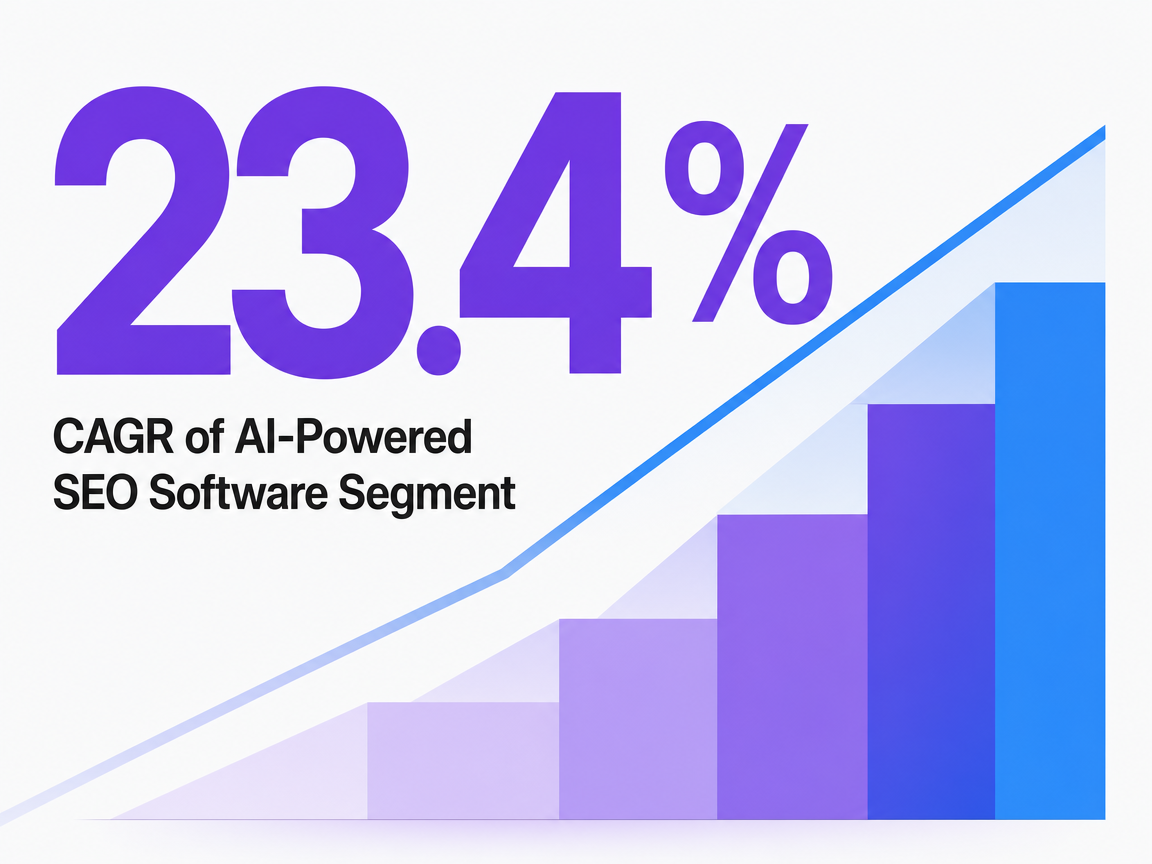 CAGR of AI-Powered SEO Software Segment
CAGR of AI-Powered SEO Software Segment
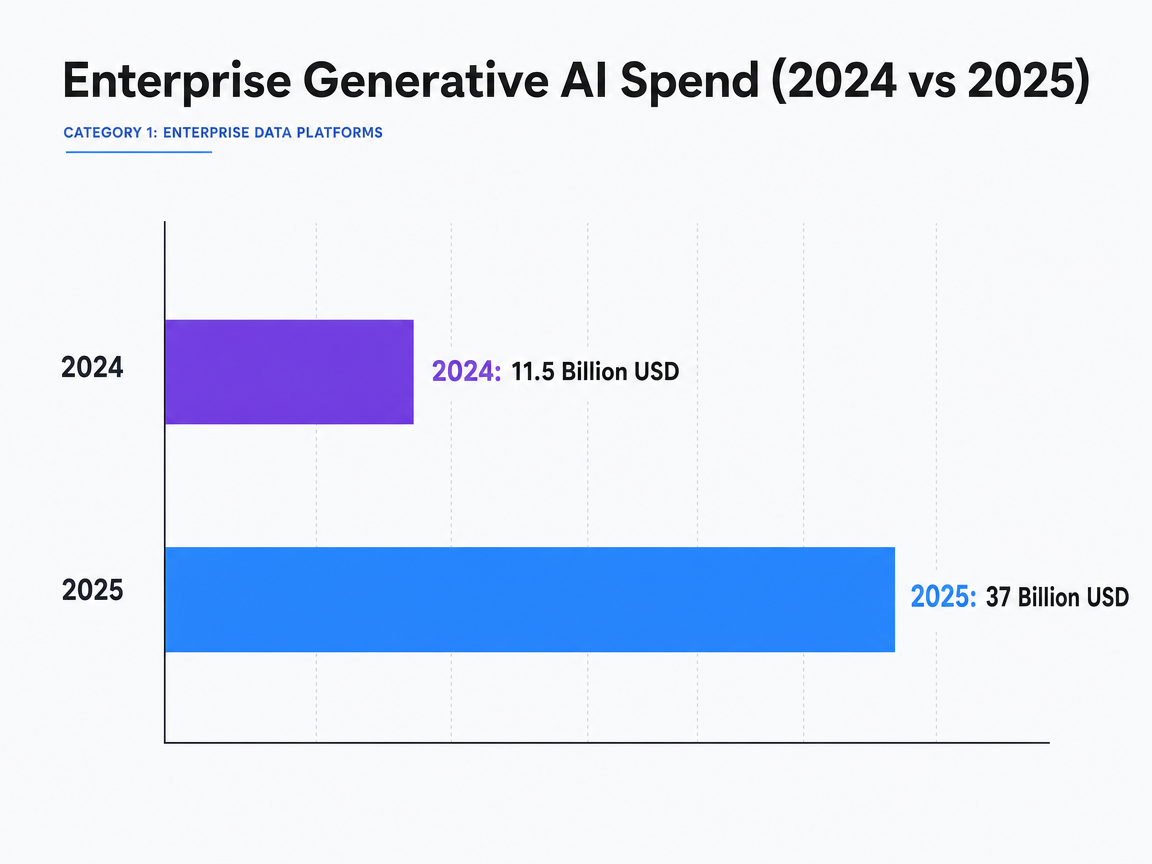 Enterprise Generative AI Spend (2024 vs 2025)
Enterprise spending on generative AI is projected to grow from $11.5 billion in 2024 to $37 billion in 2025, indicating rapid market expansion.
Category 2: Technical Crawlers and Audit Engines
The Bottleneck Removed: Audit Throughput Across a Portfolio
Technical audits are where junior throughput collapses first. A single site with a few hundred thousand URLs is manageable. Fifty client sites, each with its own CMS quirks, faceted navigation, and canonical drift, is a full-time job that never ends.
Crawlers exist to compress that work. They handle the scan itself and, when paired with AI-assisted diagnostics, cluster issues by root cause so a strategist reviews patterns instead of individual URLs. The peer-reviewed AI SEO study found that AI-supported workflows, including automated technical audits, cut manual workload measurably while improving ranking stability across the sites tested 1. Market data supports the same shift: over 40 percent of businesses report better ROI from AI-driven site audits and technical SEO improvements 12.
The operational effect is that a senior strategist stops running crawls and starts reviewing prioritized issue lists. That is the difference between one audit a week and audits refreshed continuously across a portfolio.
Named Exemplars: Screaming Frog and Adjacent Log-File Tools
Screaming Frog remains the reference crawler in most agency stacks, and modern stack blueprints keep it in that slot. The 2026 Arvow stack recommendation pairs Screaming Frog with a data platform like Semrush or Ahrefs and an AI delivery hub, treating the crawler as a specialist layer rather than something an all-in-one platform absorbs 15.
Log-file analysis sits alongside the crawler for sites where Googlebot behavior actually drives ranking outcomes. E-commerce, publishers, and large multi-location networks fit that profile. The Forrester enterprise platform definition also lists technical foundation audits as a required capability, which is why some agencies run both a crawler and an enterprise platform rather than choosing one 8.
Test AI-driven SEO workflows on live projects
Experience measurable SEO gains and publish real content across client accounts before making a commitment.
Category 3: Content Optimizers and AI Writing Layers
The Bottleneck Removed: Brief-to-Draft Cycle Time
The queue that eats agency margin is not keyword research. It is the stretch between an approved brief and a client-ready draft. Strategists write outlines, writers request clarifications, editors send drafts back for keyword coverage, and the calendar slips a week per asset.
Content optimizers compress that stretch by turning the brief itself into a scoring surface. Surfer, Clearscope, and similar tools score coverage against ranking competitors, flag missing entities, and let an AI writing layer generate a first pass that already sits inside the target coverage band. A generative AI SEO study framed the shift plainly: integrating generative AI into optimization procedures produces better search rankings, organic traffic, and user engagement while automating parts of the workflow 3. Market data confirms adoption has moved past pilot stage. Fifty-three percent of agencies have adopted AI-based SEO tools for predictive content generation 12.
The cycle-time gain is real. The output quality gain is conditional, which is what the next section addresses.
Where AI Writing Breaks Without a Refinement Step
AI-generated drafts fail in predictable places:
- thin analysis,
- generic phrasing,
- missing point of view,
- and citations that do not exist.
The academic literature on automated content generation is direct about the fix. AI content generators help create optimized content at scale, but human writers should refine AI-generated content to enhance clarity, emotional appeal, and originality 11.
For an agency delivering into regulated verticals or executive-facing brands, that refinement step is not optional polish. It is the difference between an asset that earns links and one that gets rewritten by the client. The synergy research reaches the same conclusion from a different angle: the durable SEO effect from AI comes from partnering AI with human expertise, not from removing the strategist 6.
Content optimizers belong in the stack. They do not remove the editor. They shift the editor's job from drafting to judgment.
Category 4: GEO and AEO Visibility Tools
The Bottleneck Removed: Visibility Tracking Inside Answer Engines
Classic rank tracking answers a question that fewer client queries now depend on. When a prospect asks ChatGPT, Perplexity, or Google's AI Overviews for a shortlist, the SERP position of a client's page is a proxy at best. The visibility that matters is whether the client shows up inside the generated answer, and with what framing.
GEO and AEO tools exist to close that measurement gap. They monitor citation frequency across large language model outputs, track share of voice inside AI summaries, and flag when a client's content is being paraphrased without attribution. Qualitative research on organizational adaptation to AI search reached a direct conclusion: AI search engines form an independent ecosystem that requires a new strategic approach, active optimization of content for AI models, and measurement against new forms of visibility 5. A modern agency stack now treats LLM visibility tracking as a standing layer, not a research project 15.
The bottleneck removed is reporting credibility. Heads of SEO who cannot show clients where they stand inside answer engines lose renewal conversations to competitors who can.
SEO + AEO + GEO as the Current Stack, Not a Roadmap Item
The integrated framework research states the position plainly: SEO plus AEO plus GEO equals sustainable visibility in the AI-driven search era, and traditional SEO alone is no longer sufficient 4. That is a current-stack requirement, not a 2027 planning item.
Operationally, GEO and AEO work adds three deliverables to a client engagement:
- Entity coverage audits verify that a brand's core facts are consistent across the sources LLMs pull from.
- Answer-shaped content production restructures existing assets so key claims sit near explicit questions.
- Citation monitoring reports on which prompts surface the client and which surface a competitor.
Generative AI SEO research supports the shift, noting that integrating generative AI into optimization procedures yields better rankings, organic traffic, and user engagement when aligned with ranking criteria 3.
Agencies that skip this layer will keep reporting green dashboards while clients watch qualified traffic decline. The category belongs in the stack now.
Category 5: Workflow Automation and Reporting Layers
The Bottleneck Removed: Client Onboarding and Recurring Deliverables
Onboarding a new client is where agency margin quietly disappears. Kickoff calls, access provisioning, baseline audits, competitor mapping, tracking setup, and the first content calendar all land in the same two-week window. Multiply that by a sales team closing three or four accounts a month and the strategist bench is behind before any optimization work starts.
Workflow automation layers exist to standardize that intake and the recurring deliverables that follow it. Templated automation converts onboarding, monthly reporting, keyword tracking refreshes, and content briefs into repeatable processes rather than bespoke projects. Research on SEO workflow automation makes the operational case directly: by eliminating manual inefficiencies and standardizing best practices, agencies can scale operations while improving service quality and client satisfaction 10. The Forrester automation report reached a related conclusion, noting that automation tools work best for organizations with dedicated strategists who interpret the data, and that agency partnerships with automation vendors are likely to grow to offload tactical work 13.
The effect on the delivery pipeline is that senior strategists stop assembling deliverables and start reviewing them.
White-Label Reporting and Multi-Account Management as Overhead Killers
Reporting is the recurring tax on agency capacity. Every account expects a monthly dashboard, and every strategist loses hours reformatting the same data for different logos. Applied evaluation of agency AI SEO platforms found that certain tools offer the specific agency features, including automated reporting, client seat management, and workflow integrations, that actually reduce operational overhead while improving client results 14.
Two capabilities carry most of the weight. White-label reporting removes the manual export-to-slide cycle, so a portfolio of 40 accounts generates 40 branded reports without a strategist touching them. Multi-account management centralizes seats, permissions, and workspace switching, which cuts the tab-juggling that quietly drags a senior hour into three. Together they turn reporting from a delivery cost into a background process.
Category 6: The AI Execution Layer
The Bottleneck Removed: Recommendation-to-Publish Coordination
Every category above this one produces recommendations. Enterprise platforms surface keyword gaps. Crawlers surface technical fixes. Content optimizers surface coverage gaps. GEO tools surface citation gaps. None of them ship the work. That handoff, from a ranked recommendation to an approved, published deliverable, is where agency delivery quietly stalls.
An AI execution layer sits between the recommendation tools and the publishing surface. It takes an approved priority, drafts the deliverable inside guardrails, routes it for strategist review, and pushes the final version into the CMS or ad platform after sign-off. A documented case study of an agency that built this pattern reported a ten-times productivity gain: SEO specialists moved from managing one to two websites to managing ten or more, with roughly 80 percent of repetitive work handled automatically and human checkpoints preserved where judgment mattered 9.
That multiplier is the whole point of the category. Recommendation tools compress research time. The execution layer compresses coordination time, which is the larger cost line at 40 or 60 accounts.
Cost Per Account Across Three Delivery Models
Cost per account is the number a Head of SEO defends to a COO. The delivery model chosen determines that number more than any single tool license. Three patterns dominate current agency operations, and the productivity math separates them cleanly.
| Delivery Model | Accounts per Senior Strategist | Tooling Cost Profile |
|---|---|---|
| Traditional agency staffing | 1 to 2 accounts 9 | Headcount-driven; tooling is a minor line relative to salaries |
| Point-tool stack, no execution layer | 2 to 4 accounts | Four to six SaaS subscriptions covering data, crawling, content, and reporting |
| Integrated AI execution layer | 10+ accounts 9 | Execution platform starting at $599 per month, layered on existing data tools |
The middle row is where most agencies sit today. More tools, better recommendations, same coordination bottleneck. The bottom row changes the denominator. When one senior strategist supervises ten accounts instead of two, the tooling line stops being the variable that matters and the salary line stops growing with revenue.
Where AI Execution Fails Without Human Approval
An execution layer without an approval gate is a liability, not a capability. Unrestricted automation ships content that misreads brand voice, cites sources that do not exist, or optimizes into a keyword the client explicitly avoids for legal reasons. The synergy research is direct on the point: the durable SEO effect from AI comes from partnering AI with human expertise, not from removing the strategist 6.
The Achmea qualitative study of AI-driven search adoption reached a parallel conclusion at the organizational level, arguing that AI search efforts require central coordination and active human oversight of visibility, rather than delegating strategic decisions to the models themselves 5. Governance is the feature, not a compliance afterthought.
Operationally, that means every recommendation the execution layer generates carries the reasoning behind it, and no draft, page change, or publish action moves without a named strategist signing off. That is the design pattern that makes the 10x productivity number defensible when a client audit lands on the desk.
See How AI-Driven SEO Platforms Outperform Traditional Workflows
Connect with our team for a data-backed walkthrough of top AI SEO solutions and learn how unified automation can help agencies scale output, cut costs, and maintain oversight across high-volume client portfolios.
Assembling the Stack: How the Six Categories Fit Together
The six categories are not interchangeable. They sit in a specific order, and the order determines whether recommendations turn into shipped work or pile up in a strategist's queue.
At the base sits the enterprise data platform, feeding keyword coverage, ranking, and share-of-voice signals across every account 8. The technical crawler runs alongside it, converting site scans into prioritized issue lists rather than URL dumps 1. Content optimizers pull from both, compressing the brief-to-draft window so writers work inside a scoring surface instead of a blank document 3. GEO and AEO tools add the answer-engine visibility layer that classic rank tracking no longer covers on its own 4. Workflow automation standardizes onboarding and reporting so those deliverables stop consuming senior hours 10.
The AI execution layer sits above all of them. Its job is coordination: taking approved priorities from the recommendation tools, drafting the work, routing it through strategist review, and pushing final versions into publishing surfaces after sign-off. The 2026 enterprise comparison reached the same architecture from the other direction, advising teams to pick a platform for execution and automation and then pair it with best-in-class data sets and a technical crawler rather than chasing an all-in-one tool 16. Stack composition, not vendor consolidation, is what defines a defensible delivery model.
If You Manage a Multi-Brand Portfolio or Franchise Network
The stack shifts when the reader is running a franchise SEO program, a DSO with 60 locations, or a multi-brand portfolio inside a larger holding group. The bottleneck is no longer per-account throughput. It is consistency across near-identical templates, local intent variance across markets, and the fact that a single brand-voice error replicates across every location before anyone catches it.
Three category priorities change:
- Workflow automation moves from convenience to non-negotiable, because onboarding a new location has to run on a template, not a bespoke intake 10.
- GEO and AEO tooling matters more, because AI Overviews now decide which location surfaces for near-me queries 4.
- The AI execution layer needs stricter approval routing, since one strategist may supervise dozens of location pages that each carry legal or compliance exposure 6.
Portfolio operators buy governance, not just productivity.
A Defensible Buying Sequence for the Next Two Quarters
Sequencing matters more than vendor choice. Most agencies already own the base layer, and the buying mistake is adding another recommendation tool when the coordination layer is what stalls delivery.
A workable two-quarter sequence:
- Audit the current stack against the six categories first, then close the largest gap before adding anything else.
- For agencies running on a data platform and a crawler, that gap is usually GEO and AEO visibility tracking, since answer engines now decide qualified traffic that classic rank reports miss 4.
- For agencies with the visibility layer already in place, the next gap is the execution layer that converts approved recommendations into shipped work, where the productivity delta hits 10x per senior strategist 9.
- Workflow automation and reporting come next, absorbing onboarding and monthly deliverables so senior hours move to judgment 10.
- Content optimizers refine last, since coverage scoring only pays off once the pipeline behind it can actually publish.
Vectoron sits in the execution-layer slot. Buy it when the recommendation tools have outrun the agency's ability to ship what they surface.
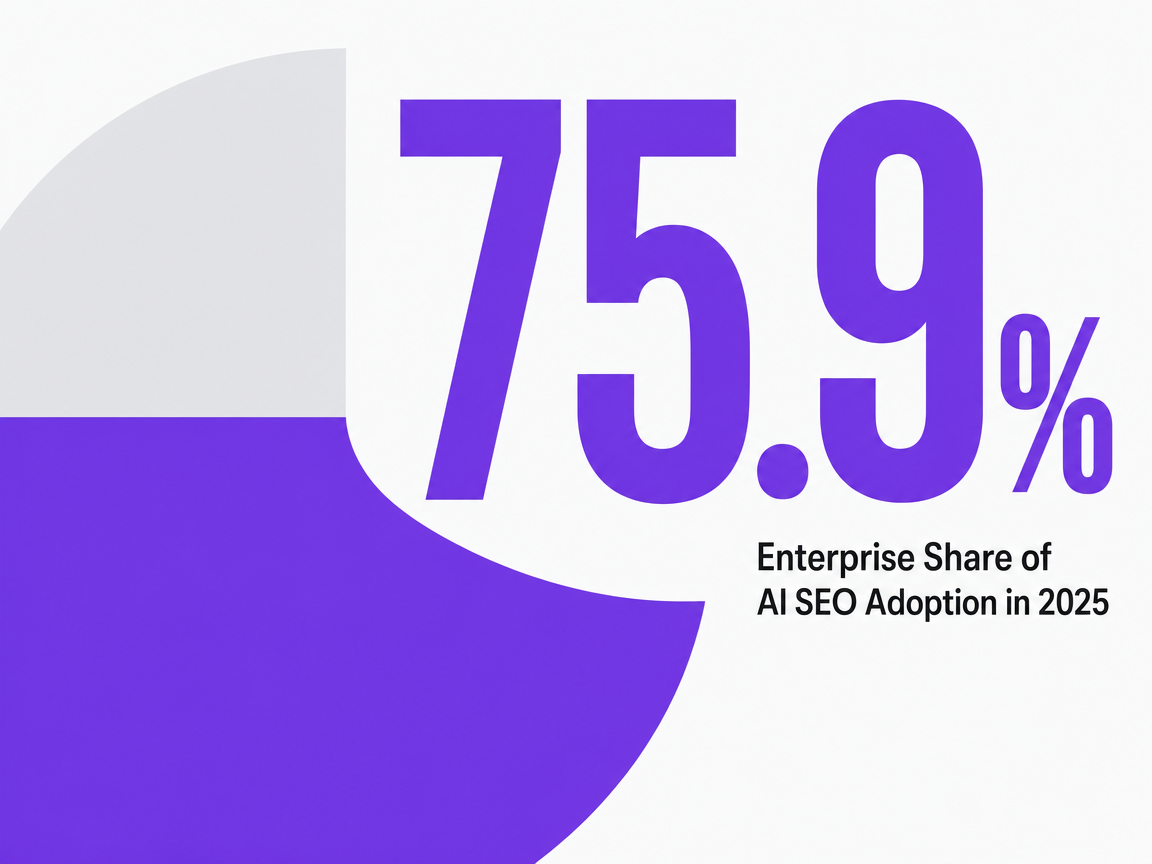 Enterprise Share of AI SEO Adoption in 2025
Enterprise Share of AI SEO Adoption in 2025
Frequently Asked Questions
References
- 1.A Study on AI-Powered SEO Optimization.
- 2.Possible Application of AI to Enhance Search Engine Optimization.
- 3.Generative Artificial Intelligence-Based Search Engine Optimization.
- 4.Optimizing for the Artificial Intelligence Driven Search Era.
- The Transition to AI-Driven Search – A Qualitative Study of Search Engine Optimization and Marketing Perspectives at Achmea. https://essay.utwente.nl/fileshare/file/108600/Bachelor%20Thesis%20The%20transition%20to%20AI-driven%20search%20%E2%80%93%20%20A%20qualitative%20study%20of%20search%20engine%20optimization%20and%20marketing%20perspectives%20at%20Achmea%20-%20by%20Ingmar%20Jogems%20.pdf
- 6.Artificial Intelligence and Search Engine Optimization: A Synergistic Approach.
- 7.Best Enterprise SEO Tools for Driving Pipeline Growth Fast.
- 8.Every Company Needs An SEO Platform.
- 9.SEO Automation Case Study | AI-Powered Workflow for ....
- 10.SEO Workflow Automation Templates.
- 11.AI-Based Automated Content Generation and its SEO ....
- 12.AI SEO Software Market Forecast & Growth 2025–2034.
- 13.Forrester Research Publishes 1st Report On Enterprise ....
- 14.Best AI SEO Tools for Agencies: 7 Platforms to Scale Client ....
- 15.Best SEO Tools for Agencies (2026) + AI SEO Stack - Arvow.
- 16.Best Enterprise SEO Software: 15 Platforms Compared (Pricing ....