
Key Takeaways
- Client QBRs now demand answers on AI Overview citations and generative answer visibility, exposing gaps that traditional enterprise rank trackers were never built to observe 13.
- A classical SERP backbone remains essential because keyword positions, share of voice, and SERP feature trends anchor every downstream AI attribution and click-loss diagnosis 9.
- Unified SERP-plus-AI suites like Conductor, BrightEdge, and seoClarity consolidate AI Overview presence with classical rank under one contract, though coverage rarely extends beyond Google's own surfaces 9.
- AI-native citation trackers such as Rankscale log prompt-level evidence across ChatGPT, Perplexity, Gemini, and Google, capturing linked and unlinked brand mentions no rank tracker produces 9.
- An execution and coordination layer converts tracker signals into approved, shipped work, addressing Forrester's warning that AI risks becoming a cost center inside agencies 12, 15.
- Google Search Console's June 2026 generative AI reports offer a free baseline for AI Overviews, AI Mode, and Discover, but cover no third-party engines and no cross-client rollup 11.
- Market forecasts for AI-powered SEO software diverge widely across 2025 sources, but every credible sizing points to double-digit growth with enterprises driving most adoption 1, 2, 7, 8.
- Consolidating around a three-layer tracking stack plus coordination compresses QBR prep and recommendation-to-ship time, plausibly lifting accounts-per-specialist ratios without degrading output quality 2, 4.
- Multi-location operators need canonical prompt sets per service line and portfolio-level rollups, since per-market AI Overview variance makes per-location prompt pricing untenable 5.
- Citation data integrity depends on logging raw prompts, responses, and source order, plus sampling across multiple runs and models to expose session variance and adversarial ML risks 14, 9.
- Sequence stack additions against the largest reporting gap—backbone, unified suite, AI-native tracker, then execution—because layering out of order produces noise instead of defensible client narratives 9, 5.
Why Client QBRs Now Demand AI Surface Coverage
The quarterly business review has changed. Clients who once opened with "where are we ranking" now open with "why did our AI Overview citation disappear" or "what's our share of voice in ChatGPT for these ten prompts." Agency Heads of SEO sitting on 20 to 200 accounts are being asked to defend performance across surfaces that most enterprise rank trackers were never built to observe.
The exposure data explains the pressure. Pew Research, analyzing March 2025 browsing behavior from a US panel, found that 58% of respondents conducted at least one search that returned an AI-generated summary during the study window, and 93% visited a page that mentioned AI 13. That figure captures browser-based encounters only, so it likely understates total exposure once app-based ChatGPT, Perplexity, and Gemini sessions are counted. Even as a floor, it means AI-mediated results are no longer a fringe experience worth a footnote on slide 42.
Practitioners have already responded. A 123-respondent survey of SEO professionals published in 2025 reported that 95% use AI tools daily in their workflows, with 93% applying AI to on-page work and 89% to content optimization 4. The sample is small and self-selected, but it points at the same direction of travel: the discipline is already operating on AI-assisted inputs while the reporting layer lags behind.
That gap is what agency leaders now inherit. Softening organic click totals show up in Search Console. Impression counts hold or grow. Clients want a coherent story that connects both trends to AI surfaces they can see in their own browsers. Delivering that story reliably, across a full client roster, is a tooling problem before it is a strategy problem, and it is the reason a single rank tracker no longer clears the bar.
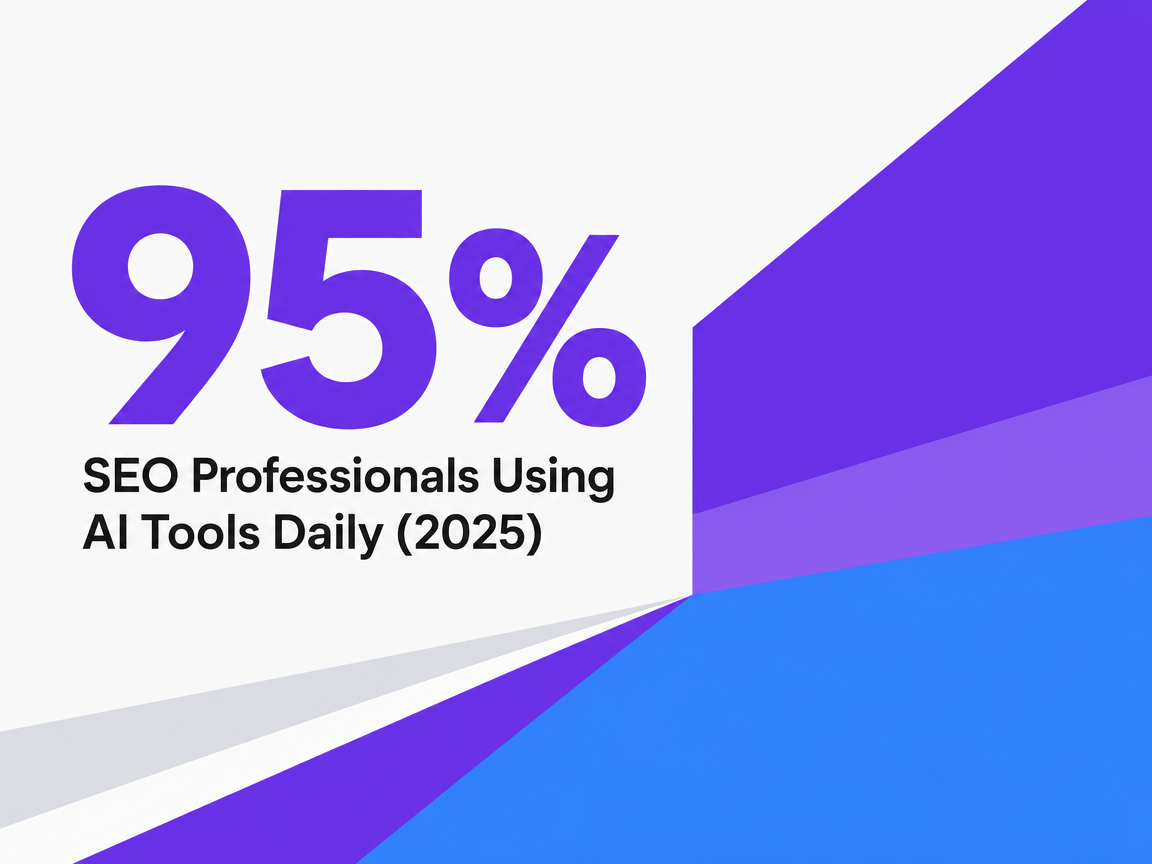 SEO Professionals Using AI Tools Daily (2025)
SEO Professionals Using AI Tools Daily (2025)
The Three-Layer Stack Replacing the Single Rank Tracker
Classical SERP Backbone
The backbone layer does what enterprise rank trackers have always done, at higher volume and with tighter SLA. STAT Search Analytics, now part of Moz, still anchors most 2026 agency rosters alongside seoClarity, Conductor, BrightEdge, and SEOmonitor, handling daily large-scale rank collection across geographies and devices 9. For a shop running 20 to 200 accounts, this layer answers the questions that never left the QBR deck: keyword-level positions, share of voice against a defined competitive set, SERP feature presence, and historical trend lines that survive Google's next core update.
Agency Heads of SEO underestimate this layer at their own expense. Without a reliable classical ranking dataset, everything downstream—AI Overview attribution, citation share analysis, click curve modeling—loses its reference point. A drop in organic clicks means one thing when position 3 is holding and another when the page has slipped to 8.
Backbone tools are also where cost tends to accumulate first, priced per tracked keyword or per domain and expected to scale linearly with the roster. That pricing shape is why the next two layers exist: they add surfaces the backbone cannot see, without forcing the agency to re-buy the ranking dataset it already owns.
Unified SERP-Plus-AI Suites
The middle layer packages classical rank tracking with AI Overview presence, SERP feature analysis, and content workflow tooling under one contract. Conductor and BrightEdge sit here in most enterprise rosters, with seoClarity extending in the same direction 9. The pitch to the buyer is consolidation: one vendor, one login, one billing line, and a dataset that ties AI-influenced results back to the same keywords already tracked classically.
The framework this layer operationalizes is the trio of Answer Engine Optimization, AI Visibility Metrics, and SERP Feature Tracking that now defines enterprise measurement expectations 5. In practice, that means an account lead can pull a single view showing which client keywords trigger AI Overviews, whether the client's domain appears as a cited source, and how classical position correlates with AI inclusion.
The trade-off is depth. Unified suites tend to observe AI surfaces through Google's own results and structured SERP scrapes, which covers AI Overviews and AI Mode reasonably well but does not extend cleanly into ChatGPT, Perplexity, or Gemini answer citations. For agencies whose clients ask about those surfaces by name, the suite handles the QBR narrative for Google properties, and a third layer picks up the rest.
AI-Native Citation Trackers
The third layer was built after the problem. AI-native trackers such as Rankscale focus on what actually appears inside generated answers across ChatGPT, Perplexity, Gemini, and Google's AI surfaces, with an emphasis on evidence rather than inferred position. In a 2026 comparison, Rankscale led on coverage and accuracy by exposing evidence trails that show the prompts, responses, and source order behind every visibility change 9. That evidence layer is the differentiator: the tool is not asking whether a domain ranks, it is logging the prompt, capturing the model's response, and recording where the client's citation appeared in the source list.
For agency reporting, this matters in two places. The first is diagnosis. When a client's AI Overview citation drops out, an evidence trail identifies whether the model reformulated the query, promoted a different source, or omitted citations entirely on that response. The second is defensibility. A screenshot of ChatGPT is not a monitoring system; a logged prompt-response-citation record across a defined query set is.
The category also tracks unlinked mentions—brand references that appear in AI answers without a URL citation 9. For high-consideration verticals where trust signals precede clicks, that unlinked visibility is a leading indicator no classical rank tracker can produce. The cost model here typically scales with prompts monitored and models queried rather than keywords.
Execution and Coordination Layer
The fourth layer is not a tracker at all. It sits on top of the other three and answers a different question: what does the agency do with the signals coming out of them. Tracking data becomes operational only when someone routes it into a content brief, a technical fix, an internal linking change, or a topical expansion, and then confirms the work shipped.
Forrester frames the tension. Generative AI is nearly ubiquitous across US marketing agencies in 2026, expanding across content, media, SEO, and strategy, yet a narrow focus on productivity and cost efficiency risks sacrificing more effective marketing 15. The 2025 predecessor report is blunter: AI is currently a cost center inside agencies 12. The execution layer is where that cost center either converts into leverage or stays a line item.
Coordination tools in this layer route recommendations from the tracking stack into an approval workflow, then execute after sign-off across specialist functions. Vectoron sits in this category, positioned around approval-first automation for content, SEO, PPC, backlinks, social, and call intelligence. The role is orchestration, not another dashboard—closing the gap between what the trackers see and what actually ships to clients.
Stack Composition at a Glance
Read across an agency roster in 2026 and the tool stacks that hold up under QBR pressure share a common shape. A classical SERP backbone handles keyword-level positions and share of voice. A unified SERP-plus-AI suite pulls AI Overview presence and SERP feature data into the same view as classical rank. An AI-native citation tracker logs prompt-level evidence across ChatGPT, Perplexity, Gemini, and Google's AI surfaces. A coordination layer routes what any of those tools surface into approved, shipped work. The measurement spine underneath all four is the trio of Answer Engine Optimization, AI Visibility Metrics, and SERP Feature Tracking that now defines enterprise expectations 5.
| Archetype | Primary job-to-be-done | Data surfaces covered | Representative tools | Cost shape |
|---|---|---|---|---|
| Classical SERP backbone | Daily large-scale rank collection, share of voice, SERP feature presence | Classical SERPs, SERP features, historical trend lines | STAT, seoClarity, SEOmonitor 9 | Per tracked keyword and per domain |
| Unified SERP-plus-AI suite | Tie AI Overview and SERP feature data back to tracked keywords under one contract | Classical SERPs, SERP features, AI Overviews, AI Mode (Google surfaces) | Conductor, BrightEdge, seoClarity 9 | Per seat, per domain, per workflow module |
| AI-native citation tracker | Log prompt-level evidence and citation share inside generated answers | ChatGPT, Perplexity, Gemini, Google AI surfaces; linked and unlinked mentions | Rankscale 9 | Per prompt monitored and per model queried |
| Execution and coordination layer | Route tracker signals into approval workflows and shipped work | Content, SEO, PPC, backlinks, social, call intelligence execution | Vectoron | Per workflow and per approved action |
The table is not a shopping list. It is a diagnostic for what a given roster is already paying for versus what remains uncovered. Most agency stacks own the top row cleanly, own part of the second, and either lack the third entirely or approximate it with manual screenshots. The fourth row is where tracked signals stop being reports and start becoming client outcomes.
Test AI-driven rank tracking on live sites now
Monitor real keyword movements and client visibility with full reporting access during your free trial.
Search Console as the Free Baseline Every Stack Should Start With
Before any purchase order gets signed, Google's own reporting deserves a seat at the table. In June 2026, Google launched dedicated generative AI performance reports inside Search Console, providing views of impressions and clicks within AI Overviews, AI Mode, and generative AI features in Discover 11. That coverage is free, first-party, and available across every property an agency already verifies for its clients.
The documentation also cuts through vendor positioning on setup. Google states that appearing in AI Overviews and AI Mode requires no additional technical work beyond standard indexing and snippet eligibility, and that performance is visible in Search Console 10. Agency Heads of SEO fielding questions about specialized schema, hidden APIs, or paid inclusion programs can point to that documentation directly.
What Search Console does not do is equally important to name:
- It reports on Google's AI surfaces only, not on ChatGPT, Perplexity, or Gemini answers.
- It shows impression and click data at the property level, not prompt-level evidence trails.
- It has no concept of citation share against a competitive set, no cross-client rollup for a 40-account roster, and no workflow for routing a lost AI Overview into a content brief.
Those gaps are what the paid layers of the stack are paying to fill.
The operational move is to treat Search Console as the always-on baseline for every client, then buy third-party tools deliberately to close specific gaps rather than to duplicate what Google already surfaces for free.
Where the Market Says This Category Is Heading
The category is real. The size of it, less settled. Four separate 2025 forecasts for AI-powered SEO software land in four different neighborhoods, and any agency leader building a multi-year tooling budget should see them side by side before quoting one number to a client or a CFO.
- market.us pegs the global AI-powered SEO software market at $3.98 billion in 2025, rising to $32.6 billion by 2035 at a 23.4% CAGR 1.
- Global Growth Insights sizes an adjacent slice at $1.96 billion in 2024, reaching $9.74 billion by 2034 at 17.05% CAGR 2.
- Wise Guy Reports values AI-based SEO tools at $2.24 billion in 2025 and projects $12.5 billion by 2035 at 18.7% CAGR 7.
- GII Research, using a broader definition that appears to include implementation and services, values the same category at $19.35 billion in 2025 and $54.39 billion by 2032 at 15.9% CAGR 8.
The spread is not a failure of research. It reflects genuine disagreement about what counts. Does the market include only pure-play AI SEO platforms, or the AI modules bolted onto existing enterprise suites? Does it capture services revenue, or license fees only? An agency Head of SEO does not need to resolve that debate. The takeaway is directional: every credible sizing points at double-digit growth through the early 2030s, and the enterprise segment is doing most of the buying—market.us reports large enterprises held a 75.9% share of adoption in 2025 1.
For stack planning, that means vendor consolidation pressure will keep rising, prices in the unified-suite layer will keep drifting toward enterprise contracts, and the AI-native citation layer is where new entrants will keep appearing. Build the stack for the surfaces clients actually ask about, not for the CAGR someone quotes at a conference.
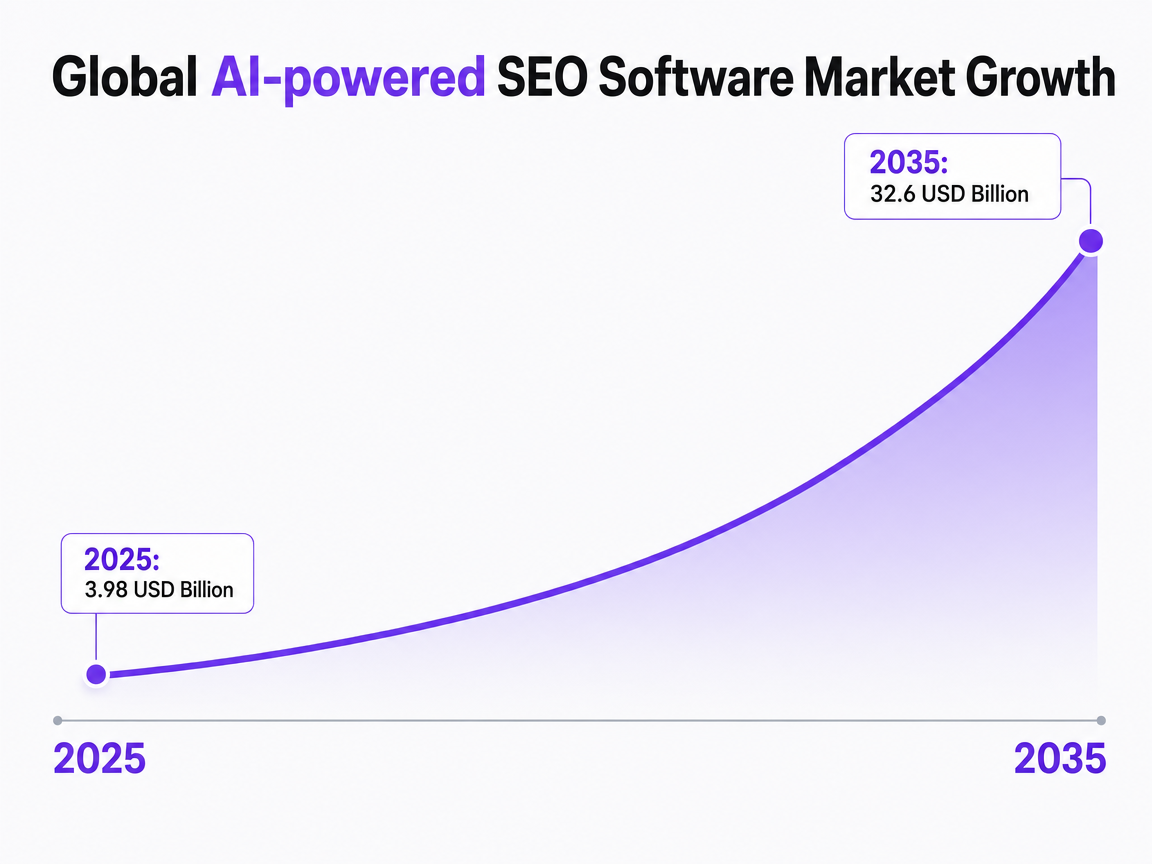 Global AI-powered SEO Software Market Growth
Forecast of the global AI-powered SEO software market size, growing from $3.98 billion in 2025 to $32.6 billion in 2035.
Delivery Economics: How the Stack Shapes Accounts Per Specialist
The stack question is really a headcount question. Forrester's 2025 read on US marketing agencies calls generative AI a cost center 12, and the 2026 update warns that a narrow focus on productivity risks trading effective marketing for cheaper marketing 15. Both point at the same operational reality: tooling only pays back when it changes how many accounts a specialist can run without the work degrading.
The traditional enterprise SEO pod sits somewhere around 8 to 12 accounts per specialist. That number is illustrative operator math, not a sourced benchmark—it assumes manual QBR prep, manual competitor pulls, hand-built content briefs, and a rank tracker that reports on classical SERPs while the specialist eyeballs AI Overviews in an incognito window. Push above 12 and quality control on strategic recommendations tends to slip before ranking data does.
Consolidating around a three-layer tracking stack plus a coordination layer changes the ratio in two places. QBR prep compresses when AI Overview presence, citation share, and classical rank live in tied datasets rather than three exports stitched in a spreadsheet. Recommendation-to-brief-to-ship time compresses when tracker signals route into approval workflows instead of Slack threads. A two-person pod running that configuration can plausibly cover 30 to 40 accounts at the same output quality, again as illustrative math with the assumptions stated.
Two economic signals support the direction. A 2025 forecast reports more than 62% of enterprises citing improved efficiency in SEO reporting and analytics through AI automation 2. A 2025 survey of 123 SEO professionals shows 95% using AI tools daily 4. Efficiency gains at the reporting layer and daily AI use at the practitioner layer are what make higher accounts-per-specialist ratios defensible. The stack does not eliminate specialists—it removes the manual work that capped how many clients each specialist could carry.
See How AI Search Tracking Streamlines Multi-Client SEO Oversight
Request a walkthrough of unified AI-powered search tracking that delivers real-time keyword rankings, automated insights, and approval-first workflow—purpose-built for agencies managing high-volume, multi-location SEO.
Multi-Location and Portfolio Operators: A Different Rollup Problem
The scope shifts here. Agencies serving multi-location operators—DSO groups running 40 to 300 practices, law firm networks with offices across state lines, senior living portfolios, home services franchises—face a rollup problem the single-brand stack was not designed to solve. The tracking data exists at the location level, but the client conversation happens at the portfolio level.
Answer Engine Optimization, AI Visibility Metrics, and SERP Feature Tracking all fragment when a single brand has 80 geographic variants of the same query 5. "Best endodontist near me" resolves to a different AI Overview in Phoenix than in Cleveland, with different cited sources and different citation ranks. A classical rank tracker handles this through geo-grid sampling. An AI-native citation tracker has to log prompt-level evidence per market, which multiplies prompt volume by the number of locations and pushes cost models built around per-prompt pricing into uncomfortable territory.
Two operational moves reduce that friction:
- Define a canonical prompt set per service line rather than per location, then sample geographies against it—accepting less granular coverage in exchange for a defensible portfolio view.
- Roll AI Overview presence and citation share up to service-line and region cuts before they reach the client, so the QBR opens on portfolio-level trends rather than 80 location dashboards.
The coordination layer is where those rollups get built once and reused, instead of rebuilt in Sheets every quarter.
Data Integrity and Citation Manipulation Risk
Tracking data is only as useful as the pipeline that produces it. AI-native trackers depend on prompting language models, parsing generated responses, and attributing citations to source URLs. Every step in that chain is exposed to the adversarial ML threats NIST catalogs—data poisoning, evasion, and extraction—which can distort what a model surfaces and, by extension, what an agency reports 14. The risk is not hypothetical for high-stakes verticals where a competitor gaming citation prominence in ChatGPT for "best personal injury lawyer" prompts translates directly into pipeline.
Two operational safeguards matter:
- The tracker should log the raw prompt, the full response, and the source order it captured, not just a computed visibility score—evidence trails are what let an analyst distinguish a real citation loss from a scraping artifact 9.
- Citation share should be sampled across multiple runs and multiple models rather than treated as a single-point reading, because generated responses vary between sessions even on identical prompts.
Agencies bringing AI visibility data into QBRs need to name that variance explicitly, or the first client who runs their own test in a browser will name it for them.
Choosing the Next Layer to Add
Most agency stacks in 2026 are already carrying one layer well, a second layer partially, and a third layer not at all. The practical question is not which vendor wins a feature comparison—it is which gap, closed next, produces the largest reduction in manual QBR prep across the roster.
Four diagnostic questions sort the decision:
- Does the current stack produce keyword-level positions and share of voice at the volume the roster demands? If not, the classical SERP backbone is the first fix, because everything downstream loses its reference point without it 9.
- Does AI Overview presence sit inside the same view as classical rank, or does an analyst stitch it in from screenshots? If stitched, a unified SERP-plus-AI suite compresses the QBR narrative for Google surfaces 5.
- Does the agency have prompt-level evidence for ChatGPT, Perplexity, and Gemini answers, or does citation share get inferred from spot checks? If inferred, an AI-native citation tracker is the next line item 9.
- Do tracker signals convert into approved, shipped work inside a defined cycle time, or do they land in Slack and drift? If they drift, the execution layer is where the stack pays back.
The order matters. Adding a citation tracker before the backbone is stable produces more noise than signal. Adding an execution layer before the trackers agree on what a client's AI visibility actually is puts approval workflows around unreliable inputs. Sequence the buys against the gaps, not against the vendor calendar.
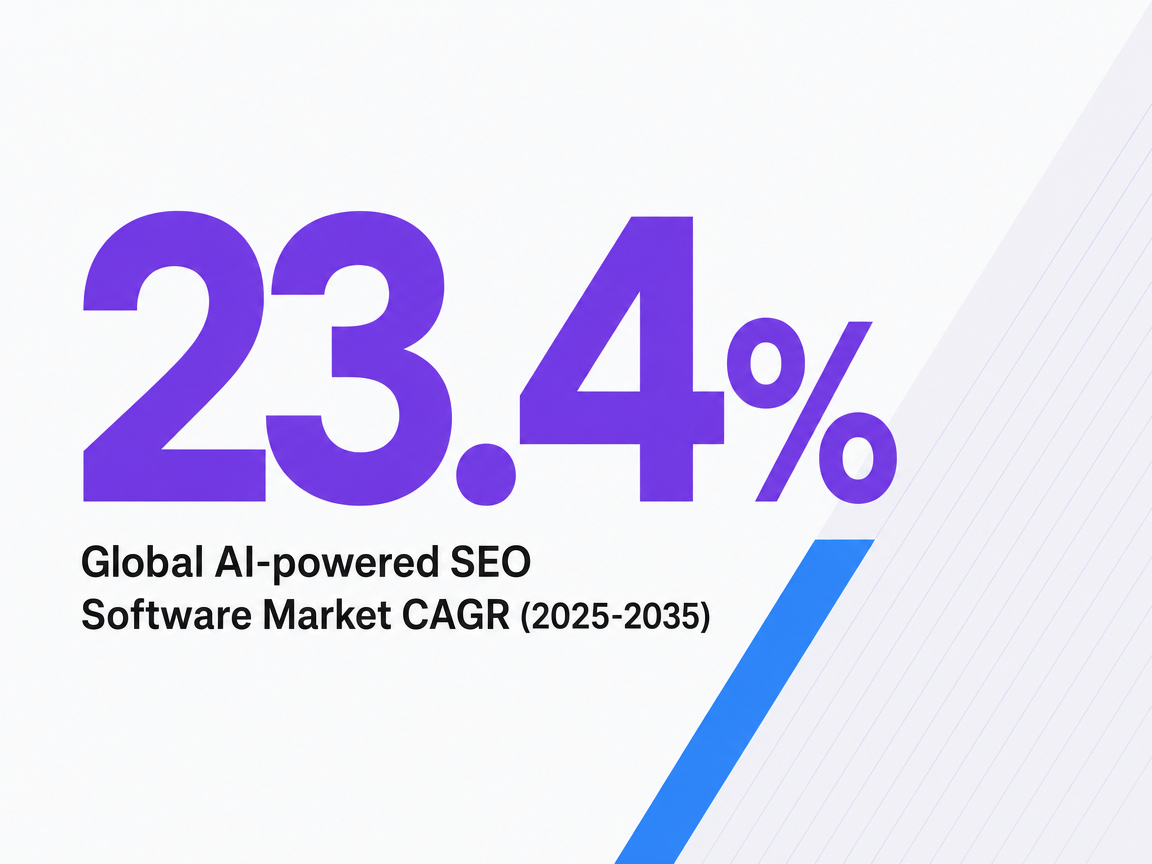 Global AI-powered SEO Software Market CAGR (2025-2035)
Global AI-powered SEO Software Market CAGR (2025-2035)
Frequently Asked Questions
References
- 1.AI-powered SEO Software Market Size | CAGR of 23.4%.
- 2.AI SEO Software Market Forecast & Growth 2025–2034.
- 3.98+ Generative Engine Optimization (GEO) Statistics for 2025.
- 4.Survey Insights from 123 SEO Professionals on Tools, ROI & Rankings.
- 5.14 Best Enterprise AI SEO Performance Tracking Services in 2025 (Complete Guide).
- 6.2024 Gartner Magic Quadrant Analytics and Business Intelligence Platforms.
- 7.Global AI-Based SEO Tools Market Research Report.
- 8.AI-based SEO Tools Market by Component, Organization Size ....
- 9.AI Site Rank Tracking Software Choices for Agencies to Use.
- 10.AI Features and Your Website | Google Search Central | Documentation | Google for Developers.
- 11.Introducing Search Generative AI performance reports in Search Console.
- 12.The State Of Generative AI Inside US Marketing Agencies, 2025.
- 13.What Web Browsing Data Tells Us About How AI Appears Online.
- 14.Adversarial Machine Learning: A Taxonomy and Terminology of Attacks and Mitigations.
- 15.The State Of AI Inside US Marketing Agencies, 2026.