
Key Takeaways
- Most AEO tool comparisons treat brand mentions and actual citations as equivalent, which inflates reported visibility; only three of nine platforms AI Rank Lab reviewed qualified as genuine conversational citation trackers 4.
- Five criteria disqualify weak tools: citation-versus-mention discipline, coverage across ChatGPT, Perplexity, Gemini, and Google AI Overviews, zero-click integration, competitive share of voice, and multi-client workflow fit.
- Tier one dedicated LLM citation trackers like Profound, Peec AI, Otterly.AI, AI Rank Lab, and Mentionova deliver the cleanest prompt-level diagnostic signal but stop at the report 2, 4, 5.
- Prompt-based pricing on tier one platforms scales non-linearly with client count, so category-level prompt templates and tiered refresh cadences are needed to control the per-client cost floor 2, 3.
- Tier two hybrid suites such as Semrush, Similarweb AI Search Intelligence, Ahrefs Brand Radar, Moz Pro, and SE Visible consolidate SEO and AEO into one contract but often skew toward Google AI features 4, 6, 7.
- Tier three execution-integrated platforms close the loop by routing citation gaps into ranked, approval-ready content queues rather than leaving them as dashboard findings for analysts to translate manually 9.
- Stack selection should follow book size: focused books pair a dedicated tracker with existing rank tools, mid-sized books consolidate on hybrid suites, and books above sixty clients add execution-integrated production.
Why Most AEO Tool Comparisons Fail the Agency Buyer
Most published rankings of the best AEO checking tools read as feature inventories, not procurement documents. They list vendors alphabetically, count engines covered, and stop short of the question a Head of SEO actually needs answered: which tools survive scrutiny when a client asks what "AI visibility" is worth paying for.
The commercial stakes are already legible in the data. Similarweb reports a 78% zero-click rate on the query "answer engine optimization" itself, and finds that 35% of consumers rate AI tools most useful during the discovery phase of their purchase journey 1. Those two figures describe a demand pattern where brand presence inside an AI answer often replaces the click that historically justified an SEO retainer. Measurement rigor is the retainer's new evidence base.
The gap most comparisons miss sits underneath the vendor logos. AI Rank Lab's review of nine AEO platforms concluded that only three qualified as genuine conversational LLM citation trackers; the remainder either monitored Google AI Overviews or counted brand mentions rather than citations 4. A comparison that treats those categories as interchangeable will steer an agency into a tool that cannot answer whether a client is actually being cited by ChatGPT, Perplexity, or Gemini.
This piece takes a different approach. It sets an evaluation rubric first, then sorts the market into three functional tiers so a delivery lead can build a stack rather than pick a favorite.
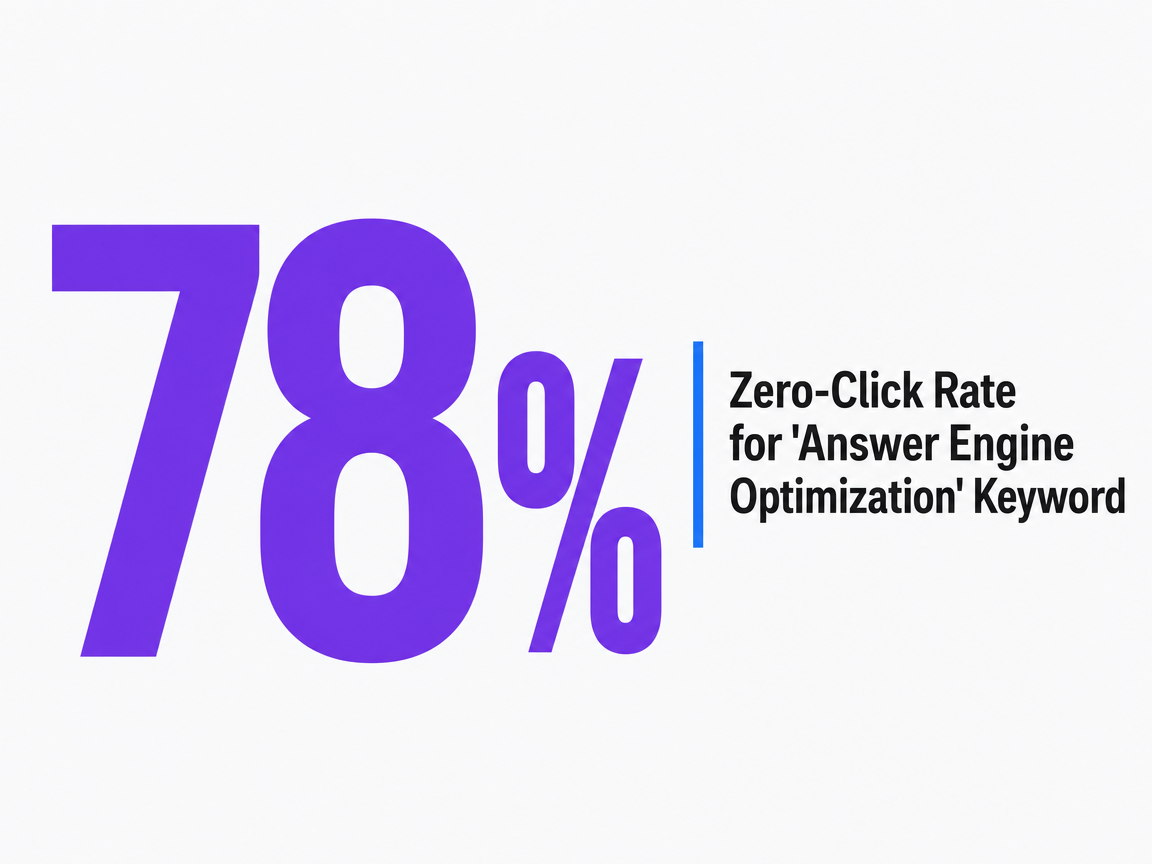 Zero-Click Rate for 'Answer Engine Optimization' Keyword
Zero-Click Rate for 'Answer Engine Optimization' Keyword
The Five Measurement Criteria That Disqualify Most Tools
Citation Frequency vs. Brand Mention Rate
The first cut in any AEO tool evaluation is whether the platform can distinguish an actual citation from a passing mention. A citation names the brand as the source an AI engine attributed its answer to. A mention is any string match in the response body, including references to competitors, generic category language, or the brand appearing as an example inside a longer list. Treating those signals as equivalent inflates reported visibility and misleads clients about whether a retainer is producing measurable AI presence.
The market-wide gap here is documented. AI Rank Lab's assessment of nine AEO tracking platforms concluded that only three qualified as genuine conversational LLM citation trackers; the remaining six either tracked Google AI Overviews as a proxy or counted brand mentions inside answers rather than the citation link itself 4. That 3-of-9 ratio is the disqualification threshold most vendor comparisons never surface.
Similarweb's KPI framework treats citation frequency and brand mention rate as separate measurements for exactly this reason, alongside share of voice, fan-out coverage, and zero-click trend 1. A tool that reports a single blended "visibility score" without exposing the underlying citation count should be treated as a mention-tracker with marketing polish, not an AEO measurement system.
Multi-Engine Coverage Across ChatGPT, Perplexity, Gemini, and Google AI Overviews
Single-engine trackers describe a slice of the answer surface, not the surface itself. The working baseline across industry comparisons is coverage of ChatGPT, Perplexity, Gemini, and Google AI Overviews, with several tools now adding Copilot and Grok to the sweep 3, 8. A platform that reports only Google AI Overview appearances is measuring one distribution channel and calling it AEO.
Coverage breadth affects the numbers a Head of SEO can defend in a client review. Beamtrace's comparison table shows refresh cadences and engine counts vary widely, with some platforms updating every few days and others running near-daily crawls across the full engine set 3. Mentionova, per Opensend's overview, tracks six engines simultaneously and packages the output for client-facing reports 5.
The operational takeaway: if a tool cannot report citations across at least the four dominant engines, it cannot answer whether a client is being cited where their buyers actually query. Any narrower footprint should be treated as a supplemental data source, not the system of record.
Zero-Click and SERP Feature Integration
AEO measurement that ignores zero-click behavior misses the mechanism it is supposed to price. Similarweb's KPI scaffold lists zero-click rate trend as one of five core AEO metrics precisely because brand presence in answers frequently replaces the click that historically justified reporting 1. A tool that reports citation counts without pairing them to zero-click movement leaves the retainer's business case unsupported.
The tools that stand up here connect AI answer appearances to the corresponding SERP feature data, AI Overview detection, and traffic patterns from the same query set. Similarweb's suite ties GEO tracking to traditional SEO signals side by side, which is why Zapier's cross-vendor snapshot flags it for combined coverage 6. Tools that only ingest LLM prompts without any SERP context force delivery leads to stitch two datasets by hand every reporting cycle.
Competitive Share of Voice and Fan-Out Coverage
Citation counts in isolation flatter the client. Share of voice across the same prompt set answers a more useful question: when the AI engine names a source in this category, how often is it this brand versus the three competitors the client actually loses deals to. Similarweb's framework treats share of voice and fan-out coverage as distinct KPIs, with fan-out measuring how many related sub-queries the brand appears across when an engine expands a topic 1.
AI Rank Lab's review adds a qualitative layer on top of the counts. Its visibility analysis tracks not just whether a brand is cited but how it is described and how its positioning compares to competitors cited in the same response 4. That distinction matters when a client sees a competitor cited with attributes the client's content never surfaces. Tools that expose competitor citation streams and attribute tagging give agencies the diagnostic input a content plan can act on; tools that only show a client-specific score do not.
Workflow, Export, and Multi-Client Reporting Fit
The last criterion is operational rather than analytical. A tool that produces defensible AEO measurement but cannot deliver it into a client workspace at the cadence a retainer requires will burn delivery hours until it is replaced. Peec AI and Mentionova are both profiled around agency reporting, client workspaces, and white-label output for exactly this reason 2, 5.
Three practical checks separate viable platforms from spreadsheet exports:
- Whether the tool supports discrete client workspaces with permissioned access, not a single tenant where every account manager sees every book.
- Whether prompt sets, competitors, and reporting periods can be duplicated across clients without rebuilding configuration.
- Whether exports run to the formats a client actually reads, whether that is a scheduled PDF, a Looker Studio connector, or a raw CSV feed into an internal warehouse.
A tool that fails on multi-client structure forces the agency to absorb the reporting labor it should be billing for. That cost surfaces in margin, not in feature comparisons.
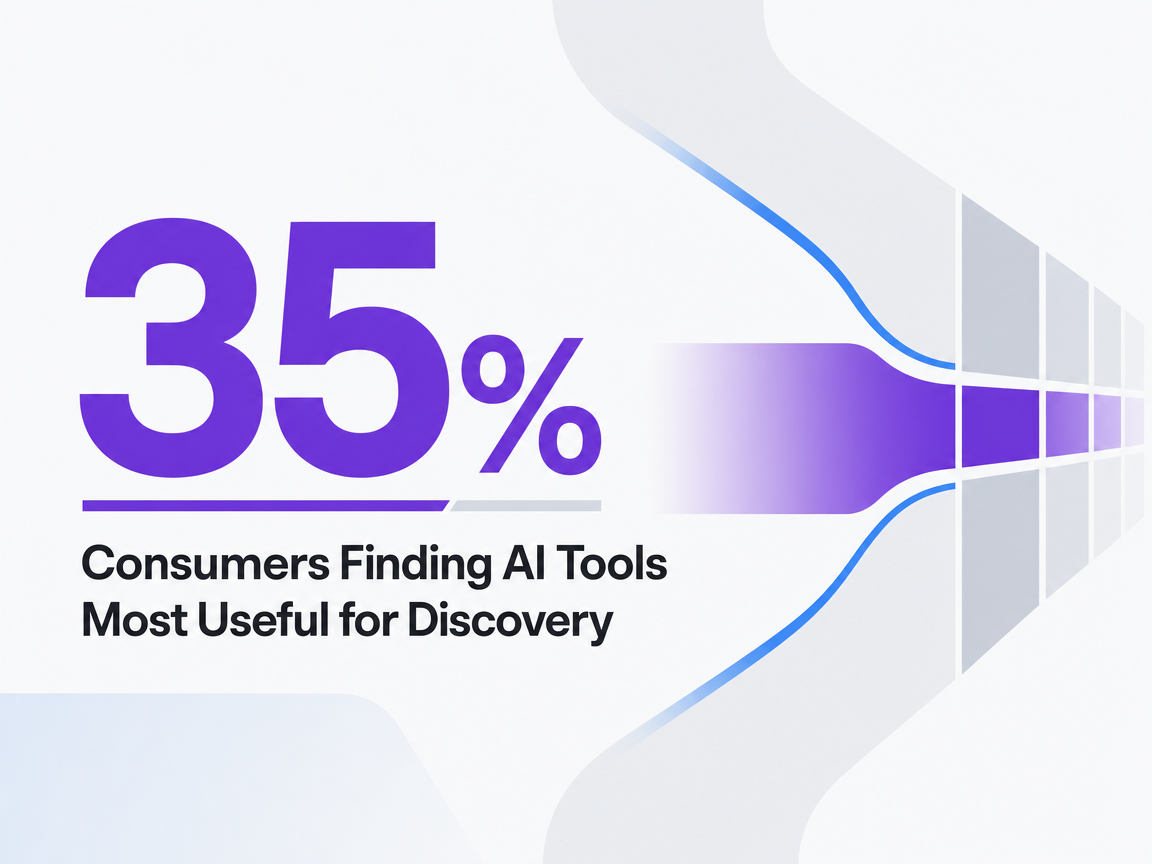 Consumers Finding AI Tools Most Useful for Discovery
Consumers Finding AI Tools Most Useful for Discovery
A Three-Tier Taxonomy for the Agency Stack
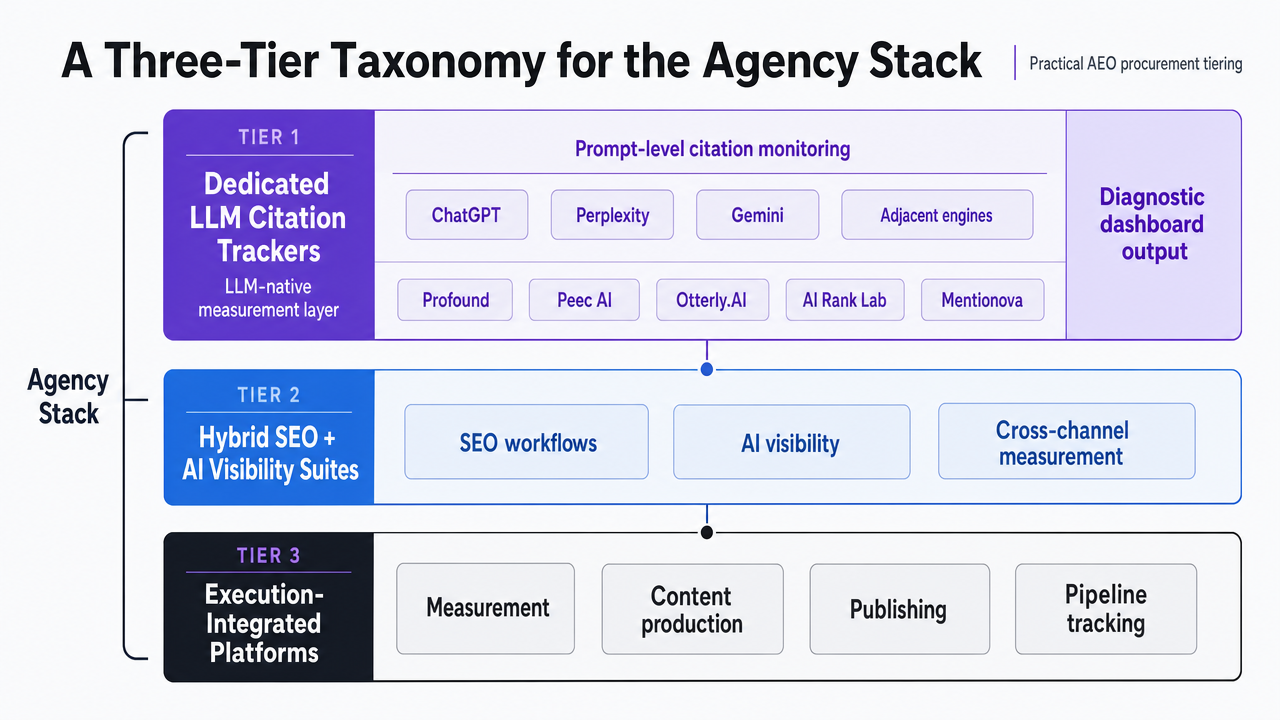
With the five criteria in place, the market sorts cleanly into three tiers. Vectoron's agency-facing framework organizes AI visibility tooling into dedicated AI answer-engine trackers, expanded social listening platforms, and execution-integrated systems that fuse measurement with content production, publishing, and pipeline tracking 9. Reframed for AEO procurement, the practical tiering a Head of SEO can build against is: dedicated LLM citation trackers, hybrid SEO and AI visibility suites, and execution-integrated platforms.
- Tier one is the LLM-native measurement layer. Profound, Peec AI, Otterly.AI, AI Rank Lab, and Mentionova sit here, purpose-built to monitor citations and mentions across ChatGPT, Perplexity, Gemini, and adjacent engines with prompt-level granularity 2, 5. Its output is a diagnostic dashboard, not a rank report.
- Tier two is the SEO suite with an AI visibility module bolted on. Semrush, Similarweb AI Search Intelligence, Ahrefs Brand Radar, Moz Pro, and SE Visible pair traditional rank and keyword data with LLM citation tracking under a single contract 6, 7. The primary output is a consolidated SEO plus AEO dashboard.
- Tier three routes visibility signals into content production. Its primary output is not a report but a queue of approved changes that alter what an AI engine can retrieve next cycle 9.
Test Automated AEO Checks Across Live Campaigns
Validate AEO optimization workflows and measure real impact on active client content, risk-free for 7 days.
Tier One: Dedicated LLM Citation Trackers
What Belongs Here: Profound, Peec AI, Otterly.AI, AI Rank Lab, Mentionova
The tier one shortlist is narrow by design. Only platforms that report citations across the four dominant conversational engines with prompt-level granularity qualify, and only three of the nine platforms AI Rank Lab reviewed cleared that bar under scrutiny 4. The names that recur across the sourced comparisons are Profound, Peec AI, Otterly.AI, AI Rank Lab, and Mentionova.
Profound is positioned by Zapier as the all-in-one enterprise option, built for organizations that need deep prompt libraries, competitor tracking, and analyst-grade dashboards under one contract 6. Peec AI runs prompt-first, letting agencies define the exact questions buyers ask and monitoring how brands surface against those specific prompts across ChatGPT, Gemini, Perplexity, and Google AI Overviews 2. Otterly.AI and AI Rank Lab both appear on AI Rank Lab's own genuine-citation-tracker list, alongside Sona, and add the qualitative visibility layer that scores how a brand is described rather than only whether it appears 4.
Mentionova sits at the reporting end of the tier, tracking brand appearance across six engines simultaneously and packaging the output for client-ready dashboards 5. Its footprint is broader than most peers, but the operational value is in the report cadence, not the analytics depth.
Prompt-Based Pricing and the Per-Client Cost Floor
Tier one platforms price on prompts, not seats. LLM V Lab's comparison flags per-prompt pricing as the defining commercial model across prompt-first tools like Peec AI, with tracked prompt volume and refresh cadence driving the invoice 2. Beamtrace's tool table confirms the same pattern across dedicated trackers, with pricing tiers scaling by tracked prompt count and engine coverage rather than by user or client 3.
The consequence for a multi-client agency is arithmetic. Each client needs its own prompt set, competitor set, and refresh schedule. A book of forty clients tracking fifty prompts each is a two-thousand-prompt commitment before any share-of-voice expansion. Prompt-based pricing scales non-linearly with client count, which means the per-client cost floor rises with every account added, not falls.
Two operational moves keep the floor manageable. Prompt libraries can be templated across similar verticals so a behavioral health client and a dental client share a category-level prompt scaffold with client-specific overrides. Refresh cadence can be tiered by retainer size, with weekly crawls reserved for enterprise accounts and monthly refreshes assigned to growth-tier books.
Where Dedicated Trackers Break for Agencies
Dedicated citation trackers produce the cleanest AEO signal on the market and the thinnest operational output. The dashboard names a client's citation share by engine, its share of voice against competitors, and the prompts where it fails to appear. What it does not do is tell the content team what to publish next.
AI Rank Lab's own review acknowledges this ceiling: the tools score how brands are described and where they lose position, but the diagnostic ends at the report 4. Vectoron's tiering framework calls out the same gap, noting that dedicated answer-engine trackers answer the CMO's question about whether the brand is named without connecting that signal to the content system that could change it 9.
For agencies, that gap converts to delivery hours. Every citation gap surfaced in a tier one dashboard requires an analyst to translate the finding into a brief, route it to production, and re-measure next cycle. The tool is right; the workflow around it is manual.
Tier Two: Hybrid SEO and AI Visibility Suites
Semrush, Similarweb AI Search Intelligence, Ahrefs Brand Radar, Moz Pro, SE Visible
Tier two collapses two disciplines into one contract. The platforms here started as rank trackers, keyword research suites, or traffic intelligence tools and have added LLM citation tracking as a module inside the existing dashboard. DesignRush's trend survey groups Semrush One, Moz Pro, Ahrefs Brand Radar, and SE Visible under this pattern, noting that each combines SEO rankings with AI visibility tracking in a single subscription 7.
Similarweb AI Search Intelligence is the deepest example. Zapier's cross-vendor snapshot flags it specifically for side-by-side SEO and GEO tracking, which is the differentiator that matters when a client review needs traditional organic traffic, AI Overview appearances, and LLM citations on the same page 6. Ahrefs Brand Radar earns its slot for benchmarking brand performance against competitors using the citation and mention data layered onto Ahrefs' existing keyword and backlink corpus 6.
Semrush enters the tier with reservations. AI Rank Lab's review classified it among the tools that primarily track Google AI features rather than the full conversational engine set, alongside SE Ranking and BrightEdge 4. That places Semrush closer to an AI Overview monitor than an LLM citation tracker, even as the suite markets AEO coverage. Moz Pro and SE Visible round out the tier with SEO-plus-AI reporting built for teams already standardized on those platforms 7.
The Consolidation Argument: One Contract, Two Disciplines
The commercial pull toward tier two is procurement, not measurement. An agency running Semrush or Ahrefs across a hundred-client book already has seat licenses, historical keyword data, competitor projects, and account manager workflows built around those platforms. Adding an AI visibility module inside the same contract avoids a new vendor onboarding, a second invoice, and a parallel data source that account managers need to reconcile against organic rankings each reporting cycle.
The reporting economics compound the argument. DesignRush's comparison notes that hybrid suites let teams measure rankings and AI brand presence together, which collapses two client review sections into one narrative 7. Similarweb's suite goes further by joining GEO tracking to zero-click and traffic data from the same query set, which is the integration Similarweb's own KPI framework treats as a core AEO measurement requirement 1, 6.
For a Head of SEO defending margin, one contract that covers rank tracking, keyword research, and AI citation reporting reduces per-client tool cost, cuts analyst switching time, and keeps the client-facing story coherent.
The Depth Trade-Off Against Dedicated Trackers
Consolidation buys convenience at the cost of measurement rigor. AI Rank Lab's review is direct on the trade: several hybrid suites market AEO coverage but track Google AI features rather than conversational citations across ChatGPT, Perplexity, and Gemini, which is the exact distinction that separated genuine trackers from the rest of the reviewed field 4.
The qualitative layer thins out as well. Dedicated trackers expose how a brand is described and how competitor attributes surface in the same response 4. Hybrid suites tend to report a citation count and a share metric without the attribute analysis that tells a content team what to change. For clients where AI visibility is a headline KPI, tier two runs the risk of producing a confident number built on a narrower engine set than the client assumes.
Tier Three: Execution-Integrated Platforms
Tier three answers a question the first two tiers leave open: what happens after the dashboard flags a citation gap. Execution-integrated platforms fuse AI visibility measurement with content production, publishing workflows, and downstream pipeline tracking under one approval loop. Vectoron's own taxonomy places itself in this category, distinguishing execution-integrated systems from dedicated answer-engine trackers and expanded social listening tools like Brandwatch and Brand24 9.
The mechanical difference is where a citation gap ends up. In tier one, a missed prompt on Perplexity surfaces as a red cell in a dashboard, and an analyst opens a brief. In tier three, the same signal routes into a queue of ranked content recommendations, each carrying the strategic reasoning that produced it, waiting on human approval before publication. The measurement layer and the production layer share one governed workflow rather than two disconnected systems and a project manager reconciling them.
For a Head of SEO managing a book of clients, the operational math is straightforward. Tier one and tier two produce diagnostics; tier three produces diagnostics plus the approved changes that respond to them. That closes the loop Vectoron's guide identifies as the ceiling on stand-alone trackers, where visibility data sits in a report rather than triggering the content that alters what an engine can retrieve next cycle 9.
Tier three does not replace tier one measurement rigor. Agencies serious about citation-versus-mention discipline still pair a dedicated tracker for the diagnostic signal with an execution-integrated layer that acts on it. The pairing converts AEO from a reporting line into a delivery line.
See How Leading Agencies Standardize AEO Checks at Scale
Request a walkthrough of AEO validation workflows proven to reduce manual review time and ensure structured data consistency across large client portfolios.
Tier Economics at a Glance
The three tiers price on different variables, which is the number a Head of SEO needs before selecting a stack architecture.
| Tier | Representative Platforms | Pricing Variable | Engine Coverage | Primary Output | Best-Fit Book Size |
|---|---|---|---|---|---|
| Dedicated LLM Citation Trackers | Profound, Peec AI, Otterly.AI, AI Rank Lab, Mentionova 2, 5 | Per prompt, scales with tracked prompts and refresh cadence 2, 3 | Full conversational set: ChatGPT, Perplexity, Gemini, Google AI Overviews 3, 8 | Diagnostic dashboard, citation and share-of-voice reporting | Focused books where AI visibility is a named KPI |
| Hybrid SEO + AI Visibility Suites | Semrush, Similarweb AI Search Intelligence, Ahrefs Brand Radar, Moz Pro, SE Visible 6, 7 | Per seat, bundled with existing rank and keyword contracts 7 | Mixed; several skew toward Google AI features rather than full conversational engines 4 | Consolidated SEO plus AEO dashboard | Mid-to-large books already standardized on the parent suite |
| Execution-Integrated Platforms | Vectoron and adjacent execution systems 9 | Per workflow, tied to production capacity rather than prompt count 9 | Measurement paired with content production and approvals | Ranked recommendations routed for approval and publication | Books where AEO is billed as a delivery line, not a report |
The pricing variable is the operator lever. Prompt-based invoices rise with client count; seat-based suites flatten cost across a book already on contract; execution-integrated platforms shift spend from measurement volume to production throughput.
Assembling the Stack: Selection Logic by Client Book Size
Stack architecture bends to book size, not vendor preference. For a focused book of ten to twenty clients where AI visibility is a named KPI, a dedicated tier one tracker paired with the agency's existing rank suite is the defensible baseline. Peec AI or Otterly.AI on the measurement side, Semrush or Ahrefs for organic context, and a manual bridge between them fits the volume without prompt-pricing blowout 2, 3.
For mid-sized books between twenty and sixty clients, the calculus shifts toward tier two consolidation. Similarweb AI Search Intelligence or Ahrefs Brand Radar absorb AEO reporting inside contracts the agency already pays for, with the caveat that engine coverage skews toward Google AI features and requires a supplemental tier one tracker on flagship accounts 4, 6. This hybrid keeps per-client tool cost predictable while preserving citation rigor where clients ask the hardest questions.
Books above sixty clients hit the ceiling where diagnostic hours outpace production capacity. Tier three execution-integrated platforms enter here, routing citation gaps directly into approved content queues rather than analyst backlogs 9. Measurement stays with a dedicated tracker; execution scales without new headcount.
Frequently Asked Questions
References
- 1.Answer Engine Optimization (AEO): What It Is, How It Works, and How to Get in the Answer.
- 2.10 Best AI Visibility Tools for Marketing Agencies in 2026.
- 3.AI Visibility Tool Guide: Track & Win in LLMs.
- 4.AEO Tracking Software: 9 Tools Reviewed (2026).
- 5.Best AI Visibility Tracking Tools (2026).
- 6.The 8 best AI visibility tools in 2026.
- 7.Top 10 Tools for Tracking LLM Brand Visibility in 2026.
- 8.The Best AEO Tools for Answer Engine Optimization (2026).
- 9.AI Brand Visibility Checking Software Guide for Agencies.
- 10.Understanding Google's E-E-A-T, YMYL, and Search Quality Guidelines.
- 11.Google E-E-A-T: A Comprehensive Guide.
- 12.Search Gallery | Google Search Central Documentation.
- 13.Search Engine Optimization (SEO) Starter Guide.
- 14.Detecting AI-generated text: A comparative study of tools and methods.