
Key Takeaways
- Semrush AI Visibility Toolkit consolidates keyword, backlink, and AI answer tracking under one login, giving agencies a single AI Visibility Score to trend in weekly client reports 6.
- SE Ranking distinguishes linked versus unlinked mentions and records source position inside AI answers, which matters in legal, healthcare, and financial categories where citation quality decides the click 8.
- SEOmonitor combines Google rank, AI Overviews, and ChatGPT, Gemini, and Perplexity visibility in one platform priced per keyword, keeping cost predictable as client keyword universes scale 6.
- seoClarity and Nightwatch extend Tier 1 coverage to enterprise sentiment and citation-accuracy checks and to mid-market rank trackers that added AI tracking without disrupting existing client reporting layers 7, 2.
- Profound treats prompt-level diagnostics and trust signal analysis as its core product, earning a slot when enterprise clients need evidence a suite module cannot produce at required depth 3.
- Peec AI focuses narrowly on AI search engines including DeepSeek and Claude, added to accounts where suite modules cover those engines thinly rather than replacing the Tier 1 tracker 5.
- Brand Radar samples across five AI indexes and more than 100 million prompts, catching long-tail prompt variants in high-volume categories that thinner specialist samplers miss 8.
- Vectoron operates as the Tier 3 governed execution layer, routing visibility-driven content priorities through a Command Center approval workflow so gaps close within the next client reporting cycle.
Why agency stacks now need a second visibility surface
The Head of SEO at a mid-market agency now fields a predictable question on every client call: "Do we show up in ChatGPT?" That question has moved faster than most stacks. Traditional rank trackers still tell an agency where a client sits on the blue-link SERP, but they say nothing about whether the same brand appears inside a Gemini answer, gets cited in Perplexity, or lands as a source in a Google AI Overview. Two surfaces now decide visibility, and only one is being instrumented at most agencies.
The tooling market has already restructured around that gap. More than 25 LLM visibility products are now on offer, and the operating pattern most teams settle on is to pair a legacy SEO suite that has added LLM tracking with a specialized GEO tool built for AI answers and citations 2. AI/LLM visibility tools are now treated as crucial infrastructure for tracking brand mentions and source citations inside answers generated by ChatGPT, Gemini, Perplexity, Claude, and Grok 4.
BCG frames this as part of a wider AI marketing transformation, not a bolt-on: measurement and insights are one of the workflow steps CMOs are told to redesign around AI 1. For agency SEO leads, that reframes the tool selection question. It is no longer which rank tracker to renew. It is which combination of trackers instruments both visibility surfaces without doubling headcount or spend.
Four operator criteria for judging an LLM visibility tracker
Feature lists in vendor decks do not survive contact with a 100-account book of business. Four criteria decide whether an LLM visibility tracker earns a slot in the stack, and each maps to a concrete operational cost the Head of SEO already carries.
- Engine coverage breadth. The minimum viable surface is ChatGPT, Gemini, Perplexity, Claude, and Grok, since these are the engines where brand mentions and source citations now shape the AI customer journey 4. Coverage should also extend to Google AI Overviews and Copilot, both of which enterprise platforms have added over the past year 7. A tracker that instruments only two engines forces the agency to buy a second one, which is where consolidation math starts to fail.
- Citation granularity. A brand mention is not one signal. SE Ranking's AI Visibility Tracker records whether the brand appears inside an AI answer, whether the mention is linked or unlinked, and where the brand sits among the sources the model pulled from 8. That level of resolution is what lets an agency diagnose why a client is cited but not clicked, or listed but not linked.
- Cost model at agency scale. Pricing behavior matters more than sticker price. SEOmonitor uses per-keyword pricing across Google rank tracking and AI visibility for ChatGPT, Gemini, Perplexity, and AI Overviews in one platform 6, which scales predictably with client keyword lists. Specialist tools that meter by prompt volume behave differently as coverage grows.
- Reporting export path. Data that cannot land in Looker Studio or a client dashboard is data the agency will not use. Every shortlisted tracker should expose exports or an API that joins cleanly with Search Console baselines pulled through
searchAnalytics.query10.
The three-tier stack architecture
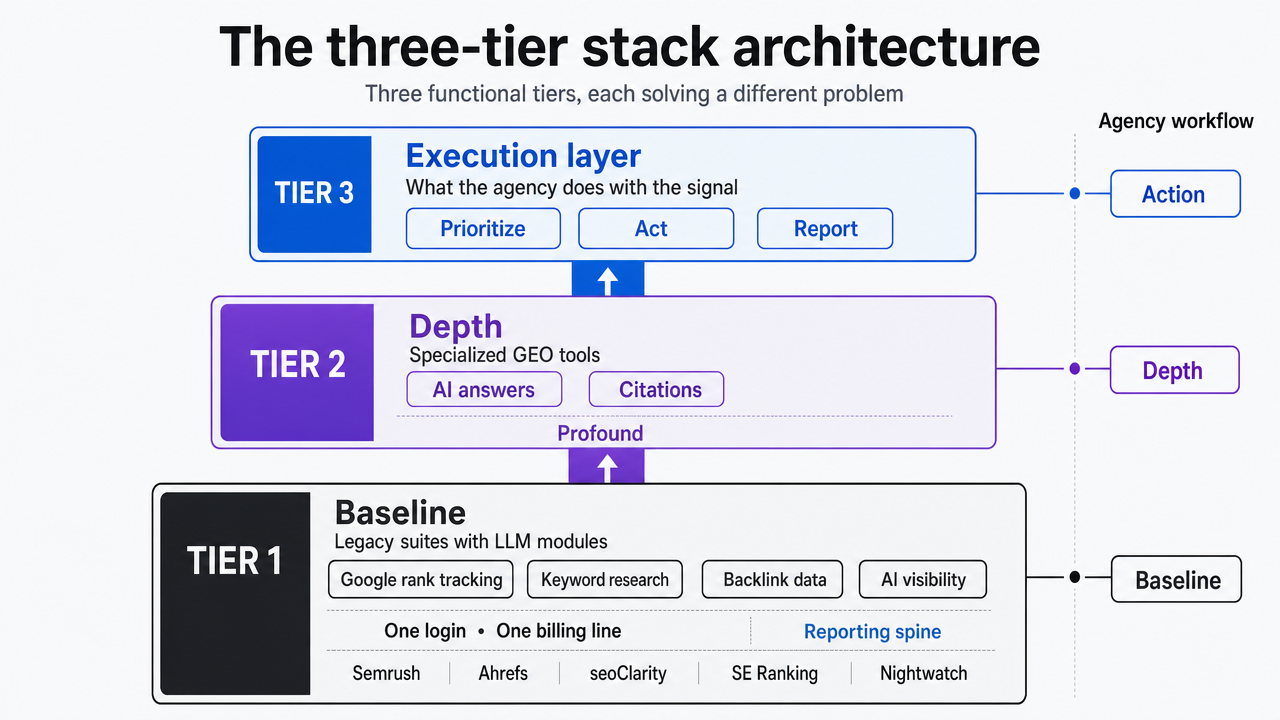
The cleanest way to read the LLM visibility market is not as a ranked list of vendors but as three functional tiers, each solving a different problem inside the agency workflow. Stacker's survey of the 25+ tool market frames the operating pattern directly: most teams pair legacy SEO suites that added LLM tracking, such as Semrush, Ahrefs, seoClarity, SE Ranking, and Nightwatch, with specialized GEO tools built for AI answers and citations 2. That pairing is the first two tiers. The third tier is what the agency does with the signal once the trackers surface it.
- Tier 1 handles the baseline. Legacy suites with LLM modules keep Google rank tracking, keyword research, backlink data, and AI visibility inside one login and one billing line. They are the reporting spine for the book of business.
- Tier 2 handles depth. Dedicated GEO specialists like Profound, Peec AI, and Brand Radar go further on prompt coverage, citation resolution, and answer-level diagnostics that suite modules still treat as a secondary feature.
- Tier 3 handles execution. Measurement without production is a report, not a result. This tier is where visibility gaps convert into approved, shipped content work.
Test LLM visibility tracking at scale today
Experience live, production-level LLM ranking insights on active SEO projects during your trial—no limitations.
Tier 1: Legacy suites that added LLM tracking
Semrush AI Visibility Toolkit
Semrush extended its core SEO suite with an AI Visibility Toolkit that tracks brand presence across ChatGPT, Google AI Overviews, AI Mode, Perplexity, and Gemini, and rolls the signal into a branded AI Visibility Score 6. For agencies already invoicing clients against Semrush dashboards, the appeal is administrative before it is technical: keyword research, backlink data, position tracking, and AI answer visibility sit inside one login and one billing line.
The AI Visibility Score is the operational hook. It gives account managers a single number to trend in weekly client reports, which is easier to defend in a retainer conversation than a scatter of prompt-level screenshots. Agencies running 50 to 200 accounts get consolidated reporting without a second procurement cycle, and the toolkit shares infrastructure with the Google rank tracker most books of business already run.
The trade-off is depth. Suite modules treat AI visibility as an added feature layer rather than the core product, so citation-level resolution and prompt customization remain shallower than what dedicated GEO specialists ship. Semrush earns a Tier 1 slot for agencies that need one dashboard across the book; a specialist tracker still gets added when a client's category demands prompt-by-prompt diagnostics.
SE Ranking AI Visibility Tracker
SE Ranking's differentiator sits at the citation layer. Its AI Visibility Tracker checks whether a brand is mentioned inside an AI answer, whether that mention is linked or unlinked, and where the brand sits among the sources the model pulled from 8. That resolution matters because a brand can appear in a Perplexity answer as an unlinked reference and still lose the click, or appear as source three when a competitor holds source one. Aggregate visibility scores hide both cases.
The tracker sits on top of a full SERP tracking suite, which keeps the reporting story simple for account teams. One export flow covers Google positions and AI answer citations, which reduces the number of joins the analytics team has to maintain when feeding client dashboards.
For agencies with clients in categories where citation quality is contested, such as legal, healthcare, and financial services, the linked-versus-unlinked distinction is not a nice-to-have. It is the diagnostic that separates a brand-awareness win from a traffic-generating one. SE Ranking earns its Tier 1 place when the book of business needs granular citation data without paying for a second dedicated GEO platform.
SEOmonitor
SEOmonitor is built for the enterprise agency reporting motion. It combines Google rank tracking, Google AI Overview monitoring, and ChatGPT, Gemini, and Perplexity visibility in a single platform, and it prices per keyword rather than per seat or per prompt 6. Per-keyword pricing behaves predictably as an agency's book scales, because the cost line grows with client keyword lists rather than with the number of analysts touching the tool.
The unified surface is the operational win. An account team can pull an AI Overview appearance trend, a ChatGPT citation check, and a Google position history from one platform without stitching together three exports. That collapses the reporting build time for weekly and monthly client decks, which is where most agency analyst hours actually go.
SEOmonitor is the option to shortlist when the agency operates on structured keyword universes per client and needs AI visibility folded into the same reporting spine as Google rankings. It is less compelling for agencies that run prompt-based measurement outside a defined keyword list, where a specialist GEO tool metered by prompt volume fits the workflow better.
seoClarity and Nightwatch LLM
seoClarity sits at the enterprise end of the Tier 1 group. It monitors brand presence across ChatGPT, Google AI Overviews, Perplexity, Claude, Gemini, and Copilot, and pairs that coverage with sentiment analysis, citation accuracy checks, and competitive positioning inside AI-generated answers 7. For agencies running enterprise clients where legal or compliance teams review AI answer content, sentiment and accuracy layers reduce the amount of manual QA the account team has to build in-house.
Nightwatch takes a different path into Tier 1. It began as a traditional rank tracker and added LLM tracking, which puts it in the same category pattern Stacker identified across Semrush, Ahrefs, seoClarity, and SE Ranking 2. Practitioner reviews of the 2026 rank tracker market list Nightwatch alongside dedicated AI visibility tools like Peec AI and Profound as part of the working stack for individual SEOs 5.
seoClarity fits agencies whose enterprise clients require sentiment and citation-accuracy audits inside the same platform as SERP tracking. Nightwatch fits mid-market agencies that want AI tracking added to an existing rank tracker without changing the reporting layer already built for clients.
Tier 2: Dedicated GEO specialists
Profound
Profound positions itself as the enterprise dashboard for AI search presence, built to answer operator questions like "What does ChatGPT list as the best product in my category?" and "How trustworthy do AI models find my site?" 3. That framing signals what a Tier 2 specialist brings that a suite module does not: prompt-level diagnostics and trust signal analysis treated as core product surface, not as an added tab.
Enterprise rank tracking guides consistently place Profound in the AI visibility peer set alongside BrightEdge Prism, seoClarity, and Semrush's AI Visibility Toolkit 6. Practitioner reviews of the 2026 tracker market list it directly next to Peec AI as a dedicated LLM rank tracking tool that individual SEOs run in parallel with classic suites 5.
Profound earns its slot when a client is enterprise-scale, competes on category authority inside AI answers, and needs prompt-by-prompt evidence that a suite module cannot produce at the depth the account team requires. Mid-market books running standard keyword universes rarely need this level of resolution.
Peec AI
Peec AI is built for one job: understanding how a brand shows up in AI search engines like ChatGPT, Perplexity, Claude, Gemini, and DeepSeek 5. Its narrower scope is the point. Where suite modules bundle AI visibility into a wider SEO product, Peec AI treats the AI answer surface as the primary object of measurement.
Practitioner workflows in 2026 pair Peec AI with a classic rank tracker rather than replace one 5. That pattern matches the broader Tier 1 plus Tier 2 pairing thesis: legacy suites hold the SERP baseline, and a specialist like Peec AI supplies the prompt-level view the suite still treats as secondary 2.
Agencies add Peec AI when specific accounts need dedicated AI visibility coverage across DeepSeek and Claude that suite modules cover thinly. It is a targeted add, not a book-wide replacement for the Tier 1 tracker already in place.
Brand Radar
Coverage scale is Brand Radar's differentiator. The platform tracks brand mentions across five AI indexes and more than 100 million prompts, giving it one of the widest coverage footprints among specialist trackers 8. Most specialist trackers in the category measure across the standard engine set of ChatGPT, Gemini, Perplexity, Claude, and Grok 4; Brand Radar's prompt-volume ceiling extends what an agency can sample per client at any given cadence.
That matters for two operator cases. High-volume categories such as consumer finance, travel, and retail generate long-tail prompt variants that thinner samplers miss, which shows up as gaps in trend lines the account team cannot explain. Enterprise clients with brand-safety exposure need coverage breadth before depth, because a mention in a low-frequency prompt can still land on a stakeholder's desk.
Brand Radar fits the book when at least one client operates at a prompt-volume scale that a standard specialist tracker will undercount. For mid-market accounts with tighter query universes, Profound or Peec AI cover the ground at lower operational overhead.
Tier 3: The governed execution layer
Vectoron as the answer to what ships the fix
Tier 1 and Tier 2 tell the agency where the visibility gap sits. Neither closes it. A brand that shows up unlinked in a Perplexity answer, or sits as source four in a ChatGPT response where a competitor holds source one, needs new content, refreshed pages, and citation-worthy assets shipped against a schedule. That is production work, and it is where most agency books stall.
BCG frames this exact handoff in its AI marketing blueprint: measurement and insights are one step in an end-to-end workflow that CMOs are told to redesign around AI, alongside media and creative execution 1. Instrumenting AI visibility without instrumenting the response to it stops at the measurement step.
Vectoron sits at Tier 3 as the governed execution layer. Specialist AI strategists take the visibility signal surfaced by the Tier 1 suite and the Tier 2 GEO tool, rank the response priorities, and route each recommendation through a Command Center approval workflow before content ships. The Head of SEO keeps sign-off on every asset while the production cycle from brief to publish runs without additional headcount. Tier 3 is what turns a citation gap in a weekly report into an approved page live by the next reporting cycle.
See How Leading Agencies Track LLM Search Performance at Scale
Connect with an expert to analyze your current LLM visibility tracking workflow and compare it against data-driven benchmarks for multi-client SEO operations.
Stack economics: three archetypes for the book of business
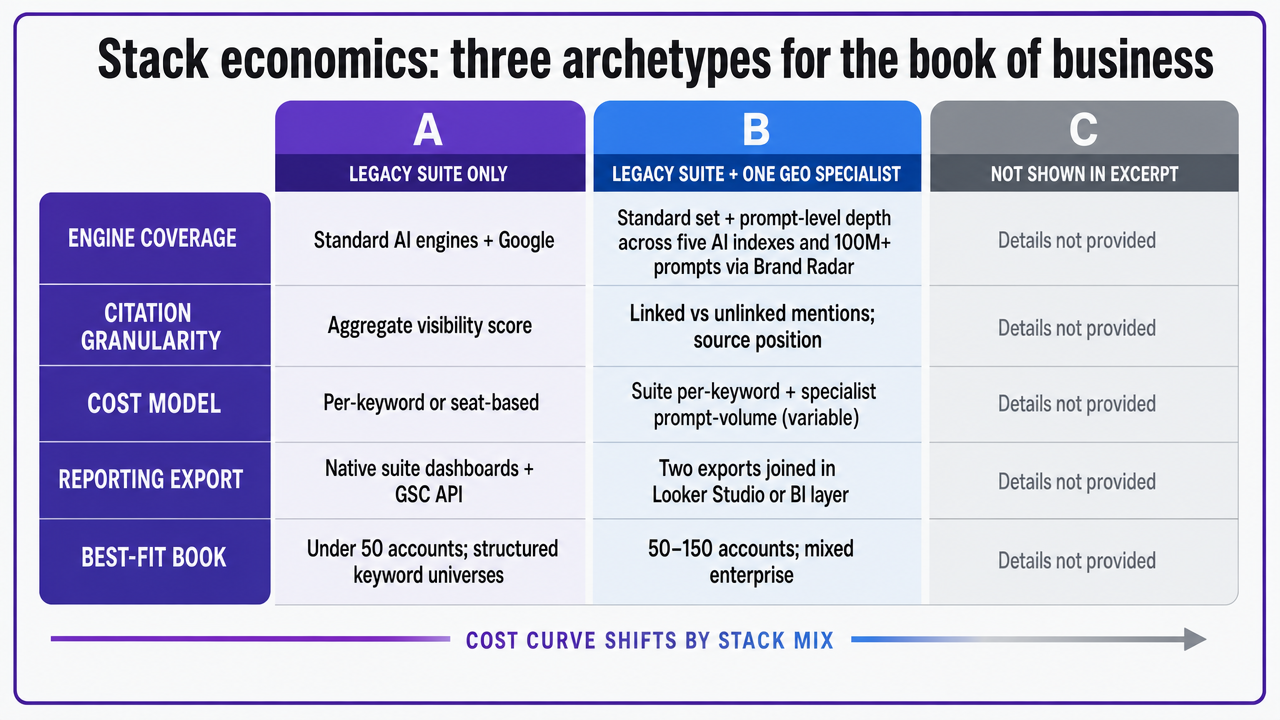
Once the tier logic is clear, the next question is which combination the agency actually funds. Three archetypes cover most books of business, and each shifts the cost curve in a different direction.
| Archetype | Engine coverage | Citation granularity | Cost model | Reporting export | Best-fit book |
|---|---|---|---|---|---|
| A. Legacy suite only | Standard AI engines plus Google 6 | Aggregate visibility score | Per-keyword or seat-based 6 | Native suite dashboards plus GSC API 10 | Under 50 accounts, structured keyword universes |
| B. Legacy suite + one GEO specialist | Standard set plus prompt-level depth across five AI indexes and 100M+ prompts via Brand Radar 8 | Linked vs unlinked mentions, source position 8 | Suite per-keyword plus specialist prompt-volume (variable) | Two exports joined in Looker Studio or BI layer | 50–150 accounts, mixed enterprise and mid-market |
| C. Legacy suite + GEO specialist + governed execution layer | Full multi-engine plus AI Overviews and Copilot 7 | Citation-level plus approved-work tracking | Layered; execution priced on production throughput (variable) | Unified pipeline from measurement to shipped asset | 150+ accounts or enterprise retainers with content SLAs |
Archetype A keeps procurement simple but leaves the account team without prompt-level diagnostics when a client's category demands them. Archetype B is the pattern Stacker documents as the market default, pairing a suite that added LLM tracking with a specialized GEO tool 2. Archetype C is the pattern that closes the loop between what the trackers surface and what the agency ships against it, which is where retainer expansion tied to AI visibility becomes defensible in the client conversation.
Joining Search Console baselines with LLM tracker exports
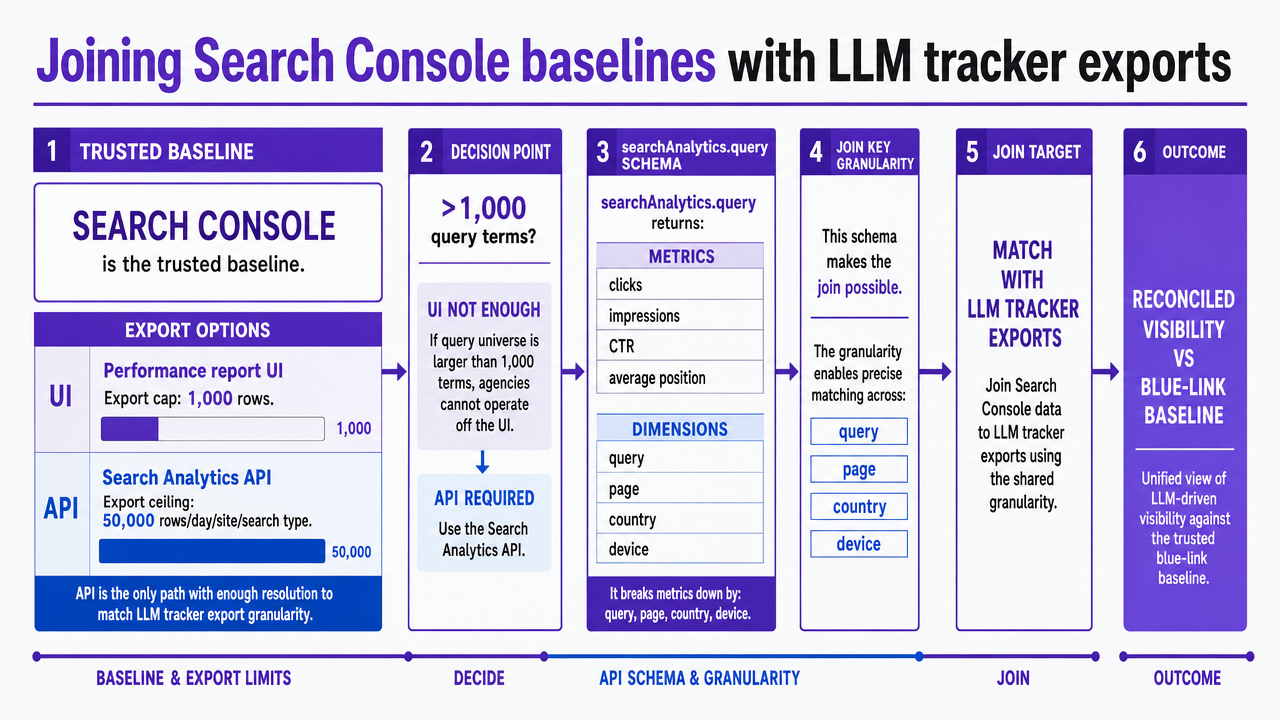
Every LLM visibility signal an agency surfaces still has to reconcile against the blue-link baseline the client already trusts. Search Console remains that baseline, and its export ceilings shape how the join actually happens. The Performance report interface caps exports at 1,000 rows, while the Search Analytics API extends that ceiling to 50,000 rows per day per site per search type 9. Agencies serving clients with query universes larger than 1,000 terms cannot operate off the UI; the API is the only path that supplies enough resolution to match the granularity of an LLM tracker export.
The searchAnalytics.query method returns clicks, impressions, CTR, and average position, and it breaks those metrics down by query, page, country, and device 10. That schema is what makes the join possible. An account team can pull the Google baseline on a per-query, per-page grain, then match it against an LLM tracker export that records whether the same page or brand appears in a ChatGPT, Gemini, or Perplexity answer, and whether the mention is linked or unlinked 8. The result is a single row per query showing both surfaces side by side.
The operational discipline is scheduling. Daily API pulls stay under the 50,000-row ceiling for most mid-market clients if the query set is scoped per property and per search type; enterprise clients with larger universes need staged pulls across multiple days or split by device to stay inside the limit 9. Client dashboards in Looker Studio or an equivalent BI layer then read from the joined table rather than from either source directly, which is what keeps weekly reporting builds down to a scheduled refresh instead of a manual export cycle.
Where consolidation is safe and where dual coverage is required
Tool proliferation is the tax most agencies pay when a new measurement surface appears. The practitioner reality in 2026 is that many teams end up running two or three overlapping trackers before anyone audits the stack 5. Two rules keep that tax bounded.
- Consolidate when the reporting grain matches. If a Tier 1 suite already covers the client's engine set and the account team reports on aggregate visibility scores rather than prompt-level citations, a second tracker adds spend without adding decisions. SEOmonitor's single-platform combination of Google rank, AI Overviews, and ChatGPT, Gemini, and Perplexity visibility is the archetype where consolidation holds 6.
- Keep dual coverage when citation resolution or prompt volume drives the client outcome. Suite modules still treat AI visibility as an added layer, so agencies serving categories where linked-versus-unlinked mentions or source position decide the traffic outcome need a specialist alongside the suite 8. The same logic applies when a client's prompt universe exceeds what standard samplers cover, which is where Brand Radar's wider footprint earns its slot 8.
Frequently Asked Questions
References
- 1.The Blueprint for AI-Powered Marketing.
- 2.25+ LLM Visibility Tracking Tools And Which Your Brand Should Use.
- 3.LLM Performance Tracking Software 2026: 24 Tools for AI ....
- 4.Best LLM Tracking Tools for Marketing Agencies.
- 5.14 best rank tracker software I'm using for SEO in 2026.
- 6.12 Best Enterprise Rank Tracking Software Platforms in 2026.
- 7.Best Enterprise AI SEO Platforms for 2026 - Stackmatix.
- 8.AI Site Rank Tracking Software Choices for Agencies to Use.
- 9.A deep dive into Search Console performance data filtering and limits.
- 10.Google Search Console API: A Guide to All Available Data.