
Key Takeaways
- AccuRanker leads on refresh speed and AI-surface tracking, including AI CTR modeling and SGE reporting, though its local grid depth trails specialist tools and per-client cost trends higher.
- Advanced Web Ranking pairs AI Brand Visibility with forecasting, useful for projecting seasonal content pushes, but forecasts should be treated as directional inputs rather than client commitments.
- Semrush Position Tracking wins on suite breadth and SERP feature capture, yet its city and ZIP-level local tracking falls short of purpose-built grid tools for multi-location work.
- Ahrefs Rank Tracker earns trust on data quality and clean historical reporting, but scheduled refresh cadence means numbers can lag the SERP during volatile update weeks.
- SE Ranking fits mid-market portfolios with predictable pricing and out-of-the-box white-label reports that junior specialists can run without extensive training.
- Local Falcon delivers coordinate-level grid scans that expose proximity decay, making it essential for DSOs, franchisors, and multi-office firms rather than a general tracker replacement.
- Nightwatch suits agencies that warehouse rank, call, and pipeline data, offering clean API access and row-level exports over pre-built reporting views.
- Vectoron sits beside the trackers as an execution layer, consuming rank signal alongside calls and bookings to route ranked recommendations through human approval before work ships 12.
Rank Position Stopped Predicting Revenue in 2025
The search results page an agency reported on five years ago no longer exists. Pew Research found that about 58% of U.S. adults ran at least one Google search in March 2025 that returned an AI-generated summary, and users on those pages were measurably less likely to click any result link 2. That figure comes from real browsing behavior, not survey recall, and it covers general U.S. searchers rather than a specific commercial vertical. Yet in the aggregate click data from consumer search behavior research, roughly 95% of clicks still land on organic listings rather than sponsored ones, with the organic share ranging from about 80.58% to 99.73% depending on the keyword 5. Organic demand has not evaporated. The path to it has fragmented.
That tension is the entire buying question for an SEO lead running delivery across a portfolio. A tracker that reports position 3 on desktop, in a single city, without noting the AI Overview above it or the local pack that pushed the ten blue links below the fold, is producing a number that no longer maps to pipeline. The eight tools evaluated below are scored against that reality: whether their signal can drive next week's decisions, not whether they can produce a prettier keyword grid.
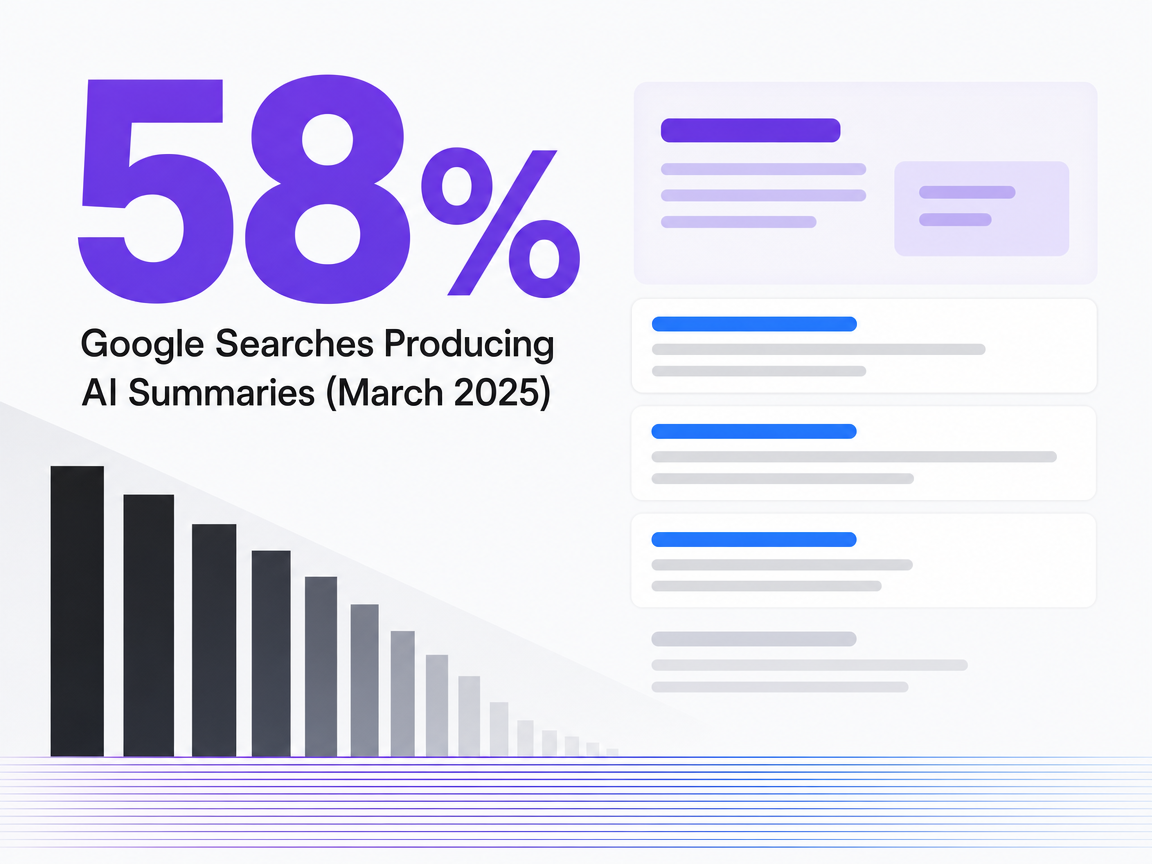 Google Searches Producing AI Summaries (March 2025)
Google Searches Producing AI Summaries (March 2025)
The Six-Point Rubric This Shortlist Uses
What a Tracker Now Has to Measure
Position is one variable in a rank tracker's output, not the output itself. A 2024 peer-reviewed study of 416,386 clicks and 31,648,226 impressions estimated organic CTRs of 9.28% at position 1, 5.82% at position 2, and 3.11% at position 3, with sharp variation by device 3. Those numbers sit well below the legacy curves many agency reports still lean on, and the gap grows further when a SERP feature or AI Overview occupies the top of the page. A separate analysis of 24 different SERP features found they generally suppress organic CTR, though the magnitude depends on position and feature type 4.
A tracker built for the current SERP has to report at least four surfaces separately: standard organic listings, local pack results, AI-generated summaries, and the SERP features stacked above or beside them. It also has to pair position with the engagement signals that predict user behavior more accurately than clicks alone, a point Google's own research on clicks, attention, and satisfaction has made 7. Reporting a single blended rank across those surfaces averages away the signal an agency needs to act on.
Scoring Criteria: AI Surfaces, Local Grid, SERP Features, Export, Automation, Unit Cost
Six criteria score each tool below, chosen because they change whether a delivery lead can run more clients per specialist without losing signal quality.
AI-surface tracking covers whether the tool detects AI Overviews, SGE panels, and LLM citations as distinct data points. Recent agency-focused reviews already treat AI CTR modeling and SGE tracking as differentiating features rather than nice-to-haves 10. Local grid granularity measures whether the tool queries from many simulated coordinates and maps proximity decay across a service area, rather than reporting one city-level number 9. SERP feature capture asks whether the tracker records the presence and position of features that suppress organic CTR 4, not just where the blue link sits.
API and warehouse export determine whether rank data can join call, booking, and pipeline data in a single reporting layer 12. Reporting automation covers scheduled client deliverables, white-label output, and alert routing. Per-client unit cost is calculated as the tool's monthly fee divided by the number of clients it can reasonably serve at the agency's keyword and location volume, not the sticker price on the pricing page.
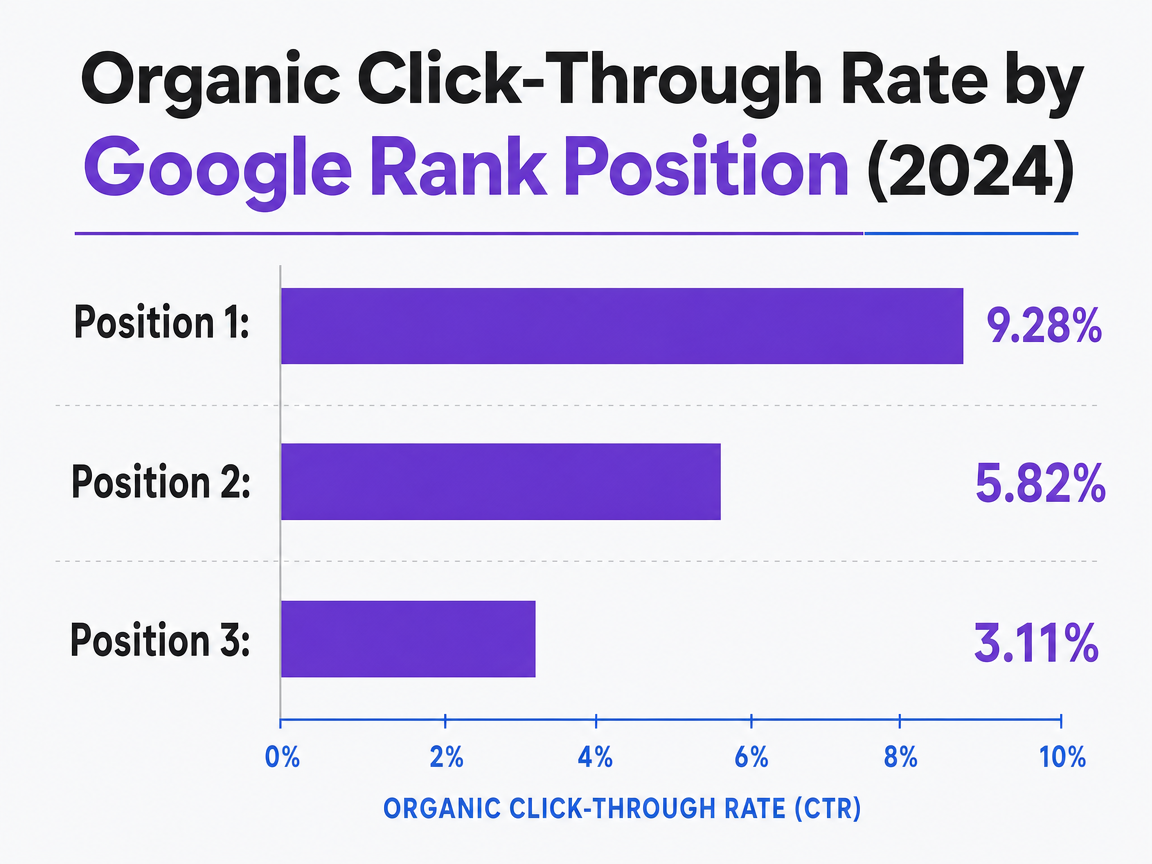 Organic Click-Through Rate by Google Rank Position (2024)
Estimated organic click-through rates (CTR) for the top three positions in Google search results, based on a 2024 academic study analyzing over 31 million impressions.
Test Rank Tracking Accuracy With Live Data
Evaluate rank performance on real client projects using full-featured trial access and publish actionable reports during your test.
The 8 Rank Trackers, Scored Against the Rubric
AccuRanker: Real-Time Refresh and AI CTR Modeling
AccuRanker earns its place on agency shortlists on refresh speed. On-demand updates let a delivery lead re-pull rankings between a client call and the follow-up email, which matters when a core update is mid-rollout and the account manager is being asked what changed. The tool has extended that speed advantage into AI-adjacent measurement, adding AI CTR modeling, AI search volume estimates, and Google SGE tracking to its standard reporting stack 10.
Against the six-point rubric, AccuRanker scores strongly on AI-surface tracking and reporting automation, and adequately on SERP feature capture. Local grid granularity is the softer spot: it reports local pack presence, but grid-based proximity scans are not its native strength, so multi-location portfolios often pair it with a dedicated grid tool. API export exists and supports warehouse pipelines. Per-client unit cost trends higher than mid-market alternatives, which is defensible for portfolios where daily refresh drives revenue decisions and less defensible for accounts checked monthly.
Advanced Web Ranking: Forecasting and AI Brand Visibility
Advanced Web Ranking positions itself around forecasting and AI Brand Visibility reporting, which places it in a different lane than the refresh-speed players 10. Forecasting matters when a head of SEO has to project whether a Q2 content push will move a client past a paid competitor in time for a seasonal budget conversation. The AI Brand Visibility layer tracks how a brand surfaces across AI answer environments, not only in the ten blue links.
On the rubric, Advanced Web Ranking scores well on AI-surface tracking, reporting automation, and SERP feature capture, and it holds usable API export for teams that pipe rank data into a warehouse 12. Local grid granularity is present but less differentiated than a dedicated grid tool. Per-client unit cost is competitive at mid-portfolio scale, particularly for agencies that value the forecasting module. The forecasting output is only as useful as the assumptions behind it, so treat the projections as directional inputs to a plan rather than commitments to a client.
Semrush Position Tracking: Breadth at the Cost of Grid Depth
Semrush wins on surface area. Position Tracking sits inside a suite that also handles keyword research, backlink monitoring, site audits, and competitor SERP capture, which is why it lands on so many agency stacks by default. For a delivery lead consolidating four or five point tools into one contract, that breadth is the argument.
The cost of that breadth shows up on the rubric. AI-surface tracking has expanded, and SERP feature capture is thorough, with the platform flagging feature presence alongside position 11. Reporting automation and API export are mature. Local grid granularity, however, is where Semrush trails specialists: city-level and ZIP-level tracking exists, but the fine-grained coordinate scans that expose proximity decay across a service area are thinner than a purpose-built grid tool offers 9. Per-client unit cost improves when the same seat supports research and backlink work, and worsens when Position Tracking is used in isolation. Agencies running multi-location clients typically keep Semrush and add a grid layer beside it.
Ahrefs Rank Tracker: Clean Data, Slower Refresh Cadence
Ahrefs is the tool most SEO leads trust for underlying data quality. Rank Tracker inherits that reputation, and the reports it produces read cleanly in client meetings because the historical series is stable and the SERP snapshots are legible. That trust is the reason Ahrefs stays in stacks even when other tools refresh faster.
The refresh cadence itself is the honest limitation. Standard updates run on a schedule rather than on-demand, so during a volatile week the numbers a client sees Monday may already lag the SERP by Wednesday. On the rubric, Ahrefs scores well on SERP feature capture, reporting automation, and API export, and its competitor SERP capture is strong enough to anchor a competitive brief 11. AI-surface tracking has been added but is not the platform's leading edge. Local grid granularity is not the strength. Per-client unit cost is reasonable when Rank Tracker rides on a seat already paid for by keyword and backlink research, which is how most agencies deploy it.
SE Ranking: Mid-Market Pricing and White-Label Reporting
SE Ranking is the tool a growing agency reaches for when the Ahrefs and Semrush contracts start eating margin on smaller clients. White-label reporting is built in, keyword tracking scales predictably, and the interface is fast enough to hand to a junior specialist without a training arc 11.
On the rubric, SE Ranking scores solidly on reporting automation and per-client unit cost, which is the reason it appears in so many mid-market stacks. AI-surface tracking is present and improving. SERP feature capture is competent for standard features. API export exists and supports basic warehouse workflows. Local grid granularity is the criterion to check against a specific portfolio: SE Ranking handles local pack tracking well, but agencies with dense multi-location clients typically supplement it with a grid tool rather than lean on it alone 9. Where SE Ranking pulls ahead is the client-facing deliverable: the white-label reports come out of the box in a format that most clients accept without a redesign, which saves specialist hours every reporting cycle.
Local Falcon: Grid Scans Built for Proximity Decay
Local Falcon is not a general rank tracker, and treating it as one misses the point. It is a grid-scan tool built specifically to query Google from many simulated coordinates around a business location and map how visibility decays as the searcher moves away from the pin 9. That is the exact signal a DSO, home services franchisor, or multi-office law firm needs and cannot get from a city-level ranking.
On the rubric, Local Falcon scores at the ceiling for local grid granularity and produces artifacts that clients understand at a glance: a colored grid showing where the business appears in the top three, the top ten, or nowhere at all. SERP feature capture and AI-surface tracking are narrower by design. API export supports feeding grid data into a broader reporting stack. Per-client unit cost scales with locations and scan frequency rather than keyword count, which changes the math for multi-location portfolios. Most agencies run Local Falcon alongside a broader tracker rather than as a replacement.
Nightwatch: API-First Reporting for Agencies That Warehouse Data
Nightwatch is the choice when the agency's reporting layer lives outside the rank tracker. Teams that pipe rank, call, booking, and pipeline data into a shared warehouse and rebuild the client dashboard in Looker Studio or a comparable tool value Nightwatch for the clean API, the granular location targeting, and the willingness to expose data at the row level rather than only through pre-built views 12.
On the rubric, Nightwatch scores strongly on API export and location granularity, and adequately on SERP feature capture and reporting automation. AI-surface tracking has been added but is not the platform's marquee capability. Local grid granularity is respectable for a general tracker, though not at Local Falcon's depth. Per-client unit cost lands favorably when the agency already maintains a warehouse: the tool replaces built-in reporting the team was not going to use, so the spend concentrates on the data feed itself. For teams still building reports inside a tracker's UI, Nightwatch is more infrastructure than most portfolios need.
Vectoron: The Execution Layer That Consumes Rank Signal
Vectoron is on this list on different terms than the seven tools above. It is not a pure rank tracker. It is the execution layer that reads rank data alongside qualified calls, bookings, cost per lead, and pipeline, then surfaces ranked recommendations for a human to approve before content, SEO, PPC, backlink, or social work ships 12. For a delivery lead, the question it answers is not "what rank am I at" but "what should the specialist do next week, given the rank movement, the AI Overview presence on the query, and the call volume from the affected pages."
On the rubric, Vectoron does not compete on native local grid depth or SERP feature capture the way a specialist tracker does; it consumes those signals from the rank layer and pairs them with engagement and conversion data, echoing the multi-signal evaluation framing in Google's own SERP research 7. Per-client unit cost is calculated against specialist hours saved on prioritization and briefing, not against keywords tracked, which is why it sits beside the trackers above rather than inside their category.
Reading the Scorecard Without Anchoring on One Feature
Scored across the six rubric criteria, no single tool dominates every column, which is the finding a delivery lead should actually take to a tooling review 10, 11, 12.
- AccuRanker leads on refresh speed and AI-surface tracking.
- Advanced Web Ranking pairs AI Brand Visibility with forecasting.
- Semrush and Ahrefs win on breadth and data quality, and both lag specialists on local grid depth.
- SE Ranking wins the per-client unit cost column at mid-market volume.
- Local Falcon scores at the ceiling on local grid granularity and narrower everywhere else.
- Nightwatch wins API export for warehouse-native teams.
- Vectoron reads rank signal into an execution layer rather than competing on native capture.
The operator move is to score against the portfolio, not the feature list. A stack with heavy multi-location work weights local grid and per-client cost. A stack chasing AI-surface share weights AI tracking and SERP feature capture. A stack rebuilding reports in a warehouse weights API export. The scorecard below is a starting artifact, not a verdict.
Evaluate Rank Tracking Solutions That Scale With Your Client Portfolio
Request a tailored walkthrough of advanced rank tracking workflows designed for agencies managing high-volume SEO, including multi-location and enterprise-level reporting requirements.
If You Manage Multi-Location Portfolios: Grid Tracking Economics
Why Single-Point Rank Checks Misrepresent Service-Area Visibility
This section is written for delivery leads running multi-location portfolios: dental support organizations, home services franchisors, multi-office law firms, senior living operators, and behavioral health groups with more than one physical footprint. Single-location agencies can skim it. Everyone else pays for the mistake it describes.
A single-point rank check queries Google once, from one simulated coordinate, and reports a number. For a service-area business, that number is a fiction. Modern local trackers query Google many times, from many simulated locations, and map results back to the geography the business actually serves, because visibility decays with distance from the physical pin 9. A dental office that ranks in the local pack at its own address may fall out of the top three within a mile, and out of the top ten within three miles, on the same query in the same hour.
That decay is what a grid scan exposes. A 7x7 grid across a service area produces 49 ranked snapshots per keyword per location, which is why grid tools have become the operator standard for local delivery 9. Local search intent is also skewed toward directions and availability, so a query that looks like a ranking win at the pin is often a lost booking three ZIP codes away 8.
Per-Location Cost Model: Locations, Keywords, Cadence, Specialist Hours
Grid tracking cost is not a keyword fee. It scales on four variables the delivery lead controls:
- Number of locations
- Keywords tracked per location
- Scan cadence
- Specialist hours spent turning grids into recommendations
The math below uses the reader's own inputs. Pricing is described qualitatively where the research does not supply figures, and the only fixed dollar reference is the Vectoron trial context supplied in brand materials ($599/month after a two-week trial).
A representative model for a 20-location DSO tracking 15 keywords per location on a weekly cadence produces 20 × 15 × 4 = 1,200 grid scans per month before any competitor overlay. Per-location tracking cost is calculated as (tool subscription ÷ locations), and per-scan cost as (subscription ÷ total scans). The specialist-hours line is the one most agencies underprice: reading 1,200 grids, flagging proximity decay patterns, and writing recommendations runs 8 to 12 hours per week on portfolios that size unless the workflow is templated.
| Variable | Formula | Notes |
|---|---|---|
| Grid scans / month | Locations × keywords × cadence | Weekly cadence is standard for active portfolios 9 |
| Per-location tracking cost | Subscription ÷ locations | Falls sharply above 10 locations on volume-priced tools |
| Specialist hours / week | Scans ÷ throughput per hour | Templated review runs 100–150 grids/hour |
| Reporting cost per client | Hours × loaded rate | Compare against tool automation savings |
| Execution layer trial | $599/month after 2-week trial | Vectoron trial context, supplied |
The operator move is to run the model against the actual portfolio before signing the contract. A tool that looks affordable at 5 locations often inverts at 40, and the specialist-hours line is where consolidation into an execution layer that reads rank signal alongside call and booking data starts to pay 12.
Wiring Rank Data Into the Weekly Decision Loop
A tracker earns its budget when it changes what the specialist ships next week, not when it produces a prettier Monday report. The delivery pattern that survives portfolio scale is a five-step loop:
- Pull rank signal across organic, local pack, and AI surfaces.
- Join it with Search Console clicks, impressions, and average position, which Google now exposes through a faster recent-performance view 1.
- Rank the recommendations by expected impact.
- Route the top items through human approval.
- Ship the approved work and measure the KPI delta the following week.
Two signals make that loop defensible. Pairing rank with engagement data, rather than clicks alone, predicts user behavior more accurately, a point Google's own SERP evaluation research settled years ago 7. Watching organic and paid movement together also matters, because organic click-through influences paid performance more than the reverse, so rank shifts on a core commercial term should trigger a paid budget review the same week 6.
The operator test for any tool on the shortlist is simple: can it feed that loop by Wednesday, or does it produce a report that arrives after the decision has already been made?
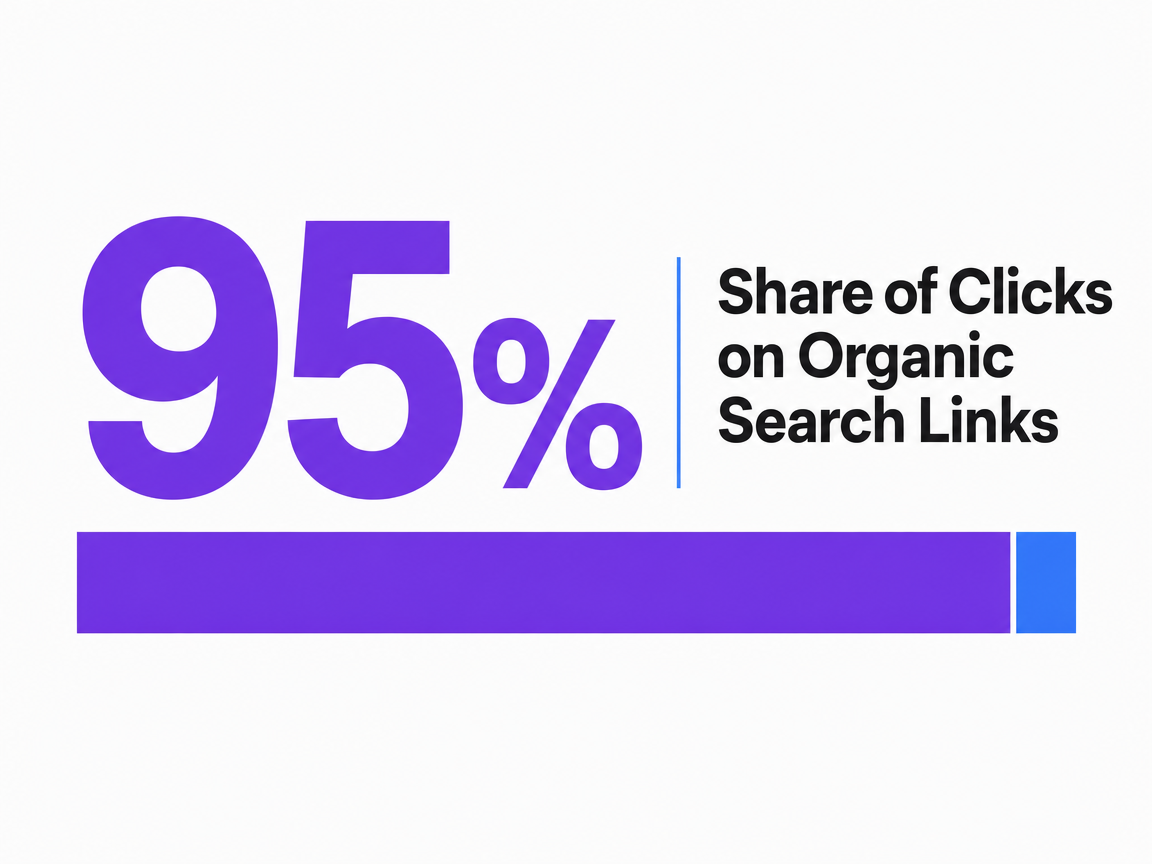 Share of Clicks on Organic Search Links
Share of Clicks on Organic Search Links
Frequently Asked Questions
References
- 1.An improved way to view your recent performance data in Search Console.
- 2.Do people click on links in Google AI summaries?.
- 3.Device-dependent click-through rate estimation in Google organic search results based on clicks and impressions data.
- 4.Exploring the Impact of SERP Features on Organic Click-through Rates.
- 5.Consumer Click Behavior at a Search Engine: The Role of Keyword Popularity.
- 6.Analyzing the Relationship Between Organic and Sponsored Search Results.
- 7.Incorporating Clicks, Attention and Satisfaction into a Search Engine Result Page Evaluation Model.
- 8.Understanding Consumers' Local Search Behavior.
- 9.How to Track Local SEO Rankings for Multiple Locations.
- 10.Discover the Top 6 Agency Rank Tracking Tools for 2026.
- 11.14 best rank tracker software I'm using for SEO in 2026.
- 12.Best SEO Rank Tracking Software for Agencies and Teams 2024.