
Key Takeaways
- Agency SEO leads now score SERP trackers on eight dimensions including AI Overview visibility, local granularity, governance, and per-keyword economics, not just ranking accuracy 7, 9.
- The market has split into collection engines and reporting layers, and portfolios above 25 clients need both handled as separate purchases 12.
- STAT Search Analytics is the enterprise pick for daily SERP collection at large-market scale, with API access built for warehouse and reporting integration 9, 10.
- BrightEdge combines GPS-level local tracking with role-based governance and multi-site controls, clearing procurement at agencies where in-house tools cannot 8, 10.
- SE Ranking is the mid-market agency default, bundling rank tracking, audits, competitor capture, and collaboration under one per-project economic model starting near $65 per month 2, 4.
- AccuRanker suits agencies treating rank data as a downstream input, delivering precise daily pulls with device and country segmentation into BI stacks or reporting layers 1, 13.
- Nightwatch structures projects around geographic sets from setup, making it the mid-market pick for multi-location portfolios that do not require enterprise-tier GPS precision 11, 13.
- Nozzle captures the full SERP as a structured object, giving analysts share-of-voice math and forensics needed to explain visibility drops caused by AI Overviews or local pack shifts 3, 7.
- seoClarity renders AI answer visibility next to traditional rankings with visual SERP feature analysis, shortening the gap between spotting a drop and diagnosing its cause 7, 10.
- Vectoron shifts SERP data from deliverable to control surface, wiring ranking signals into an approval-first workflow across content, backlinks, and paid execution.
The evaluation rubric agency SEO leads actually use
Agency SEO leads no longer pick a SERP tracker on ranking accuracy alone. The evaluation has moved to a broader scoring frame that treats classic position data as one signal among several, alongside AI answer visibility, local pack granularity, and how cleanly data flows into reporting and execution layers.7, 9
Eight dimensions consistently show up across 2026 comparisons.
- First, update cadence: daily desktop and mobile refresh at portfolio scale, not weekly averages.9, 10
- Second, local granularity: ZIP-, city-, and GPS-level pulls for multi-location clients where a two-block shift changes the local pack.10
- Third, SERP feature capture: featured snippets, People Also Ask, local packs, video carousels, and image blocks, tracked with share-of-voice math rather than a binary flag.1
- Fourth, AI Overview visibility: exposure inside Google AI Overviews and citation presence across AI answer engines, now surfacing in enterprise trackers as a first-class metric.7, 9
- API and BI integration matter once a stack pipes ranking data into Looker, Snowflake, or a client warehouse.8
- Governance—role-based permissions, multi-site controls, and audit trails—separates enterprise platforms from consumer trackers as agencies push past tens of thousands of keywords across markets.8
- Reporting UX covers white-label dashboards and executive-ready outputs, which increasingly sit in a category separate from the tracking engine itself.12
- Per-keyword economics closes the rubric: what a keyword actually costs when a portfolio scales from one client to fifty.
Rankability's SPI framework captures why this matters. It rolls traditional rankings, local pack, AI answers, AI citations, and video visibility into a single index, arguing that trackers still fixated on blue-link position under-report real visibility.7 The eight picks that follow are scored against this frame, not against each other as interchangeable rank checkers.
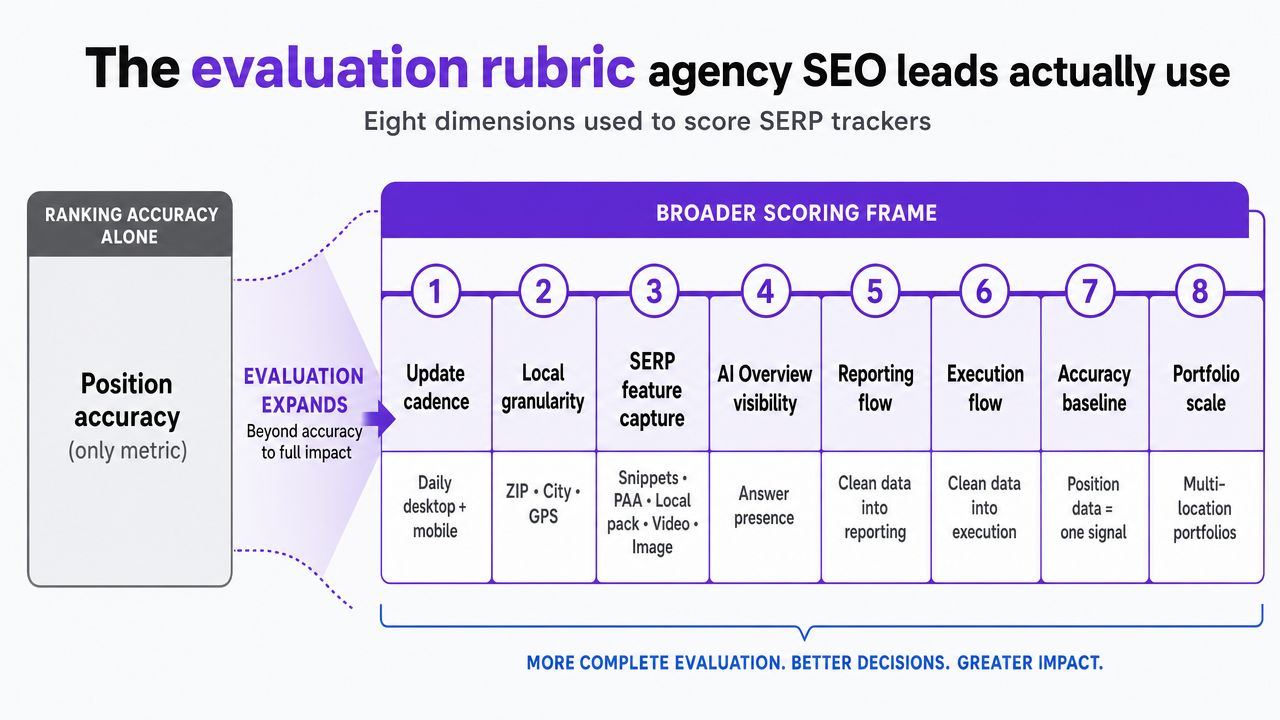 Visualize the eight evaluation dimensions Heads of SEO use to score SERP trackers, directly supporting the section's rubric explanation
Tracking vs reporting: the split most stacks quietly need
The 2026 tool landscape has quietly separated into two categories that agencies keep confusing at purchase time. On one side sit the collection engines: STAT, Nozzle, AccuRanker, and enterprise suites that pull ranking data at daily cadence, capture full-SERP features, and expose it through an API.9, 10 On the other sit the reporting layers: white-label dashboards, executive-ready templates, and AI/LLM-aware presentation tools that consume ranking data rather than gather it.12
Treating both as the same purchase leads to predictable failure modes. An agency picks an all-in-one for its dashboard aesthetics, then discovers the underlying tracker refreshes weekly and misses local pack variants. Or the reverse: a precision-focused engine gets bought for accuracy, then analysts spend hours rebuilding QBR decks the tool cannot produce natively.12
The cleaner pattern for portfolios above roughly 25 clients splits the stack deliberately. A collection engine handles daily pulls, SERP feature capture, and API access into a warehouse.8 A reporting layer sits on top with white-label branding, AI visibility panels, and client-facing views.12 The rubric from the previous section applies to both halves separately, which is why the eight picks below are grouped by the job they actually do, not by feature checklist parity.
Enterprise depth: STAT and BrightEdge
STAT Search Analytics for daily, large-market SERP collection
STAT Search Analytics earns its enterprise reputation on two counts: daily refresh at scale and full-SERP capture that survives the volume most agencies underestimate until they cross their fifth mid-market client. 2026 comparisons position it specifically for “daily at enterprise scale” tracking with “very deep, large-market coverage” and “extensive full-SERP capture” alongside an API built for reporting stacks.9
For agency heads managing portfolios in the tens of thousands of keywords, that combination matters more than any single dashboard feature. STAT handles large-scale daily SERP collection, share-of-voice math, and segmentation by market, device, and intent—the exact primitives that let an analyst answer “why did visibility move” without a manual pull.10 The API is the piece that unlocks downstream reporting: pipe rankings into a warehouse, join to conversion data, and the tool stops being a dashboard and starts being an input to the delivery model.8
STAT is quoted, not price-carded, and the platform's weight sits on collection rather than presentation. Agencies running it typically pair it with a reporting layer for client-facing outputs, which is consistent with the tracking-vs-reporting split the market has now formalized.12 For a Head of SEO scaling past 25 clients with heavy keyword counts per account, STAT is the collection engine to benchmark first—then decide what sits on top of it for QBRs and client dashboards.
BrightEdge for GPS-level local and enterprise governance
BrightEdge sits in a different corner of the enterprise tier. Where STAT optimizes for collection breadth, BrightEdge pairs enterprise-grade local coverage with the governance apparatus large agencies need once headcount and client counts stop being trivial.9, 10
The local story is the sharper differentiator. Agencies serving multi-location clients—DSOs, home services rollups, healthcare networks—need ranking data that reflects how a searcher two blocks over actually sees the local pack. BrightEdge is grouped with the platforms delivering GPS-level local tracking and full-SERP feature detection, which puts it in the small set of tools that can honestly report on multi-location visibility without averaging away the variance.10 That granularity feeds into executive-ready dashboards and migration utilities designed for portfolios rather than single sites.10
The governance layer is the second reason BrightEdge shows up on enterprise shortlists. Buyer guides for large-scale SEO platforms treat multi-site governance, role-based permissions, API access, and BI integrations as non-negotiable once a tool has to handle tens of thousands of keywords across markets.8 BrightEdge is built against that spec, which is why it clears procurement at agencies whose in-house tools cannot.
Pricing is enterprise-quoted, so the trade is straightforward: pay for governance and local depth, or absorb the analyst hours that manual segmentation, permissioning, and reporting create at scale.
Test SERP tracking workflows on real campaigns
Experience live rank monitoring and reporting with your own client projects before committing.
Mid-market workhorses: SE Ranking and AccuRanker
SE Ranking as the agency collaboration pick
SE Ranking is the tool that gets named when agency practitioners describe their default mid-market pick. Multiple 2026 guides tag it explicitly “for agencies,” citing collaboration features, multi-user workflows, and pricing that starts around $65 per month.2 A separate practitioner roundup lists it as “best for SEO agencies” within a 14-tool comparison, and another positions it as the “affordable all-in-one solution” when agencies want a single vendor instead of a fragmented stack.11, 4
What makes it a workhorse rather than a specialist is the shape of the platform. Rank tracking sits alongside site audits, competitor SERP capture, and keyword research inside one login, which matters when analysts rotate across accounts and cannot afford context-switching between five tools per client.4 Local pack tracking runs at ZIP-code granularity, competitor SERP capture is native, and the collaboration layer—shared projects, role-based access, client logins—is built for teams handing off work rather than solo consultants.13
The trade is honest. SE Ranking will not match STAT's collection depth or BrightEdge's enterprise governance apparatus. What it offers instead is a coherent per-seat, per-project economic profile that scales predictably from ten clients to fifty, which is why 2026 buyer guides keep landing it in the agency column rather than the enterprise one.2, 3 For a Head of SEO whose portfolio sits in the mid-market band, it removes the argument for owning three separate subscriptions.
AccuRanker for precision and API-first pulls
AccuRanker occupies a narrower slot. Where SE Ranking optimizes for breadth across an agency workflow, AccuRanker is the tool agencies buy when ranking accuracy is the point and everything else is negotiable. It shows up in 2026 enterprise rank-tracking comparisons alongside Semrush, Ahrefs Enterprise, and Ranktracker, evaluated specifically on daily SERP tracking with device and country segmentation plus SERP feature monitoring.1
The API-first posture is the reason it earns space in mixed stacks. Agencies that already run Semrush or Ahrefs for research often bolt AccuRanker on for the ranking layer, pulling clean daily data into their warehouse or reporting tool of choice rather than trusting the position module built into a generalist suite.3, 13 That pattern shows up repeatedly in agency-tested comparisons that flag AccuRanker for accuracy and precision-focused workflows rather than dashboard aesthetics.13
The operational takeaway is straightforward. AccuRanker is the pick when an agency has already decided that ranking data will be consumed downstream—piped into a BI tool, a client warehouse, or a white-label reporting layer—and the tracker's job is to be the cleanest, fastest, most reliable feed possible.1 For portfolios that treat rank data as an input rather than a deliverable, that specialization is worth more than another all-in-one login.
Local and multi-location depth: Nightwatch
Nightwatch is the pick when the client roster is dominated by multi-location operators and the local pack is where retainers get won or lost. Practitioner comparisons in 2026 flag it specifically for local tracking strength alongside broader rank monitoring, which puts it in a different lane from the generalist suites.11 It captures rankings at ZIP and city precision, tracks competitor SERP variants per location, and structures projects around geographic sets rather than a flat keyword list.13
The tier below enterprise is where Nightwatch does its real work. STAT and seoClarity operate at GPS-level granularity with full-SERP feature detection at enterprise-quoted pricing, while BrightEdge covers the same GPS-precise territory with governance layered on top.10 Nightwatch sits under that band with strong local pack capture at a mid-market economic profile, and mainstream generalist trackers sit further down at ZIP-level granularity without the location-first project structure.10, 13 The choice for agency heads is not whether Nightwatch matches STAT—it does not—but whether GPS precision is worth enterprise-tier spend when a client base of 30 dental locations or 50 home services branches can be served at ZIP granularity with dedicated local workflows.
For portfolios where every client has more than five locations, Nightwatch replaces the awkward pattern of forcing a generalist tracker to segment by city after the fact.13 The keyword sets are organized by location from setup, competitor capture runs per market, and the reporting reflects the way local SEO analysts actually think about the work.
AI-era visibility: Nozzle and seoClarity
Nozzle for SERP intelligence and full-feature capture
Nozzle earns its spot on the enterprise shortlist by treating the SERP as a structured object rather than a ranked list. It appears alongside Rankability Tracker, STAT, seoClarity, BrightEdge, and Conductor in 2026 enterprise rank tracker comparisons, evaluated on the same axes that separate serious collection engines from generalist suites.7 Where mainstream trackers report a position and a SERP feature flag, Nozzle captures the full result set with the granularity needed to run share-of-voice math across intent segments and device splits.3
The intelligence layer is what makes it agency-relevant. Nozzle is grouped with the tools delivering deep SERP intelligence and full-feature capture, which matters when an analyst needs to explain a visibility drop that had nothing to do with the client's position and everything to do with a new AI Overview or an expanded local pack absorbing the click.3, 7 That level of SERP forensics is the difference between a QBR that ends in a strategy conversation and one that ends in a defensive explanation.
Nozzle sits closer to a data warehouse than a dashboard. For agencies already piping ranking data into BI stacks, it is the collection layer that repays the integration effort with SERP context most trackers throw away.7, 8 Pair it with a reporting layer for client-facing outputs and it stops competing with SE Ranking or AccuRanker—it plays a different position entirely.
seoClarity for AI answer visibility and visual rank analysis
seoClarity is the enterprise pick when AI answer visibility has to sit next to traditional rankings inside the same reporting view. Agency-targeted 2026 comparisons describe it as offering visual rank analysis for SERP features alongside local tracking down to GPS precision, which puts it in the small group of platforms treating the modern SERP as a multi-surface problem rather than a single-position feed.10
The AI visibility layer is the reason it belongs in this category. Rankability's SPI framework—rolling traditional search, local pack, AI answers, AI citations, and video into one index—maps directly onto what seoClarity is built to report against, which is why it shows up in the enterprise tracker set alongside Nozzle, BrightEdge, and Conductor.7 Conductor gets flagged for AI assistant visibility tracking in the same 2026 agency guide that positions seoClarity for visual SERP feature analysis, so the two often appear together on shortlists for portfolios where AI Overview exposure is a KPI, not a footnote.10
The visual analysis piece is the operational differentiator for analysts. Instead of reading a table of positions and feature flags, seoClarity surfaces the SERP layout itself, which shortens the time between “visibility dropped” and “here is why” when the cause is a new AI Overview or a reshuffled local pack.10 Pricing is enterprise-quoted, consistent with the tier it competes in.
See How Leading Agencies Monitor SERP Performance at Scale
Connect with experts to explore advanced SERP tracking solutions proven to streamline multi-client reporting, automate insights, and maintain quality control without expanding your team.
Execution-integrated: Vectoron as the eighth pick
The eighth pick sits in a category the other seven do not occupy. Every tracker profiled so far treats rank data as an output—a feed, a dashboard, a QBR slide. Vectoron treats it as an input to coordinated execution, wiring SERP visibility into the same approval workflow that governs content production, backlink outreach, and PPC decisions across a client portfolio.
The category shift matters for agency heads managing delivery across 25 to 100+ accounts. Traditional stacks pair a collection engine like STAT or Nozzle with a reporting layer for client-facing outputs, then hand the analysis to strategists who translate ranking movement into content briefs, technical fixes, or link priorities.12 That translation step is where analyst hours accumulate and where retainer economics break down at scale. Execution-integrated platforms compress the loop: ranking signals feed a specialist SEO strategist that ranks priorities against live business data, drafts the recommended work, and routes each action through human approval before anything ships.
The rubric applies here too. Daily SERP capture, SERP feature tracking, and AI Overview visibility are inputs to the recommendation engine rather than dashboard endpoints, which aligns with the 2026 shift toward AI-enhanced visibility metrics and multi-surface reporting that enterprise buyers now expect.10, 12 For agencies scaling without adding headcount, Vectoron is the entry that turns rank tracking from a deliverable into a control surface for coordinated execution.
Per-keyword economics when you scale from one client to fifty
The evaluation frame changes when the buyer is a portfolio operator rather than a single-brand SEO lead. A tracker that costs $65 per month looks trivial against one client's retainer. Multiply the keyword count by 50 accounts, layer in daily updates, and add three device-location splits per client, and the per-keyword line item becomes the deciding variable behind which platform actually clears margin.2, 8
The public pricing signal is thin by design. SE Ranking anchors the mid-market band at roughly $65 per month starting, with agency-friendly collaboration and multi-project structure built into that tier.2 Enterprise-grade platforms—STAT, BrightEdge, seoClarity, Conductor—do not publish price cards. They quote against keyword volume, market count, seat count, and update frequency, which is consistent with their positioning as governance-heavy platforms built for tens of thousands of keywords across markets.8, 10
| Tier | Representative tools | Pricing signal | Update cadence | Local depth | Governance |
|---|---|---|---|---|---|
| Mid-market | SE Ranking, AccuRanker | Starts ~$65/mo (SE Ranking)2 | Daily desktop/mobile | ZIP-level | Multi-user, project-based |
| Enterprise collection | STAT, Nozzle | Enterprise-quoted9, 10 | Daily at scale | City to GPS | API, BI integration |
| Enterprise suite | BrightEdge, seoClarity, Conductor | Enterprise-quoted10 | Daily desktop/mobile | GPS-level | Role-based, multi-site |
The variables that move the number are predictable.
- Tracked keyword count is the dominant lever.
- Update frequency—daily versus weekly—typically doubles or triples the per-keyword rate at any tier.9
- Location count matters most for multi-location portfolios where a 30-branch client can multiply an underlying keyword set by 30 before any competitive terms get added.10
- Seat count feeds governance-tier pricing more than mid-market pricing, which is why enterprise quotes scale with headcount in ways that SE Ranking's per-project model does not.8
The operational takeaway for a Head of SEO running the numbers: model per-keyword monthly cost across three variables—keywords tracked, update frequency, and locations—before comparing platforms. The tool that looks cheapest on a single-client pilot often stops being cheapest at 25 clients, and the enterprise quote that looks punitive at 10 clients can flatten out at 50 once analyst hours and manual segmentation get priced into the alternative.8
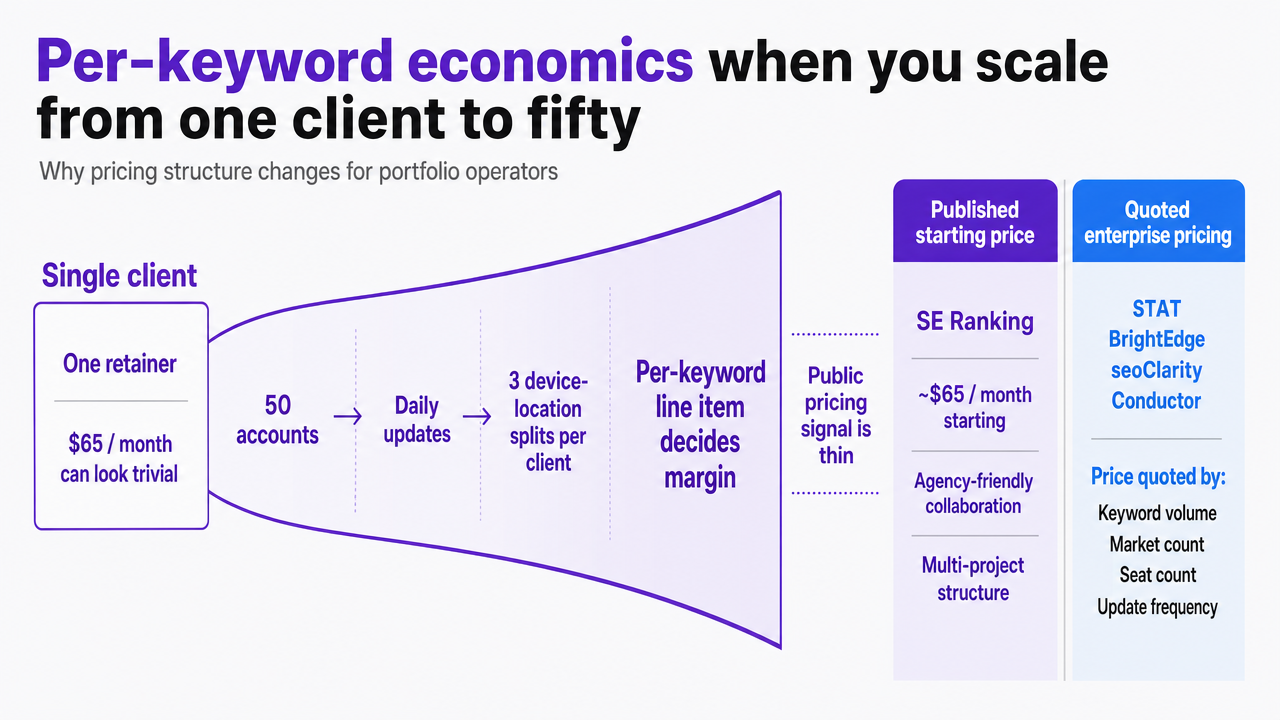 Reformat the article's tier comparison table into a scannable visual reference tied directly to the pricing tiers discussed in this section
Matching the pick to the agency job
The eight picks map onto six distinct agency jobs, and the selection error most Heads of SEO make is treating them as interchangeable. Enterprise collection at daily cadence across tens of thousands of keywords is STAT territory, with Nozzle as the alternative when SERP forensics matter more than raw volume.9, 7 Enterprise governance and GPS-level local depth for multi-location portfolios sit with BrightEdge, and seoClarity earns the slot when AI answer visibility has to render inside the same view as classic rankings.10
Mid-market delivery splits cleanly. SE Ranking is the default when a single vendor has to cover ranking, audits, competitor capture, and client logins under a per-project economic model.2, 4 AccuRanker replaces it when ranking accuracy is the point and the data will be consumed downstream by a warehouse or reporting layer.1 Nightwatch answers the multi-location question below enterprise spend, structuring projects around geography from the first setup.11, 13
The eighth job is different. Vectoron sits where SERP data stops being a deliverable and starts driving coordinated execution across content, backlinks, and paid—an approval-first control surface rather than another dashboard to interpret.
Frequently Asked Questions
References
- 1.7 Best Enterprise Rank Tracking Software Tools in 2026.
- 2.The 12 best rank tracker tools.
- 3.15 Best Rank Tracking Software (Tested on Real Campaigns).
- 4.15 Secret SEO Tools Top Agencies Use to Rank Fast.
- 5.Top 10 Best Serps Enterprise Seo Software: 2026 Comparison.
- 6.Screaming Frog Seo Spider.
- 7.10 Best Rank Trackers for Enterprise SEO (2026).
- 8.12 best enterprise seo tools for 2026.
- 9.Best SERP Tracking Tools for 2026.
- 10.10 Best SEO Enterprise Software for Agency Keyword Tracking.
- 11.14 best rank tracker software I'm using for SEO in 2026.
- 12.The 12 Best SEO Ranking Reporting Software for 2026.
- 13.Best SEO Rank Tracking Software for Agencies and Teams ....