
Key Takeaways
- Treat pillars as a routing layer that decides quarterly budget, cluster depth, and refresh cadence, not as editorial labels applied after posts are already drafted.
- Three pillars is the working default for lean teams, each supporting 8 to 15 clusters with pillar pages at 1,500 to 3,000 words and clusters at 1,000 to 2,500 2, 4.
- AI-assisted drafting compresses one stage of production, so realistic output lands at 25 to 40 assets per month, not the raw 5x multiplier applied end-to-end 15.
- Rewrite one pillar this quarter with commercial intent, cluster targets, source rules, and refresh triggers, then run a cannibalization pass on its existing cluster set 5.
The plateau lean content teams hit at 15 posts a month
Most in-house content managers running lean know the shape of the ceiling. A team of one manager, two writers, and a rotating freelancer or two can produce roughly 12 to 15 well-briefed pieces per month before something breaks: brief quality slips, SEO review gets skipped, or the editorial calendar becomes a sprint of unrelated posts chasing whichever keyword looked ripe that week. Adding a writer buys another three or four posts. It does not change the ceiling.
The pressure to break through that ceiling is documented. CMI's B2B benchmark research identifies lack of resources as the top situational challenge marketers face, even as 45% of respondents expected content marketing budgets to grow in 2024 13. Budgets rise; headcount does not track proportionally. Managers are told to produce more, prove ROI faster, and absorb AI tooling into workflows that were already fully loaded.
The reflex is to treat content pillars as the answer and stop there. Pick three to five themes, tag posts against them, publish on cadence. That taxonomy approach is what produces the 15-post plateau. It organizes output without changing how capacity is allocated, how clusters are architected, or how quality is governed once AI drafting enters the pipeline.
The argument in the sections that follow is narrower and more operational. Pillars, treated correctly, are not editorial buckets. They are the routing layer that decides where budget, keyword targets, cluster depth, and refresh cadence land each quarter. That distinction is what separates teams stuck at 15 posts from teams compounding topical authority across a defined architecture.
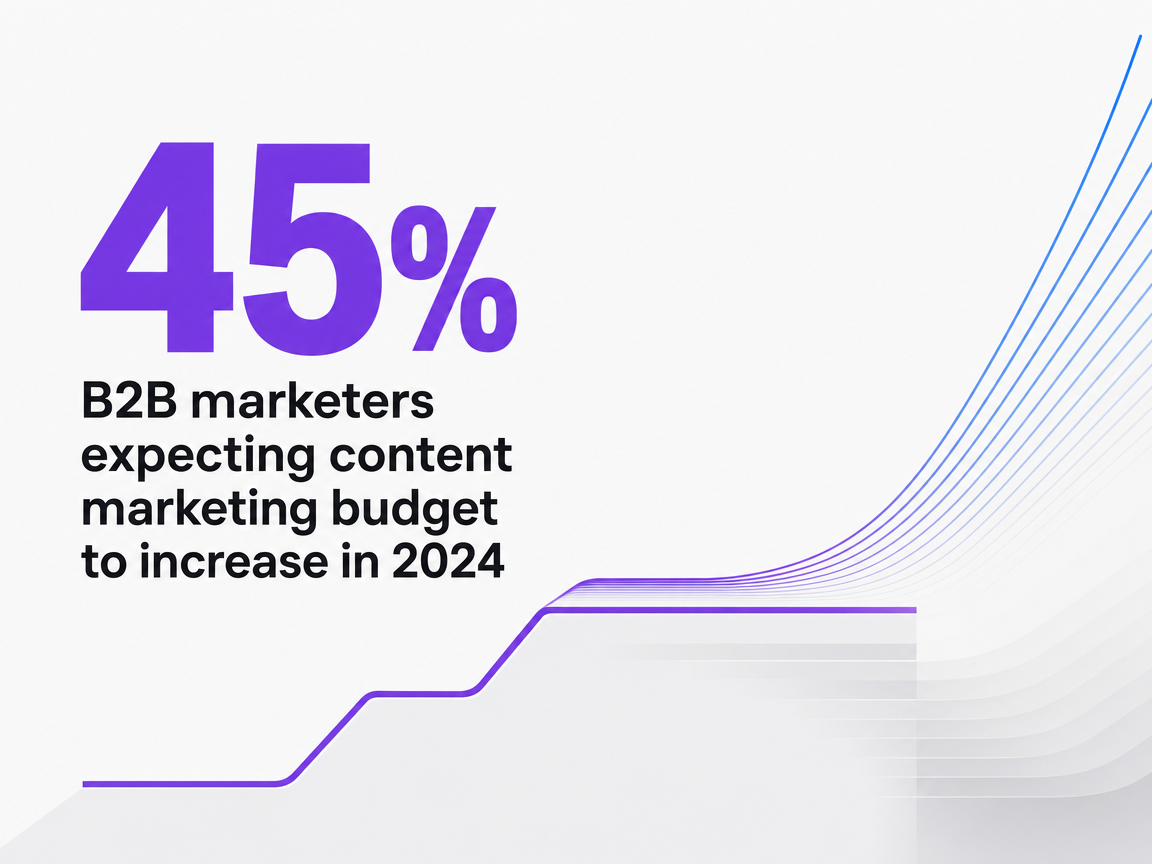 B2B marketers expecting content marketing budget to increase in 2024
B2B marketers expecting content marketing budget to increase in 2024
Pillars as a routing layer, not an editorial taxonomy
The taxonomy view of pillars treats them as labels applied after the fact. A post gets written, a manager tags it under "customer retention" or "operations," and the pillar exists mostly to make the content calendar look organized in a slide deck. Nothing about the pillar decides which post gets written next, how much depth it warrants, or whether it should exist at all.
The routing view inverts that sequence. Pillars decide before anything is drafted: which keyword clusters get budget this quarter, how deep each cluster goes, which subtopics justify a 2,000-word cluster article versus a 400-word FAQ entry, and when a pillar page gets refreshed rather than a new asset commissioned. The pillar is the decision layer sitting above the calendar, not a field inside it.
This matters more once AI drafting enters the workflow. Practitioner guidance on implementing pillars across channels increasingly frames each pillar as structured metadata that tags every asset across theme, journey stage, channel, and voice rules, so engagement and conversion can be analyzed by pillar rather than by post 19. That metadata is only useful if the pillar was defined as a routing instruction in the first place. A pillar labeled "industry trends" tells a writer nothing. A pillar defined as "mid-funnel evaluation content for buyers comparing in-house vs. outsourced production, targeting 12 commercial-intent clusters, refreshed quarterly" tells a writer, an editor, and a drafting model what to produce and what to reject.
The consequence is architectural. When pillars route capacity, three decisions get made once, at the quarter boundary: which pillars receive net-new cluster investment, which get refresh cycles, and which get held flat. Individual post decisions collapse into a queue governed by that allocation. The 15-post ceiling described earlier is a symptom of skipping this layer and letting each post compete for attention on its own merits.
Architecture: what a defensible 3-pillar system actually contains
Pillar page and cluster specifications that hold up under scrutiny
The pillar-and-cluster model has settled into a fairly narrow set of operational specifications, and lean teams benefit from adopting them as defaults rather than debating them per project. The SEO Handbook's guidance places pillar pages at 1,500 to 3,000 words and cluster pages at 1,000 to 2,500 words, with each cluster covering one subtopic in depth and linking back to the pillar 2. Practitioner guidance from a parallel implementation guide recommends breaking each pillar into 8 to 15 major subtopics, with bidirectional linking between the pillar and each cluster article 4.
Those ranges are not aesthetic preferences. A pillar page under 1,500 words rarely covers a commercially meaningful topic with the depth search engines and AI systems now reward for topical authority. A pillar page over 3,000 words tends to accumulate scope creep, absorbing what should be standalone cluster assets and starving the internal linking pattern of destinations. Cluster articles below 1,000 words compete poorly for long-tail queries; above 2,500 they begin overlapping the pillar's territory and inviting cannibalization.
The linking pattern matters as much as the word counts. Each cluster links up to the pillar with descriptive anchor text tied to the subtopic it owns. The pillar links down to every cluster, and clusters link laterally only when the subtopic relationship is direct. That discipline is what turns 8 to 15 assets into a routable topology rather than a folder of related posts, and it is the specification that determines whether a lean team's quarterly output compounds or dissipates.
How many pillars: the case for three, and when four or five is defensible
Practitioner guidance on pillar count converges around a narrow band, and the convergence is the story. Multiple frameworks recommend three to five core pillars, each broad enough to support at least ten subtopics 6. A parallel framework advises identifying three to five themes aligned with expertise, audience needs, and offers 7. Guidance on multi-channel pillar implementation puts the range at three to five, with three as the starting point and seven or more risking diluted focus and broken tagging discipline 19. A broader strategic framework extends the ceiling to three to seven pillars for enterprises with wider commercial surface area 1.
For genuinely lean teams, the case for three is stronger than the case for five. Guidance specific to small content operations recommends two or three pillar topics mapped directly to services, with supporting posts planned around specific questions and use cases 18. The math is straightforward: a team producing 12 to 15 assets per month cannot maintain cluster depth across five pillars simultaneously without spreading each pillar too thin to compound authority.
Four or five pillars becomes defensible when:
- a business has distinct buyer personas or product lines that share little search overlap,
- internal expertise is deep enough to sustain differentiated coverage, or
- an AI-assisted workflow has already proven throughput at three pillars and capacity is available to absorb a fourth.
Adding a pillar because it feels commercially attractive, without evidence the team can service ten-plus clusters on it within two quarters, is how the 15-post ceiling reappears.
Test Content Pillar Workflows With Full Access
Validate your pillar approach by publishing live content and measuring real impact during your trial.
Capacity math: what a 3-pillar system produces at AI-assisted throughput
Throughput and cost mechanics behind the lean-team promise
The productivity claims around AI-assisted content are specific enough to plan against, and specific enough to misuse. Synthesized industry data attributes a 5x average speed increase and a 40–60% cost-per-asset reduction to generative-AI-assisted production for standard content formats 15. Both figures come with scope conditions worth stating plainly: they describe standard formats such as cluster articles, FAQs, and product-adjacent explainers, not original research, executive thought leadership, or narrative case studies where drafting is a smaller share of total effort.
Applied to a lean team's actual workflow, the 5x multiplier does not mean five times the finished, publishable output. It compresses the drafting stage, which is typically 30 to 45% of end-to-end production time on a standard cluster article. The remaining share—brief construction, SME input, editorial review, SEO checks, internal linking, and publishing—does not compress at the same rate. A team that previously shipped 12 to 15 assets per month and preserves its editorial standards realistically lands between 25 and 40 assets per month once AI drafting is integrated into the cluster tier, not 60 to 75.
The 40–60% cost-per-asset band behaves similarly. It applies most cleanly to the marginal cost of producing an additional cluster article inside an existing pillar, where research, keyword targeting, and brief templates are already amortized. Net-new pillar pages, refreshes on high-stakes commercial pages, and any asset requiring first-party data or SME interviews sit closer to the low end of the reduction band or outside it entirely. The capacity math that follows uses these ranges as scoped inputs, not universal multipliers.
 Average content production speed increase with generative AI
Average content production speed increase with generative AI
Quarterly output under a 3-pillar architecture
The point of scoping the multipliers is to make quarterly planning defensible rather than aspirational. Under a three-pillar architecture with 10 to 15 clusters per pillar as the target end state 4, a lean team can plan against three production models with meaningfully different output curves. The table below indexes cost-per-asset at 100 for a traditional agency baseline and applies the sourced reduction band to the AI-assisted model. Absolute dollar figures are intentionally omitted; the operator interest is relative capacity, not vendor benchmarking.
| Metric per quarter | Traditional agency baseline | In-house lean team | AI-assisted lean team |
|---|---|---|---|
| Pillar pages published or refreshed | 1 | 1–2 | 2–3 |
| Cluster articles published | 18–24 | 30–45 | 60–90 |
| Cost-per-asset index (standard cluster) | 100 | 55–70 | 40–60 |
| Quarters to reach 10-cluster depth on all three pillars | 5–6 | 3–4 | 1–2 |
The cost-per-asset column applies the 40–60% AI-assisted reduction band directly to the baseline 15. The cluster-throughput row assumes drafting compression flows through to publication only when the editorial and QA layers can absorb the additional volume, which is the constraint the next two sections address. Reading the last row is the operator decision: an AI-assisted lean team can reach full 10-cluster depth across three pillars within one to two quarters, which is the point at which topical authority begins to compound rather than accumulate.
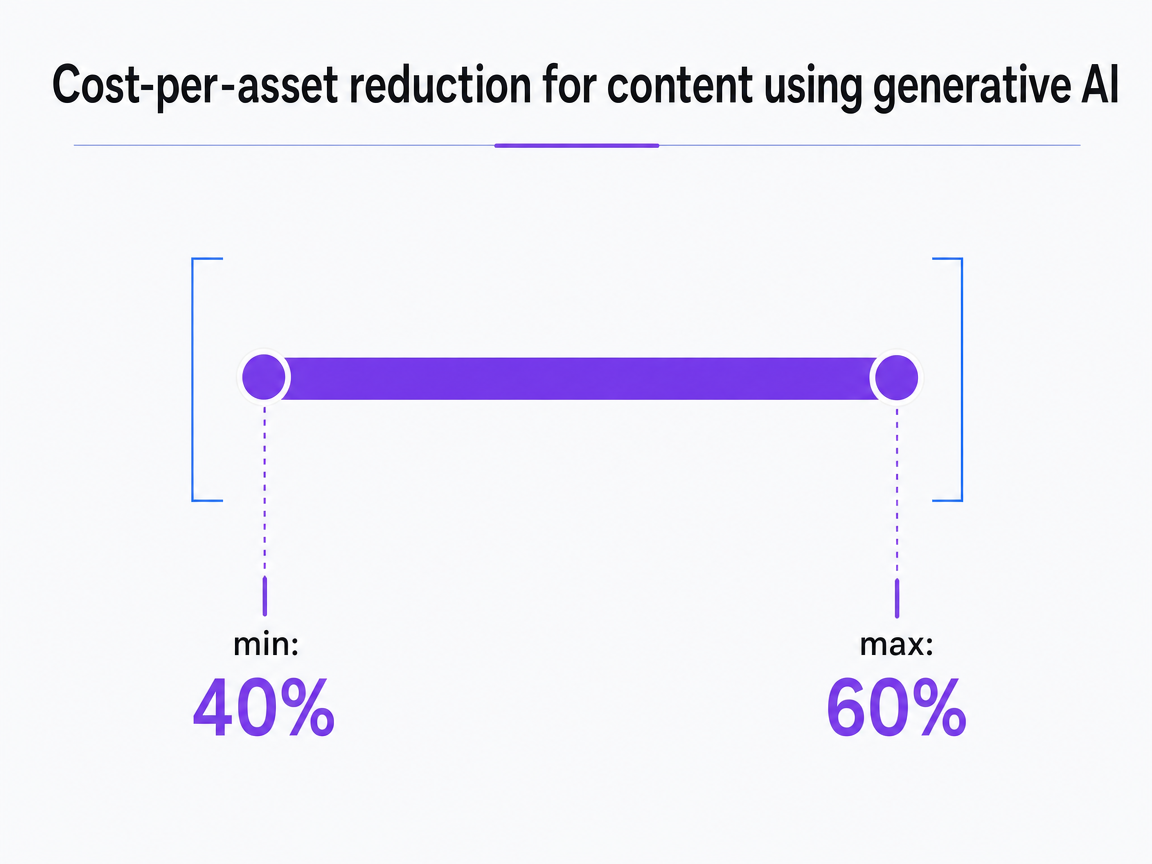 Cost-per-asset reduction for content using generative AI
Data from McKinsey (2025) indicates that using generative AI for standard content formats can lead to a 40-60% reduction in cost per asset.
Diagnostics: signals a pillar is failing before traffic tells you
Traffic is a lagging indicator. By the time organic sessions to a pillar flatten or dip, the underlying architecture has usually been degrading for two or three quarters. Lean teams that wait for the traffic signal spend the next quarter diagnosing what went wrong instead of correcting course. Four earlier signals tend to surface first, and each maps to a specific correction rather than a general call to iterate.
- The first is keyword cannibalization inside a cluster. When two cluster articles begin ranking on rotating URLs for the same query, or when the pillar page loses ranking to one of its own children, the pillar's subtopic map has drifted. The 2026 topic-cluster methodology treats this as a distinct diagnostic pass: scope, map, check for cannibalization, then consolidate or split before publishing more 5. The correction is a merge or a redirect, not another draft.
- The second is flat topical authority growth across the cluster set. If eight of ten cluster articles under a pillar sit outside the top 30 for their primary query after two full quarters of indexing, the pillar is not accumulating authority; it is accumulating pages. The subtopic selection is likely too broad, too competitive, or too disconnected from the pillar's commercial spine.
- The third is low internal link equity flowing to the pillar. When cluster articles link up with generic anchors, or when the pillar receives fewer inbound internal links than a peer category page, the topology is decorative rather than routable 2.
- The fourth is drafting drift under AI assistance: cluster articles that pass QA individually but collectively repeat framing, examples, or definitions. That signal shows up in editorial review before it shows up in Search Console, and it is the pillar's job to prevent it.
Governance: pillars as the QA framework AI workflows are missing
Enterprise B2B adoption of generative AI in the content production cycle reached 72% in Gartner's 2025 CMO Spend Survey, up from 41% a year earlier 16. Formal governance has not tracked that curve. The gap between drafting speed and editorial oversight is where AI-assisted lean teams generate the most preventable rework, and it is where pillars earn their second job.
A pillar defined only as a theme cannot govern drafting. A pillar defined as a routing instruction—commercial intent, target cluster count, allowable formats, source-quality requirements, voice constraints, and refresh triggers—becomes a checklist a reviewer can apply in minutes and a drafting model can be prompted against. Google's guidance on helpful content evaluates originality, completeness, and value at the individual-page level 11, but a lean team cannot run that evaluation from scratch on every draft. Encoding the standard into the pillar specification is what makes the review repeatable.
The same discipline compounds trust signals across the cluster set. CMI's analysis of content that both humans and AI agents cite emphasizes that established authority and well-structured, comprehensive coverage translate directly into citation preference by AI systems 12. That authority does not accumulate at the post level; it accumulates at the pillar level, which is why pillars carrying explicit E-E-A-T requirements—named author expertise, first-party evidence thresholds, source recency rules—outperform pillars that treat quality as the reviewer's judgment call.
The operational rule is simple: a pillar specification that cannot fail a draft is not a governance layer. Any AI-assisted output that clears the pillar's stated bar ships; anything below it routes back with the specific criterion cited.
See How High-Performing Teams Operationalize Content Pillars at Scale
Get a walkthrough of automated workflows that turn content pillar strategy into measurable output—without increasing headcount. See how digital agencies and brand teams streamline pillar-based execution and approval cycles.
If you manage multiple locations or a service portfolio
The framing shifts here. Everything above assumes a single brand with one commercial spine. Managers running content for a multi-location service business or a portfolio of related service lines face a different allocation problem: whether pillars belong to the brand, the location, or the service line, and how much cluster depth each layer can sustain.
The workable pattern is a two-tier pillar system. Brand-level pillars carry the commercially defining topics that apply across the portfolio—three, following the lean-team logic already established 18. Location or service-line pillars sit underneath, each running two or three clusters tied to local intent, regulatory context, or service-specific queries. The brand pillars accumulate topical authority for the domain; the sub-tier captures the long-tail conversion queries a single national pillar cannot address.
The discipline that keeps this from collapsing into duplicate content is the cannibalization pass 5. Before a location pillar publishes a cluster, the brand pillar's cluster set is checked for overlap. If the query is already served nationally, the location asset routes to a schema-enhanced service page rather than a new article. Portfolio operators who skip this check produce parallel cluster sets that split link equity across URLs that should be consolidated, and the topical authority curve flattens even as output rises.
The economics ceiling: what mature orchestration adds on top
The throughput and cost figures in section four describe what a lean team can capture by integrating AI drafting into an existing pillar architecture. Those are the accessible gains. The ceiling numbers sit further out, and they belong to organizations that have rebuilt marketing as a continuous orchestration system rather than a campaign calendar with AI bolted on.
McKinsey estimates generative AI could increase marketing productivity by 5 to 15% of total marketing spending across the function 20. That is a spend-weighted average, not a per-asset figure, and it reflects gains distributed across research, planning, drafting, personalization, and analytics rather than concentrated in content production. A parallel McKinsey analysis of organizations that have redesigned around AI-enabled orchestration reports 4 to 7% revenue growth, two- to threefold productivity improvements, and 60 to 70% savings on execution tasks 21. Those are ceiling figures for mature operators running continuous insights, scaled creativity, and always-on orchestration in concert.
The practical read for a lean content manager is scope discipline. A well-architected three-pillar system captures the drafting and cluster-throughput gains without requiring the orchestration stack behind the ceiling numbers. Pursuing the ceiling means adding personalization infrastructure, live signal integration, and cross-channel execution capacity that most in-house teams do not own. Pillars are the entry point, not the endgame.
The next operator decision
The decision in front of a lean content manager this quarter is not whether to adopt pillars. It is whether the current three-to-five themes on the content calendar function as routing instructions or as labels. The test is concrete: can a writer, a reviewer, and an AI drafting model each read the pillar specification and reject a bad idea without escalation? If not, the pillar is a taxonomy, and the 15-post ceiling will hold.
Rewriting one pillar this quarter—commercial intent, cluster targets, format rules, source requirements, refresh triggers—costs a week. Running the cannibalization pass on its existing cluster set costs another. That is the entry point, and it is where the compounding starts.
Frequently Asked Questions
References
- 1.Content Pillars & Topic Cluster Framework.
- 2.Topic Clusters and Pillar Pages | The SEO Handbook.
- 3.Topic Clusters and Pillar Pages: A Complete Guide.
- 4.Topic Clusters & Pillar Pages: Complete SEO Content ....
- 5.Topic Cluster Content Architecture: 2026 SEO Method - Digital Applied.
- 6.Content Pillar Strategy: Practical Framework With Examples.
- 7.The Content Pillar Framework That Actually Works.
- 8.คิดคอนเทนต์แบบมีกลยุทธ์ด้วย Content Pillars Framework - Popticles.com.
- 9.Strategic Pillars Behind Every Winning Content Strategy.
- 10.Pillars of Content Marketing Success.
- 11.Creating Helpful, Reliable, People-First Content.
- 12.How To Build Content That Both Humans and AI Agents Trust.
- 13.B2B Content Marketing Benchmarks, Budgets, and Trends: Outlook for 2024.
- 14.57+ Content Marketing Statistics To Help You Succeed in ....
- 15.AI in Marketing Statistics 2026.
- 16.AI Content Workflow Trends 2025 - The Starr Conspiracy.
- 17.B2B Marketing Benchmark Report 2024.
- 18.Content Marketing Strategy for Lean Teams - Kadlecek Consulting.
- 19.Content Pillars for Social Media Explained with Proven Strategy Tips.
- 20.The economic potential of generative AI: The next productivity frontier.
- 21.The future of marketing in the age of AI.
- 22.2026 CMO Survey.