
Key Takeaways
- Google Search Console anchors the stack as the truth layer, delivering clicks, impressions, CTR, and average position for owned properties at no cost, though it excludes competitor data 2, 5.
- SEO PowerSuite's Rank Tracker desktop mode provides unlimited keywords across 500+ search engines in its free tier, making it the monitoring layer that removes keyword caps as a bottleneck 6.
- SERP API free credits fund the competitive layer for burst intelligence like onboarding SERP mapping, but exhaust quickly if used as an always-on tracker 7.
- The narrative layer uses AI-assisted commentary on Search Console data to draft trend paragraphs, converting the largest analyst cost from writing to reviewing 1.
- Free plans, free trials, and free API credits behave differently, and misclassifying them, such as treating a 14-day trial or metered credits as permanent, is the top reason free stacks incur surprise costs 7, 1.
- Free tiers break under agency load at predictable points: Seobility caps at 10 keywords, Ranktracker.app at 500 with GSC delay, and desktop trackers shift the constraint to analyst export time 3, 6.
- Reporting cadence sets a hard ceiling since Search Console lags two to three days and desktop free tools lack scheduling, so daily or intraday reporting typically forces at least one paid upgrade 2, 6.
- The minimum viable backbone combines Search Console, GA4, and Looker Studio templates, with an AI narrative layer added on top to turn dashboards into scalable client deliverables 11, 1.
- Delivery economics favor AI commentary because it compresses the from-scratch writing step, reclaiming roughly ten analyst hours across 40 monthly reports when 15 minutes are saved per narrative 1.
- At 50+ client accounts, orchestration becomes the constraint, so Search Console property governance and AI-drafted commentary shift from optional to production dependencies 11, 1.
The Stack Problem Behind Free Rank Tracking
Agency SEO leads searching for free rank tracker software often encounter flat feature comparisons that overlook the actual delivery challenge. No single free tool comprehensively covers first-party ranking data, extensive keyword monitoring, competitive SERP intelligence, and client-ready reporting. Effective free rank tracking is a stack decision, not merely a tool choice.
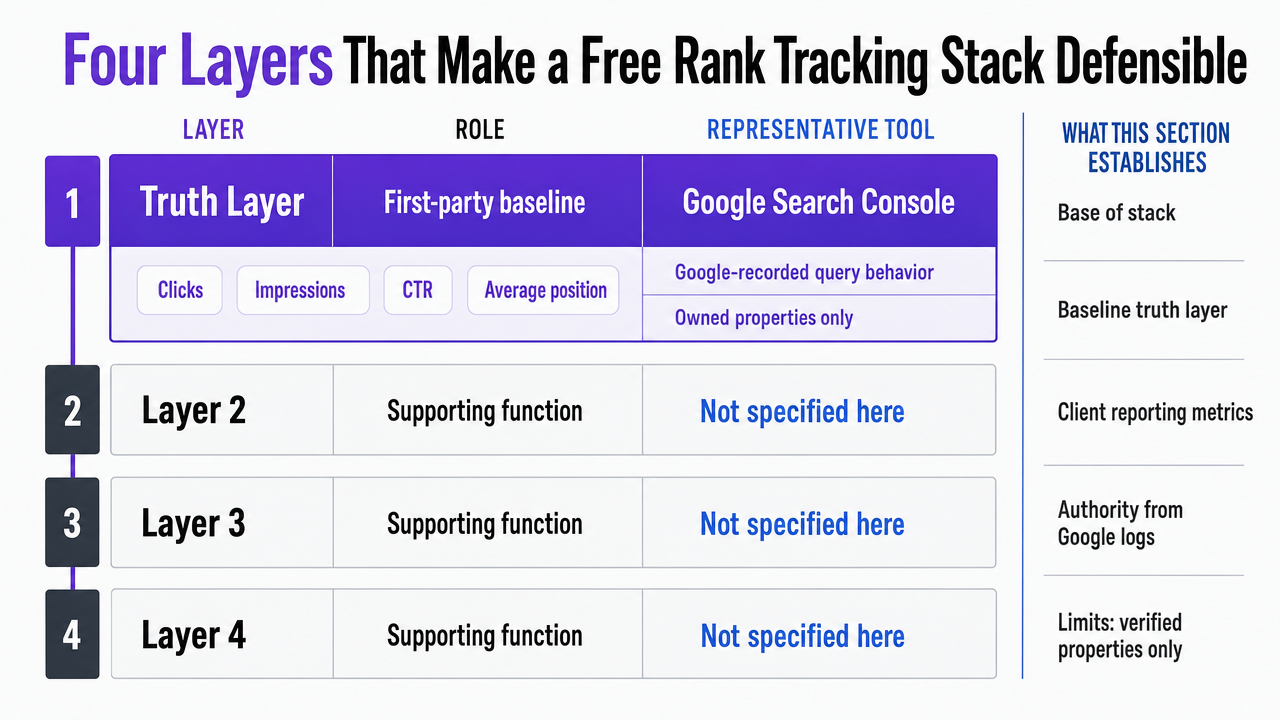
This stack comprises four key components. Google Search Console forms the foundational truth layer, providing clicks, impressions, CTR, and average position for owned properties at no cost 2. A freemium desktop tracker, such as SEO PowerSuite Rank Tracker, enables unlimited-keyword monitoring across numerous search engines without per-seat fees 6. Free credits from a SERP API offer competitive and SERP-feature intelligence for targeted analyses 7. Finally, an increasingly AI-assisted narrative layer translates raw position data into digestible client commentary 1.
By 2026, data acquisition is no longer the primary bottleneck. Free tiers have advanced to a point where agencies can build robust ranking coverage for clients without significant licensing costs. The main challenge has shifted to the analyst hours consumed by integrating disparate data exports and crafting dozens of report narratives monthly. The following sections detail each layer, identify relevant tools, highlight where free tiers become insufficient under agency demands, and quantify the analyst-hour cost of manual versus AI-assisted reporting.
Four Layers That Make a Free Rank Tracking Stack Defensible
The Truth Layer: Google Search Console as First-Party Baseline
Google Search Console is indispensable as the stack's base because it is the sole source of Google-recorded query behavior for owned properties, offered at no licensing cost 2. Industry reviews consistently identify it as the baseline truth layer for SEO diagnostics, rather than a comprehensive rank tracker 8.
Its performance report provides four crucial metrics for client reports: clicks, impressions, click-through rate, and average position 2. These metrics directly address common client inquiries about search visibility, engagement, ranking, and movement. Unlike third-party trackers, Search Console's data originates from Google's own logs, ensuring unparalleled authority 9.
However, Search Console has limitations:
- It only reports on verified properties, preventing insights into competitor rankings for shared queries 5.
- Data is privacy-filtered and delayed by approximately two to three days, which can be a drawback for agencies requiring immediate movement reports 2.
- Average position aggregates data across impressions, potentially obscuring important distinctions, such as a query ranking 3 on mobile and 11 on desktop 9.
When used as a truth layer, Search Console effectively handles owned-property reporting for an unlimited number of client sites. The subsequent layers address its inherent blind spots.
The Monitoring Layer: Unlimited-Keyword Desktop Trackers
Beyond the truth layer, agencies require continuous position monitoring for keyword sets that extend beyond what Search Console effectively provides, including low-impression terms. This is where freemium desktop trackers become essential.
SEO PowerSuite's Rank Tracker offers a free desktop version that supports unlimited keywords across over 500 search engines, including local, mobile, and desktop coverage 6. This model differs significantly from cloud SaaS trackers, which typically impose strict keyword limits on their free tiers. For instance, Seobility's free plan is capped at 10 keywords, while Ranktracker.app allows up to 500 keywords but with a multi-day data delay as it pulls from Search Console 3.
The challenge with desktop freemium tools is operational rather than financial. Free versions usually lack cloud saving or scheduled reporting, necessitating manual project file opening, checks, and exports by an analyst 6. This approach is manageable for smaller teams with a few clients but becomes a significant bottleneck for larger delivery teams managing numerous accounts on weekly cadences.
The monitoring layer's primary role is to provide broad coverage. Free desktop trackers deliver this without per-keyword or per-seat costs, provided the agency maintains a disciplined export routine and understands that advanced features like scheduling, white-label PDFs, and multi-user access are premium features 6, 8.
The Competitive Layer: SERP API Free Credits for Burst Intelligence
Search Console offers no competitive insights, and desktop trackers prioritize position over SERP composition. The competitive layer addresses both, operating on a free API credit model rather than a continuous free plan.
Most SERP APIs, as noted in Apilayer's 2026 review, provide either a free trial or an initial credit allowance, enabling agencies to retrieve live SERP data, feature breakdowns, and competitor rankings without upfront costs 7. These are typically used for real-time SERP analysis, keyword research, and market intelligence for pitches or quarterly business reviews 7.
This model is suited for burst usage, not constant monitoring. An SEO lead might use 2,000 free credits to map the SERP landscape for a new client's top 200 queries during onboarding, then revisit this six months later for an update. This pattern keeps client accounts within the free allowance. Attempting daily SERP pulls for the same 200 queries would quickly deplete credits, forcing a paid subscription 7.
Agencies should view SERP API credits as an intelligence budget, not a continuous feed. They are ideal for answering specific questions, such as why a competitor gained positions on a feature-rich SERP, with reliable data. Using these APIs as an always-on rank tracker undermines the economic model of the free tier.
The Narrative Layer: AI-Assisted Commentary on Free Rank Data
While the data layers provide spreadsheets and CSVs, a client report requires a narrative that explains changes, their causes, and future actions. This translation has historically been a significant agency cost, tied to analyst hours rather than software licenses.
The narrative layer is where AI-assisted commentary is transforming delivery economics. Tools integrated with Search Console data can now generate trend commentary on clicks, impressions, CTR, and position—metrics an analyst would otherwise manually interpret 1. One such tool packages Search Console data into a client-friendly format, generating commentary on trend lines, with a free tier covering unlimited keywords and pages across up to three properties 1.
This output serves as a first draft of the commentary, saving analysts 20 to 40 minutes per account. A senior editor still reviews, corrects inaccuracies, and refines recommendations. The shift is in how human hours are spent: from generating initial observations to validating and enhancing them.
For agencies managing many reports monthly, the narrative layer transforms a free data stack into a scalable delivery model. Data acquisition is addressed by the first three layers; automating the analyst-hour problem is the next logical step.
Free Plan vs Free Trial vs Free Credits: Reading the Fine Print
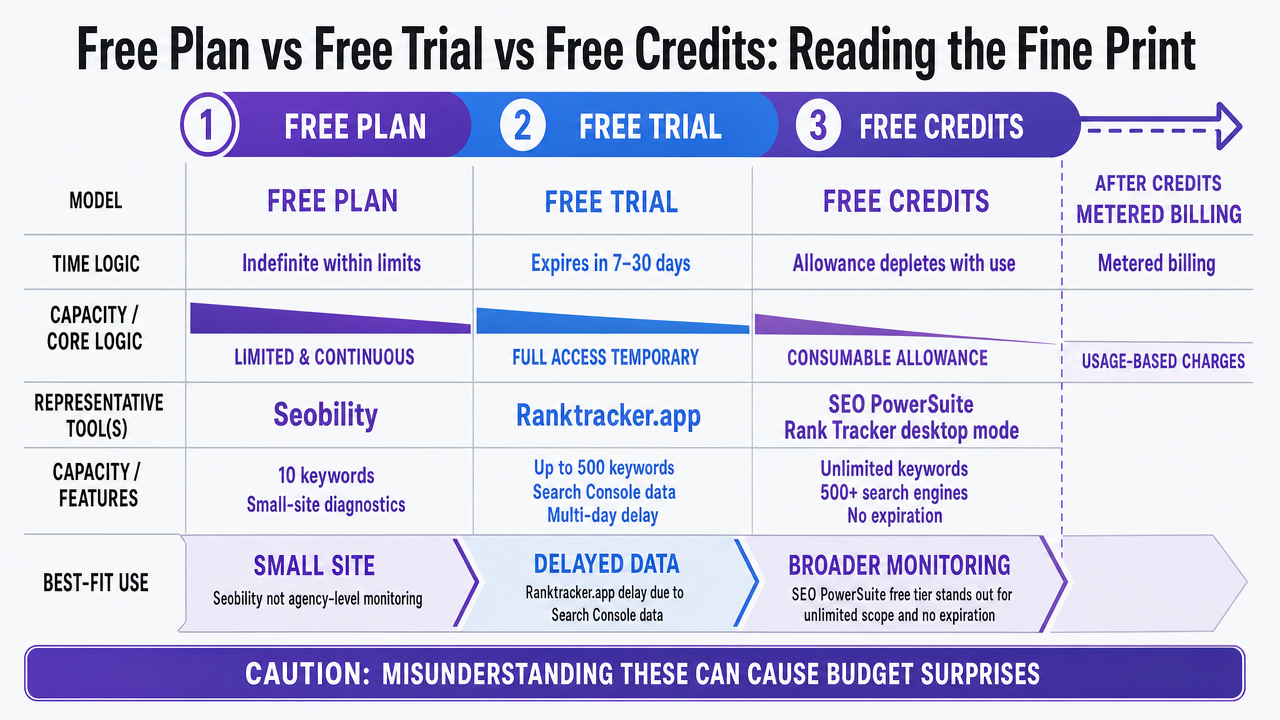
Tools marketed as free rank trackers fall into three distinct categories, and misunderstanding these can lead to unexpected budget issues:
Free plan : Operates indefinitely within its defined limits.
Free trial : Has a fixed expiration, typically 7 to 30 days.
Free API credits : An initial allowance that depletes with use, transitioning to metered billing thereafter 7.
Capacity differences highlight these distinctions:
- Seobility's free plan is limited to 10 keywords, suitable for small-site diagnostics but not agency-level monitoring 3.
- Ranktracker.app offers up to 500 free keywords but relies on Search Console data, introducing a multi-day delay 3.
- SEO PowerSuite's Rank Tracker desktop mode stands out with unlimited keywords across over 500 search engines, with no expiration on its free tier 6.
- Serpstat provides a metered free plan capped at 30 queries daily, useful for research bursts but inadequate for continuous client monitoring 1.
- SE Ranking operates on a 14-day trial, not a perpetual free plan, creating a hard deadline for its use 1.
Operationally, only a few of these are suitable for long-term reporting. Ranktracker.app and SEO PowerSuite's desktop mode can sustain ongoing loads. Others serve specific, short-term needs: Seobility for quick spot checks on small properties, Serpstat for daily research bursts, and SE Ranking for a two-week evaluation before a paid commitment.
SERP API free credits represent a separate category. Apilayer's 2026 review confirms that all listed SERP APIs offer either a free trial or credit allowance, intended for evaluation and burst intelligence, not continuous rank monitoring 7. An agency treating API credits as a permanent tracker will exhaust them quickly with any significant client portfolio.
For agency SEO leads, the rule is to classify each tool before integration. True free plans support recurring workflows. Trials facilitate evaluation, not delivery. Credits fund one-off intelligence. Misapplying these categories is the most common reason a "free" stack incurs unexpected costs.
Experience full-scale rank tracking in action now
Test real-time rank tracking workflows on live client data without limitations during your trial.
Where Each Free Tier Breaks Under Agency Load
Client Count and Keyword Volume Breakpoints
Free tiers are robust for diagnostic use but falter under production demands. Each tool has a unique breaking point, which dictates whether a stack can endure its second quarter with an active client roster.
Search Console has no keyword or property limits; an agency can verify hundreds of client sites and access performance data at no cost 2, 10. Its limitation lies in scope: it only reports on verified properties, excluding competitive queries and unowned domain intelligence 5. Thus, client count isn't the constraint, but scope is.
Seobility's 10-keyword cap is an immediate barrier for any serious client 3. A typical mid-market service business monitors 80 to 300 target queries, rendering Seobility ineffective as a monitoring tool and suitable only for small-property spot checks. Ranktracker.app extends this to 500 keywords per free account, which might cover one or two clients before reaching saturation 3. SEO PowerSuite's Rank Tracker desktop mode offers the highest volume, with unlimited keywords across over 500 search engines in its free tier, effectively removing keyword count as a bottleneck 6.
However, volume re-emerges as an analyst constraint. Tracking thousands of keywords for multiple clients in a desktop tool incurs no licensing fees but demands significant analyst time for manual data export and integration into client deliverables 6.
Reporting Cadence and Data Freshness Ceilings
Reporting cadence is where free tiers introduce client-facing risks that budget concerns often mask. Search Console data has a two to three-day lag and is privacy-filtered 2. This means a Monday report reflects data only up to the previous Friday. While this lag is negligible for monthly reviews, it necessitates caveats for weekly reports on time-sensitive campaigns.
Ranktracker.app inherits this delay because it sources data from Search Console, extending the freshness gap regardless of report generation time 3. Agencies requiring daily or intraday movement notifications cannot rely on Search Console-derived data sources.
SEO PowerSuite's desktop tracker updates on demand in its free mode, making data freshness dependent on when an analyst runs the check 6. Cloud scheduling, automated re-checks, and alert triggers are all paid features. Serpstat's 30-queries-per-day free limit prevents broad daily refreshes, pushing the tool towards research bursts rather than continuous monitoring 1.
Operationally, free stacks comfortably support monthly reporting for any client volume. Weekly reporting is feasible if the delivery team accepts a lagged data window. However, daily or intraday cadences will likely require upgrading at least one layer to a paid tier.
Composing the Minimum Viable Reporting Backbone
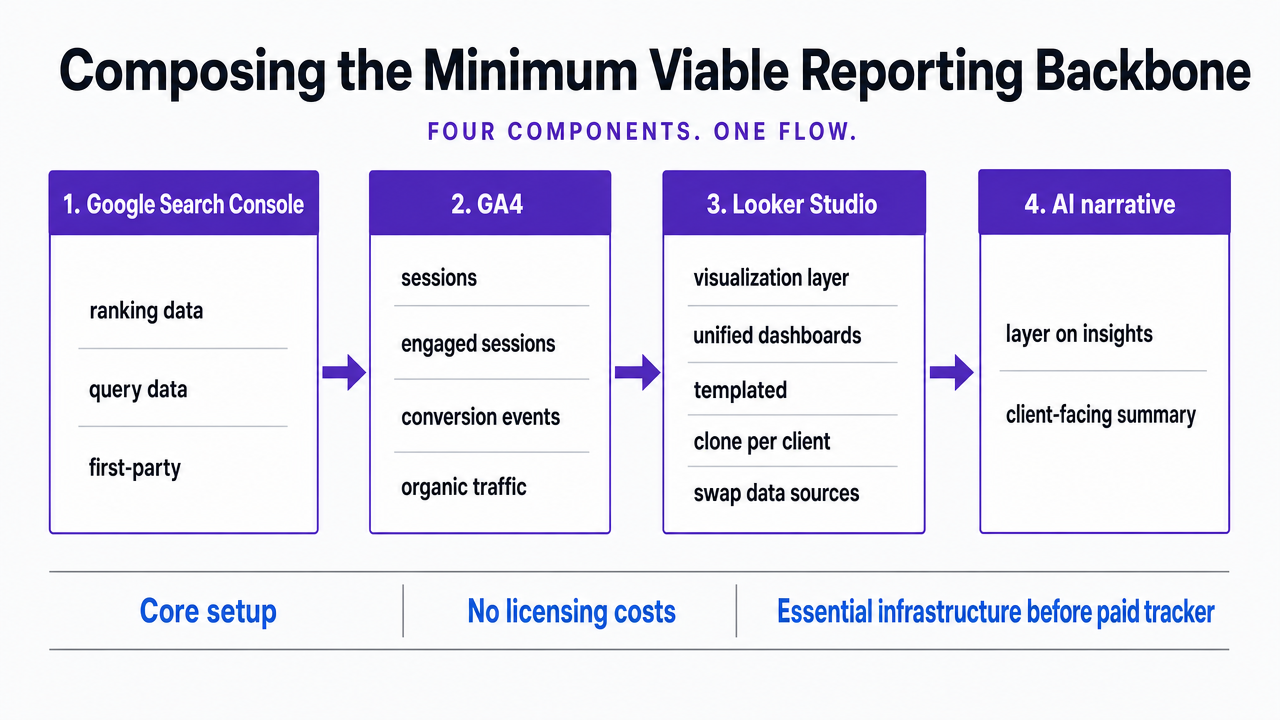
Enterprise SEO reporting guidelines typically recommend a core setup: Google Search Console for first-party ranking and query data, GA4 for traffic and conversion signals, and Looker Studio as the visualization layer to unify them into client-facing dashboards 11. This trio incurs no licensing costs and provides the essential reporting infrastructure before any paid tracker is considered.
Search Console supplies position and query data. GA4 tracks post-click behavior, including sessions, engaged sessions, and conversion events from organic traffic. Looker Studio integrates both into templated dashboards that analysts can clone for each client, eliminating the need to rebuild reports monthly. Once a template is established, adding a new account simply involves swapping data source connections.
An AI narrative component can then be layered on top, converting dashboard trend lines into the commentary clients prioritize 1. This fourth layer, not explicitly named in older enterprise KPI guidance, has emerged as a mature category 11. It transforms free rank data from a spreadsheet exercise into a scalable delivery product.
Two operational principles ensure this backbone remains stable:
- Standardize the Looker Studio template before onboarding multiple clients to prevent template inconsistencies that undermine efficiency.
- Treat Search Console property verification as a mandatory onboarding step, as gaps in GSC data will propagate to GA4 and Looker Studio 2, 11.
The integrity of all layers above depends on thorough verification at the base.
Streamline Multi-Client Rank Reporting With Enterprise-Grade Accuracy
Connect with our team to see how automated, scalable rank tracking and reporting can support agency-wide SEO delivery—without increasing headcount or sacrificing data integrity.
Delivery Economics: What Free Tools Cost in Analyst Hours
While a zero license cost is easily justifiable, the true expense of a free stack lies in analyst hours. A monthly client report, even when built on Search Console, a desktop tracker, and a Looker Studio template, still requires manual data pulling, position reconciliation, movement charting, and narrative writing. This labor determines whether a free stack scales or silently erodes profit margins.
Examining delivery hours across three operational models clarifies this trade-off. All models use the same free data sources; the distinction lies in how the narrative is produced.
| Model | Data acquisition | Narrative production | Hours per report |
|---|---|---|---|
| Manual free stack | Analyst exports from GSC and desktop tracker | Analyst writes commentary from scratch | D + Nmanual |
| Free stack with AI commentary | Same exports, or GSC-connected AI layer 1 | AI drafts, senior editor reviews and sharpens | D + Nreview |
| Paid enterprise platform | Automated ingestion and dashboarding | Analyst writes or edits commentary | Dautomated + Nmanual |
Key variables include:
D : Data-handling hours.
Nmanual : From-scratch writing hours, typically 20 to 40 minutes per account in agency settings.
Nreview : Editing an AI draft, significantly shorter than writing from scratch.
Blended analyst rate : Multiplying these by the number of reports per month reveals the actual delivery cost of a seemingly free stack.
The economic advantage emerges from compression. A manual free stack shifts costs to Nmanual. A paid enterprise platform reduces D but leaves Nmanual unchanged. Only the AI-commentary approach targets the largest single cost item, as tools that integrate Search Console data and generate trend commentary directly convert writing into a review task 1. For an agency producing 40 reports monthly, saving 15 minutes per narrative can reclaim approximately ten analyst hours, removing junior utilization as a client capacity ceiling.
If the Agency Manages a Portfolio of 50+ Client Accounts
With 50 or more active client accounts, the free stack's limitation isn't data, but orchestration. Search Console verification, Looker Studio template maintenance, desktop tracker exports, and narrative writing all scale linearly with account volume. A delivery team efficient with 20 clients will encounter coordination issues between 40 and 60 accounts, even without changing tools 11.
Two operational adjustments become critical at portfolio scale:
- Search Console property management must be treated as a governance function, not an analyst task. Verification gaps, permission changes due to client staff turnover, and inconsistent property definitions (domain vs. URL prefix) accumulate across many accounts, compromising the foundation of all dashboards.
- The AI-commentary layer must be adopted as a production dependency, not an experiment. Search Console-connected commentary tools that draft trend paragraphs for unlimited keywords transform the largest variable cost in the delivery model into a fixed review step 1.
The Vectoron-category workflow integrates above the four data layers, routing draft commentary and recommendations through senior review before client delivery. For agencies managing 50+ accounts, this approval-gated layer prevents free rank data from necessitating an expanded hiring plan.
Frequently Asked Questions
References
- 1.AI Free Rank Tracking Software for Improved Agency Reporting.
- 2.Search Console Help – Performance Report.
- 3.Best SERP Tracking for 2026 – My 10 + 1 Favorite Rank Trackers.
- 4.The 12 Best SERP Tracking Tools in 2025.
- 5.Google Search Console: The Ultimate Guide.
- 6.Best Free Rank Tracking Tools (2025) – Monitor Your SEO Keyword Rankings.
- 7.7 Best SERP APIs in 2026 Ranked Best for SEO and Market Research.
- 8.15 Best Rank Tracking Software We're Using for 2026.
- 9.10 Top Rank Tracker Tools (for Serious SEOs) in 2026.
- 10.13 Best Rank Tracking Tools For 2026: Monitor Keyword ....
- 11.Enterprise SEO KPIs: What to Measure and Report | Lawrence Hitches.