
Key Takeaways
- Google Search Console anchors any agency stack as the definitive ranking record, offering query-level data no third-party crawler fully replicates 3, though it lacks portfolio segmentation and competitor tracking.
- Ahrefs earns its seat when position questions extend into why rankings move, pairing backlink depth with competitive keyword overlap for verticals where authority signals drive ranking volatility.
- Semrush suits portfolio managers who need weekly ranking reviews across a dozen clients quickly, thanks to campaign-per-project structure, tag grouping, and templated client reports.
- Screaming Frog serves as the diagnostic layer beneath rank data, letting technical leads isolate indexation, canonical, or internal linking causes behind a client's position drop in one session 9.
- Clearscope justifies its cost as a conversion-aware editing layer, closing the gap between ranking lift and revenue lift that on-page work alone rarely bridges 8.
- BrightLocal covers grid-based local pack and Maps rankings for multi-location clients, exposing coverage gaps that national-focused platforms like Semrush and Ahrefs average away.
- Conductor fits enterprise engagements where executive-ready dashboards, funnel-attributed organic revenue, and role-based views reduce the strategist hours spent translating SEO metrics for CMOs 11.
- seoClarity supports high-volume content operations with unlimited keyword tracking and AI-assisted research, but only pays back when strategists genuinely adopt its workflow instead of exporting to slides 11.
- Profound and peer AI-visibility tools track citation share across generative engines, filling a reporting gap in verticals where a brand supplies only 5–10% of AI answer sources 6.
- Vectoron sits downstream of rank data as an approval-first execution layer, compressing the time between identifying a ranking opportunity and shipping the completed client work 2.
Why the Ranking Tool Category Split in 2025
The focus for agency SEO leads evaluating rank-tracking tools has shifted. It's no longer just about accurate position reporting, but about how quickly ranking movements can be translated into approved and executed client work. This change reflects a deeper understanding of where real returns are generated.
Research indicates that sophisticated analytics tools significantly impact customer conversion rates, explaining 61.2% of the variance, and are linked to lower acquisition costs (β = -0.412, p<0.001) 2. This improvement stems from integrated reporting and richer analysis that convert data signals into actionable decisions, rather than simply providing daily position updates. Therefore, comparing rank checkers based solely on feature counts overlooks the key factor driving outcomes.
This shift has led to a split in the category. One side includes traditional trackers and enterprise SEO platforms that focus on ROI reporting and large-scale keyword tracking 11. The other side consists of execution-oriented platforms that recognize the value of position data only when it leads to production. The ten tools discussed below are categorized by their role in an agency's delivery workflow, not by feature parity.
How to Read This Shortlist: Three Agency ROI Axes
While feature lists might highlight vendors with the most offerings, agency profitability is driven by different metrics. The ten tools below are evaluated based on three key axes that directly influence how an Head of SEO justifies purchases, protects margins, and maintains client retention.
The first axis is cost per tracked client. This considers the actual expense of the tool after factoring in seats, project limits, and keyword caps across all active client accounts. A platform costing $2,000/month will have a very different cost per client if it serves forty clients versus eight.
The second axis is hours saved per reporting cycle. Position data must be transformed into a client-facing narrative each month. Tools that offer clean exports, client segmentation, and pre-formatted query-level insights significantly reduce this cycle. Conversely, tools requiring strategists to manually rebuild reports increase time expenditure.
The third axis is time-to-executed-change—the duration between identifying a ranking opportunity and implementing the necessary work. This is where advanced analytics prove their worth, by translating data signals into approved production rather than just another dashboard update 2. Each tool in this list is assessed against these three axes, rather than its individual feature set.
The 10 Google Search Ranking Tools, Sorted by Job
Google Search Console: The Source-of-Truth Ranking Layer
Unlike other tools that estimate, Google Search Console (GSC) provides direct reports. This fundamental difference positions it as the foundational element of any SEO stack.
GSC delivers daily ranking updates and query-level data for every keyword a client's site receives an impression for, a level of detail no third-party crawler can fully replicate 3. For an agency Head of SEO, GSC serves as the definitive source against which all other rank data is reconciled. It provides impressions, average position, and CTR by query and page, all exportable per property, directly feeding into monthly client reports without additional licensing costs.
However, GSC has limitations: it doesn't segment by client portfolio, track competitors, or retain historical data beyond 16 months. This is why it acts as an anchor rather than a complete solution. Agencies that build their reporting around GSC as the official record, supplementing it with a paid platform for competitive context and cross-client aggregation, achieve more accurate client reports and fewer disputes over data discrepancies.
Ahrefs: Competitive Intelligence and Backlink Context
Ahrefs becomes indispensable when the inquiry moves beyond "where does the client rank" to "why, and what is required to improve." Its extensive index of referring domains and organic keyword overlap transforms a simple position report into a comprehensive competitive analysis. It reveals which pages are attracting links, which competitors are gaining ground on specific term clusters, and identifies keyword gaps that align with the content team's capabilities.
For agencies serving highly competitive verticals like legal, dental/DSO, or senior living, backlink context is crucial because ranking movement is heavily influenced by authority signals. A weekly dip in position for a high-value term is easier to explain and counteract when the tool simultaneously shows a competitor's newly acquired referring domains.
The cost per tracked client can escalate rapidly as project limits and keyword caps are exceeded. Agencies managing more than a dozen active SEO retainers should carefully compare the economics of Ahrefs against Semrush, as these two platforms often overlap in functionality.
Semrush: Multi-Client Position Tracking at Scale
Semrush offers similar data breadth to Ahrefs but integrates differently into an agency workflow. Its Position Tracking tool is structured around campaigns per project, aligning well with a one-client-per-project model. Its reporting module provides templates that reduce the hours strategists typically spend rebuilding presentations.
For Heads of SEO managing a portfolio, the critical factor isn't which platform has more keywords, but which allows a strategist to conduct weekly ranking reviews for a dozen clients in under an hour. Semrush's client-facing report builder, tag-based keyword grouping, and share-of-voice tracking against defined competitors address this need for many mid-market agencies.
The trade-off is in backlink analysis, where Ahrefs generally offers more depth. An effective stack might use Semrush as the primary tool for position tracking and reporting, reserving a lighter Ahrefs seat for specialized link intelligence and content gap analysis, rather than duplicating full licenses for both.
Screaming Frog: Technical Audit Behind the Rank Signal
Ranking fluctuations without a solid technical foundation are speculative. Screaming Frog remains the go-to crawler for most agency SEO teams when a client's position drop requires immediate root cause analysis.
It functions not as a rank tracker, but as the diagnostic tool underpinning the tracker. Structured methodology is vital here, as SEO tools optimize sites only when applied against consistent criteria 9. Screaming Frog's crawl configurations, JavaScript rendering, and integrations with GSC and Analytics APIs enable a technical lead to diagnose a ranking anomaly—whether it's an indexation, canonical, or internal linking issue—in a single session.
The cost per seat is minimal compared to the potential financial impact of a single misconfigured hreflang or noindex directive on a critical client page. Agencies lacking a technical-audit layer in their stack often mistakenly attribute ranking losses to content rather than unaddressed crawl issues.
Clearscope: Content Optimization Where Rank Meets Conversion
Clearscope operates at the intersection where a ranking gain either converts or fails to. It evaluates content drafts against the terms and topical coverage of top-ranking pages, providing writers and editors with concrete targets instead of vague instructions.
This is important because ranking lift and revenue lift are distinct. An empirical study on SME metadata optimization showed that structured on-page work led to a 28% increase in organic traffic over three months, but the conversion rate only moved from 1.78% to 2.15% 8. For agencies compensated on client outcomes, this gap is crucial.
Clearscope justifies its cost when used as a conversion-aware editing layer, not merely a keyword density checker. Agencies that combine its content grading with GSC query data and post-click UX reviews capture more value from their traffic. Those that stop at the content grade often achieve ranking wins that look good in reports but yield minimal pipeline growth.
BrightLocal: Local Pack and Map Rank for Multi-Location Clients
For agencies managing multi-location service clients—such as home services franchises, DSO groups, or senior living portfolios—the most critical ranking surface isn't the traditional ten blue links. It's the local pack and Google Maps grid within each location's service area.
BrightLocal specializes in this specific area. Its grid-based rank tracking displays positions by exact coordinates around a location, revealing coverage gaps that standard rank trackers might average out. A dental group with twelve offices doesn't have one ranking for "emergency dentist"; it has twelve, each influenced by proximity, category, and review velocity.
Citation management and review monitoring are integrated into the same platform, streamlining local operational tasks. For agencies whose retainer economics depend on local visibility rather than national head-term rankings, BrightLocal addresses blind spots that platforms like Semrush and Ahrefs were not designed to cover.
Conductor: Enterprise Reporting for Executive Stakeholders
Conductor shifts the tool selection criteria from strategist utility to executive defensibility. Enterprise SEO platforms in this category are designed for ROI reporting, large-scale keyword tracking, and coordinating SEO efforts across an organization 11.
For agencies serving enterprise clients or in-house teams reporting to a CMO, Conductor's value lies less in unique data and more in how it packages that data. Features like segment-level share of voice, funnel-attributed organic revenue, and role-based dashboards allow client executives to understand the SEO program without requiring a strategist to translate metrics monthly.
The cost per tracked client is high, making Conductor generally unsuitable for mid-market portfolios. It becomes justifiable when a single client's contract value supports the seat, and when that client's stakeholders would otherwise consume significant strategist hours requesting customized reports. In terms of reporting hours saved, this shift alone often covers the license cost.
seoClarity: Enterprise Keyword Coverage and Cross-Team Workflow
seoClarity is an enterprise-tier platform similar to Conductor, but it places a stronger emphasis on extensive keyword coverage and workflow tools for cross-team execution. Its promise on the enterprise review aligns with reporting ROI, tracking keywords, and facilitating organizational SEO efforts 11.
Where it differentiates in practice is its offering of unlimited keyword tracking on many plans and an AI-assisted content and research layer, designed for teams producing high volumes of content. For agencies managing large content operations across multiple enterprise accounts, the ability to track long-tail term families without keyword caps represents a significant time-saving advantage.
The key evaluation factor for seoClarity is workflow adoption, not just a feature checklist. Enterprise platforms only deliver their value when strategists actively use them. Agencies that license seoClarity merely as a data source and continue to build reports in separate presentation software often perceive the license as an unnecessary overhead.
Profound (or Peer AI-Visibility Tools): Tracking Citations in AI Answers
The ranking landscape has expanded significantly. AI Overviews, ChatGPT, Perplexity, and Copilot now answer queries by citing a curated set of sources, with a brand's own domain typically contributing only 5% to 10% of the sources an AI answer draws upon 6. This means traditional rank tracking, while accurate for the ten blue links, measures a diminishing portion of the query response surface for information-intent terms.
Profound and similar AI-visibility tools—which monitor brand mentions, citation share, and prompt coverage across generative engines—address this emerging gap. They report which prompts surface the client, which competitors are cited more frequently, and which third-party sources the AI references for target queries.
For agency Heads of SEO, the operational implication is not to replace the rank tracker with an AI-visibility tool, but to integrate citation share into the reporting stack for verticals where AI Overviews are already prevalent for high-value terms. Legal, healthcare, and behavioral health queries already exhibit high AI-answer coverage. Reporting solely on organic position in these categories would misrepresent the true visibility landscape.
Vectoron: Execution Layer Downstream of the Rank Data
While the preceding nine tools focus on measurement, Vectoron specializes in execution. It operates downstream of rank data, taking signals from GSC, Ahrefs, Semrush, and enterprise platforms to reduce the time between identifying an opportunity and delivering the completed work.
Vectoron's specialist strategists—covering content, SEO, PPC, backlinks, social, and call intelligence—analyze live business data and generate ranked recommendations through a Command Center. Every decision requires human approval before execution 6. For agency Heads of SEO, the critical metric here is time-to-executed-change, the third ROI axis previously introduced. A rank tracker identifying a Position 6 opportunity on a high-intent term yields no client benefit until a brief is written, a draft is produced, an editor approves, and the page is published.
Execution platforms in this category are how advanced analytics translate into conversion performance, rather than just another dashboard 2. Vectoron is included as one of the ten tools, positioned by its role in the stack: not as a replacement for the ranking source of truth, but as the approval-first production layer that consumes its output.
Test Real-Time Search Ranking Impact Instantly
Measure ranking improvements using live campaigns and published content during your trial—no simulations, actual results.
Balanced Stacks Beat Single-Focus Ones: What the Evidence Says
While consolidating on a single platform might seem appealing, it rarely yields optimal organic results. A study on data-driven SEO programs found that combining on-page and off-page strategies resulted in 71.8% organic traffic growth, significantly outperforming single-focus approaches which achieved 58.3% and 47.6% 2. This demonstrates a substantial difference in traffic growth—approximately 14 to 24 percentage points—lost by not adopting a balanced approach.
Applying this to tool selection, the evidence argues against a stack overly reliant on one category. A rank tracker without a technical crawler can lead to content decisions that overlook indexation issues. A content optimizer without competitive backlink context may produce briefs that struggle to outrank authoritative pages. An enterprise platform that doesn't reconcile with Google Search Console as the source of truth risks client challenges to its reports 3.
A systematic review of SEO techniques supports this, concluding that technical SEO, local SEO, and content optimization are most effective when combined, rather than isolated 10. A ranking tool stack that covers these three areas, plus an execution layer, is what the evidence supports. Single-vendor consolidation is a procurement choice, not a performance-driven one.
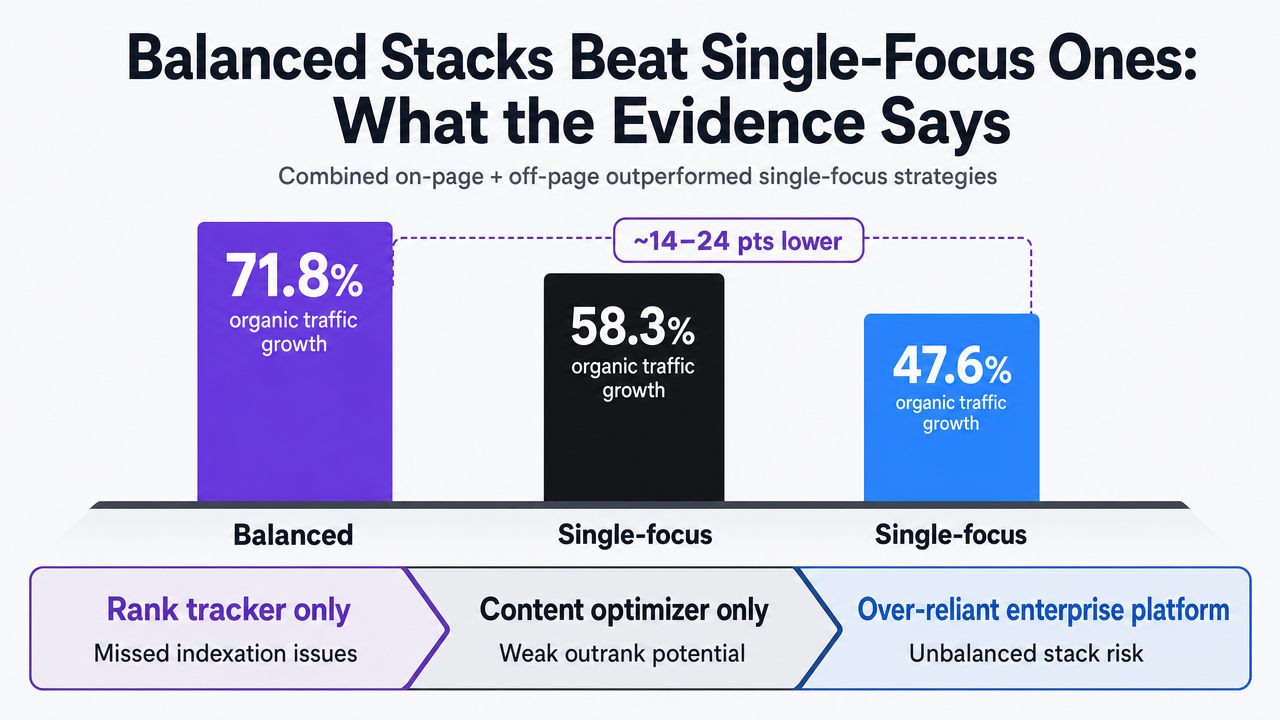 Visualize the comparative organic traffic growth across balanced versus single-focus SEO strategies cited in this section, reinforcing the argument for a diversified tool stack
If You Manage a Multi-Client Portfolio: Consolidation Economics
This section is specifically for Heads of SEO managing eight or more concurrent retainers, where cost per tracked client and hours per reporting cycle significantly impact the P&L. Single-account leads may skip this part.
In a portfolio setting, the natural inclination is to accumulate tools: a rank tracker, a backlink tool, a content optimizer, a reporting layer, and another for specific client requests. This leads to escalating seat counts, exceeded keyword caps, and strategists spending valuable time reconciling data across platforms instead of delivering work. While the evidence for SEO ROI is strong—an effect size of d = 1.049 on organic ranking and traffic across recent studies 5—this lift only materializes when the tool stack actively supports production.
The table below models two different tool stacks for the same portfolio, using variables for agency-controlled factors (H = hours per client per month, R = blended loaded rate). It does not include specific vendor pricing.
| Cost Component | Traditional Stack | Consolidated Stack |
|---|---|---|
| Per-client seat/license allocation | Enterprise SEO platform + content tool + separate reporting tool | GSC (free) + one enterprise platform + execution layer |
| Rank reporting hours per client | H_report (rebuild in slides) | ~0.4 × H_report (templated + exported) |
| Content brief hours per client | H_brief | ~0.5 × H_brief (execution layer drafts, human approves) |
| Reconciliation hours per client | H_recon (cross-tool number matching) | ~0 |
| Total loaded cost per client | Licenses + R × (H_report + H_brief + H_recon) | Licenses + R × (0.4·H_report + 0.5·H_brief) |
The argument for consolidation isn't about fewer logos on an invoice, but about reducing strategist hours spent reconciling data that GSC already provides as the authoritative record 3. This frees up more time for approved work that directly improves client rankings.
See How Leading Agencies Automate Google Ranking Insights at Scale
Request a walkthrough of unified SERP tracking, multi-client reporting, and approval-first workflows tailored for agencies managing complex SEO portfolios.
Positioning Ranking Tools Inside a Broader Search Budget
Ranking tools are not isolated; they operate within a larger search budget that also funds paid campaigns. The allocation between these two channels is a frequent debate in agencies. A comparative study of SEO and SEM concluded that both are crucial for online visibility, but their effectiveness varies based on business objectives, industry context, and target audience 7. This variance should guide tool allocation, not vendor bundling.
For accounts where organic search already captures high-intent demand—such as established legal, dental, or senior living clients with strong domain authority—the marginal dollar often yields greater returns within the ranking stack than in paid search bids. Conversely, for new accounts starting from scratch, a ranking tool cannot generate the immediate demand that a paid campaign can provide while the organic program develops. Heads of SEO who budget for tools independently of SEM often overspend on trackers for accounts needing paid velocity, and underspend on execution capacity for accounts where organic is already the dominant channel.
The practical approach is to allocate ranking-tool spend to accounts where organic is the primary revenue driver, and to maintain a joint search budget conversation with the paid lead, rather than making decisions in isolation.
A Decision Path for Head-of-SEO Buyers
Tool selection becomes more efficient when approached from the perspective of the delivery workflow, rather than vendor demonstrations. Here are four decisions, in order:
- Identify the definitive source of truth. Google Search Console serves as the authoritative record because Google tracks every keyword a client's site receives an impression for 3. All other rank data should be reconciled against it.
- Choose one paid platform for competitive context and cross-client aggregation—either Ahrefs, Semrush, or an enterprise-tier solution if a single client's contract value justifies the expense 11. Running two such platforms at full seat count is often an unsustainable duplication for most agency P&Ls.
- Deliberately cover the diagnostic and content layers. A technical crawler and a conversion-aware content grader are essential because organic outcomes are significantly improved when technical, content, and off-page efforts are integrated 5, 10. Local and AI-visibility tools should be added only when specific client verticals require them, not as a default.
- Determine where execution will reside. If strategist hours are the primary bottleneck between identifying a ranking signal and shipping the work, an execution layer is indispensable. This is the point where analytical sophistication translates into tangible client outcomes, rather than merely another report.
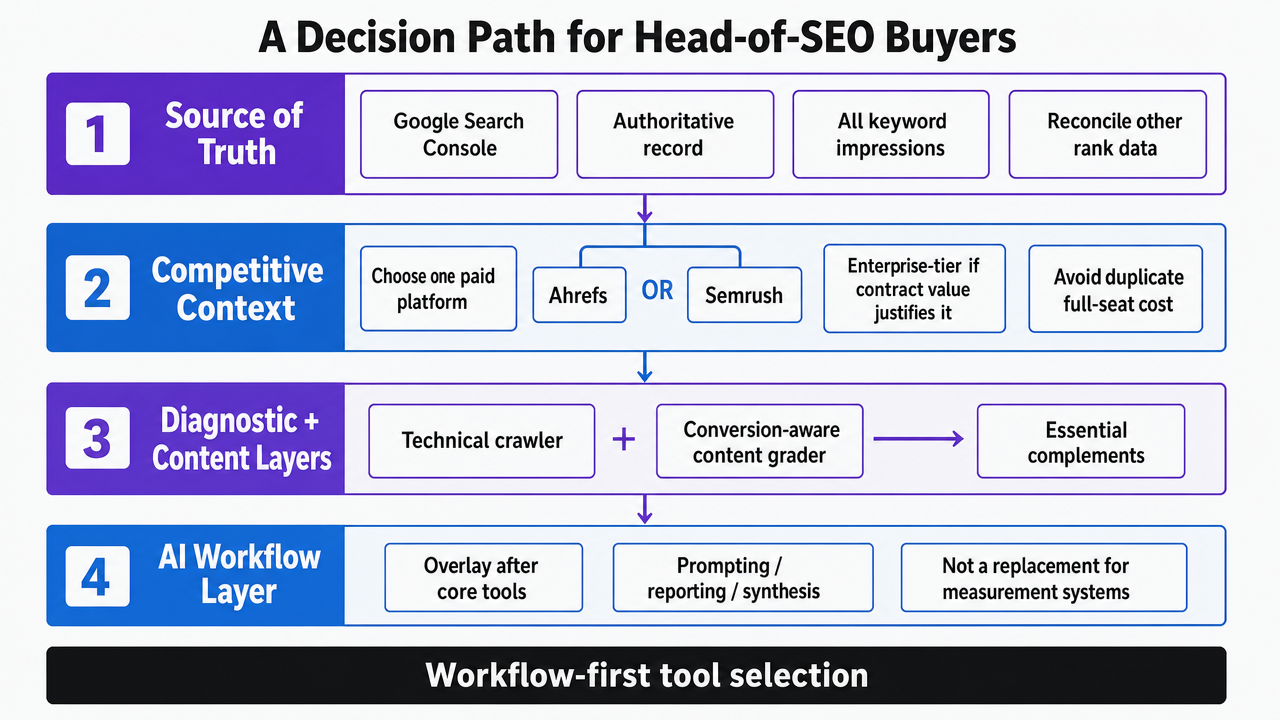 Visualize the four-step sequential decision framework outlined in this section for selecting an agency SEO tool stack
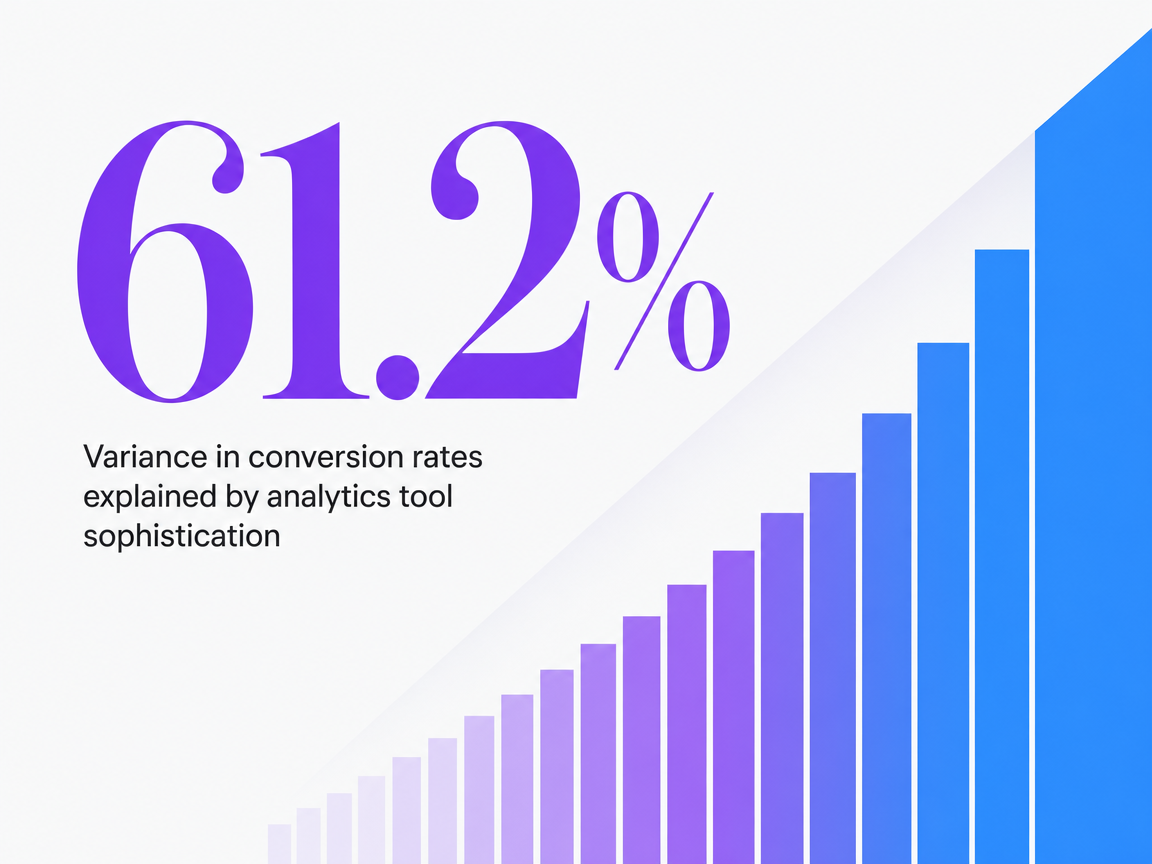 Variance in conversion rates explained by analytics tool sophistication
Variance in conversion rates explained by analytics tool sophistication
Frequently Asked Questions
References
- 1.Search Engine Optimization, Competitive Advantage and Market Performance of Tours and Travel Agencies in Kenya.
- 2.Data-Driven SEO Techniques for Strengthening Digital Customer Acquisition Performance.
- 3.A Guide to Google Search Console Reporting for SEO Agencies.
- 4.Evaluating the Effects of Search Engine Optimization on Digital Marketing Performance.
- 5.The Effectiveness Of Search Engine Optimization (SEO) In Digital Marketing: A Meta-Analysis.
- 6.Compare AI Search Optimization Tools for Agency ROI Success.
- 7.A Comparative Study on Search Engine Optimization and Search Engine Marketing.
- 8.THE ROLE OF SEO IN STRENGTHENING DIGITAL MARKETING STRATEGY TO BOOST SMES COMPETITIVENESS IN THE ORGANIC MARKET.
- 9.Implementación de un proceso de análisis de los criterios de posicionamiento web.
- 10.A Systematic Review of Search Engine Optimization Techniques for Business Sustainability.
- 11.The Top 4 Enterprise SEO Platform Tools: An In-Depth Review.