
Key Takeaways
- AccuRanker anchors fidelity-first shortlists with ±1.1 position variance against GSC, minimizing reconciliation cycles when stakeholders dispute a specific keyword position 1.
- SE Ranking pairs tracker-grade accuracy with sub-account structures and white-label dashboards, making it practical for Heads of SEO managing 25 or more accounts on weekly cadences.
- Semrush trades raw rank precision for portfolio breadth, covering competitor share-of-voice, backlinks, audits, and multi-location tracking inside one account structure 7.
- Ahrefs sits mid-fidelity at ±1.8 positions and earns its slot by embedding rank data alongside backlink intelligence and content gap analysis for reconciliation 1.
- Nightwatch resolves what GSC's blended geographies obscure, reporting ZIP-level positions across devices for law, dental, home services, and senior living portfolios 9.
- Google Search Console remains the authoritative reconciliation layer, with 80% of keywords within one position of manual checks and direct access to impression logs 11.
- Vectoron functions as an AI orchestration layer above trackers, GSC, and volatility sensors, collapsing manual reconciliation labor across 15 to 75 account portfolios 14.
Why rank position became a reconciliation problem
A single rank number became indefensible due to personalization, SERP feature proliferation, and Google's shift to impression-weighted reporting. What a client sees on their phone in Denver at 9 a.m. differs from a tracker's clean desktop query from a datacenter, and neither matches the average position shown in Search Console for the same keyword over 28 days. This creates confusion for stakeholders.
The discrepancy isn't a flaw in the tools. A dedicated rank tracker captures a Google results page for one keyword, location, device, and time. Google Search Console, however, averages every impression a URL received across all query variants, geographies, and devices that triggered it 3. John Mueller confirmed that GSC's numbers reflect
"actual search results that were shown to users"
rather than a theoretical snapshot 13. Both are accurate but incomplete.
For agency Heads of SEO managing numerous accounts, this presents a recurring reporting challenge. Client reports must withstand scrutiny from stakeholders who Google their own brand terms and expect the tracker to align. Agencies producing accurate reports at scale no longer choose between GSC and third-party trackers. Instead, they approach rank reporting as a reconciliation workflow: establishing an authoritative baseline, an operational signal layer, and a volatility overlay to explain movement between snapshots 5. The tools shortlisted for 2026 are those that streamline this workflow across a portfolio.
The accuracy baseline: what GSC actually measures
Google Search Console is the only ranking data source with direct access to Google's impression logs, consistently placing it at the top for accuracy regarding a site's own queries 6, 8. A study comparing GSC-reported positions against manual checks found 80% of keywords were within one ranking position of the GSC number, acknowledging that the data "will never be perfect" 11. This represents the closest industry standard to a first-party ground truth.
Crucially, GSC's average position is not a live rank. It is an impression-weighted mean across every query variant, device, and geography that generated an impression during the reporting window 4. John Mueller explicitly stated that this number reflects
"actual search results that were shown to users"
13. Two identical clients with similar rankings might show different GSC averages if one receives more impressions from a market where results typically rank lower.
A three-layer accuracy hierarchy clarifies tool positioning: rank checkers are Approximate, dedicated rank trackers are Approximate, and Search Console is Authoritative for average position 5. Authoritative means the underlying impressions are real and the aggregation is transparent, not that it's a live feed.
For a Head of SEO, this means GSC grounds the client narrative in actual searcher experience, while trackers address the specific question of a keyword's position on a clean SERP at a fixed moment. Treating these two numbers as competing truths leads to the very stakeholder confusion that the reconciliation workflow aims to prevent 3.
How close top trackers get to a clean SERP
Head-to-head testing against manual SERP checks provides Heads of SEO with crucial data for client meetings: how much variance to expect when a stakeholder checks their phone and finds a different result. Comparative benchmarking in 2026 shows AccuRanker with ±1.1 positions of variance against GSC, Ahrefs at ±1.8, and SE Ranking at ±2.1 1. This spread is central to any tool shortlist. A one-position difference is generally defensible, but a two-position gap becomes significant when a keyword is near the fold between page one and page two.
Independent evaluations support the top performers. In a twelve-tool comparison where accuracy accounted for 30% of the total score, AccuRanker and SE Ranking both demonstrated less than one-position variance against manual SERP checks for over 95% of tested queries 9. Consistent results from two independent tests indicate that the fidelity ceiling for a dedicated tracker in 2026 is within a single SERP position of a clean manual check.
The implication isn't that ±1.1 is "right" and ±2.1 is "wrong." Both are classified as approximate compared to GSC's authoritative baseline 5. However, tighter variance reduces the reconciliation effort required when a client questions a specific keyword. For portfolios where reconciliation labor is a constraint, tracker fidelity is a cost factor, not merely a performance metric.
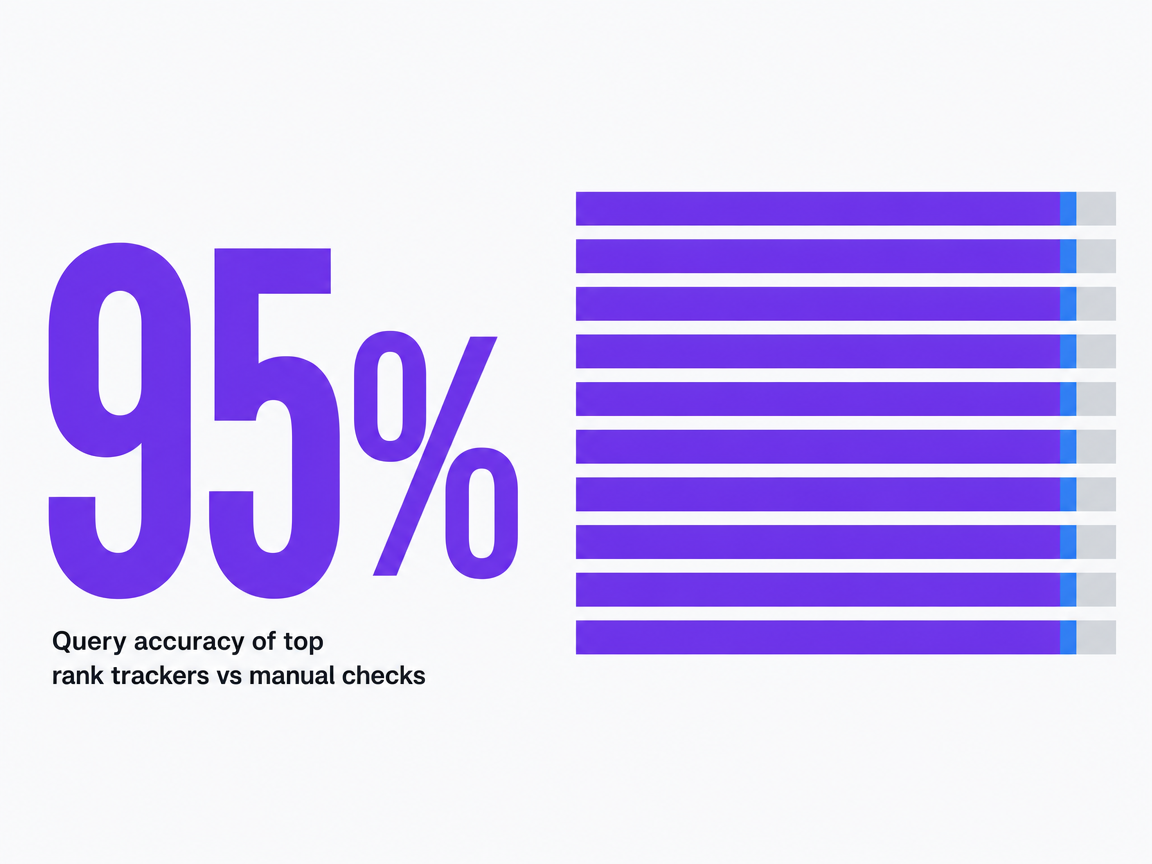 Query accuracy of top rank trackers vs manual checks
Query accuracy of top rank trackers vs manual checks
Test Real-Time Ranking Reports on Live Campaigns
Validate rank tracking accuracy using your own client data before making a commitment.
Agency evaluation criteria beyond raw accuracy
While tracker fidelity establishes a baseline, portfolio economics ultimately determine the best choice. A Head of SEO evaluating tools for 15 to 75 accounts must consider five operational factors beyond raw ±position variance.
- Multi-account workflow. Agency-focused reviews consistently prioritize tools based on their ability to manage multiple clients, track competitors, and report trends at a portfolio scale 7. A tracker requiring separate logins for each client significantly increases analyst hours, outweighing any minor accuracy advantage.
- Local and device granularity, particularly important for service industries with physical locations. GSC's impression-weighted average blends geographies, making it unhelpful for understanding why a Denver location's ranking dropped while Phoenix's remained stable 9. Trackers offering true geo-specific SERP simulation prove their value here.
- GSC reconciliation depth, white-label reporting for QBRs, and API access for automation. From an agency perspective, these are essential for reconciling tracked positions against GSC clicks and impressions before client discrepancies arise 14. A tool with high accuracy but lacking clean export to a client-branded dashboard still costs an analyst significant time per report.
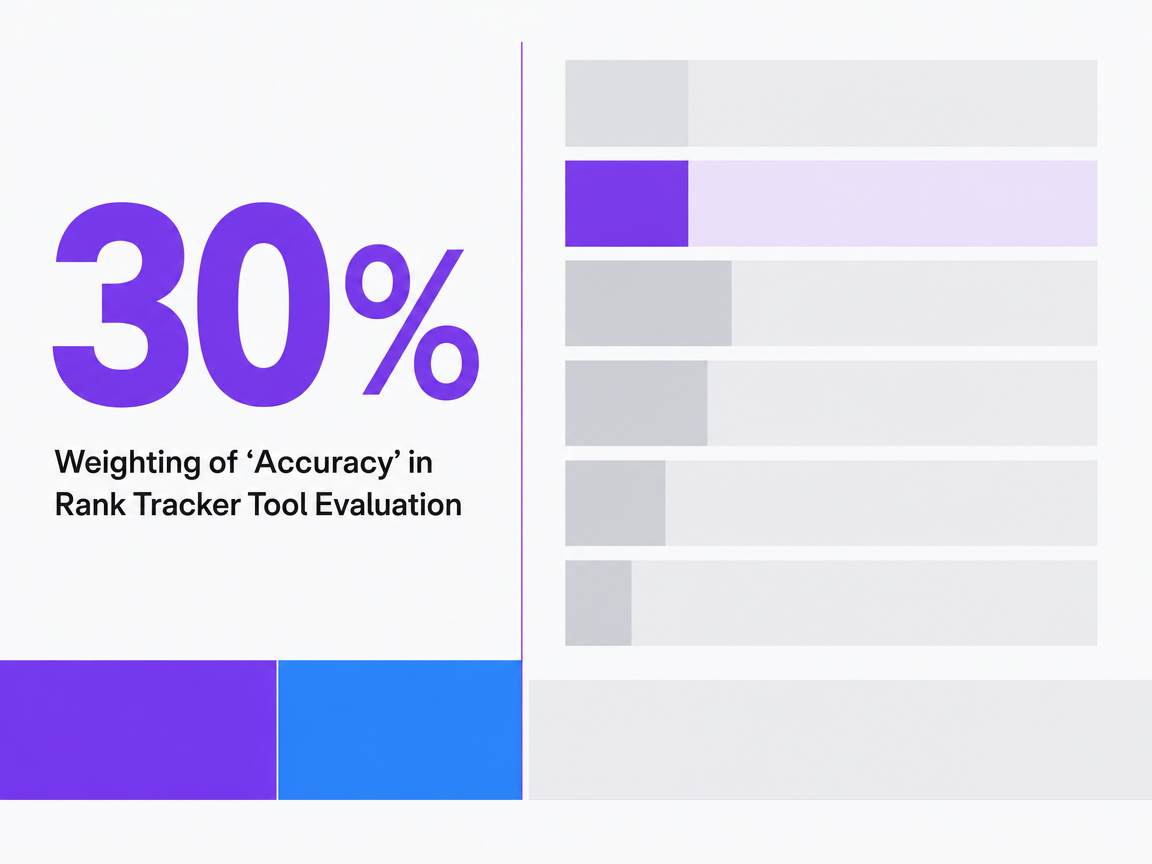 Weighting of 'Accuracy' in Rank Tracker Tool Evaluation
Weighting of 'Accuracy' in Rank Tracker Tool Evaluation
The seven tools worth shortlisting in 2026
AccuRanker: the fidelity anchor for high-stakes client reports
AccuRanker earns its top spot on the shortlist due to its exceptionally tight measured variance: ±1.1 positions against GSC in head-to-head testing 1. This minimal drift, roughly one SERP slot, is the closest any dedicated tracker gets to a clean manual check without direct access to Google's impression logs.
Its empirical strength is further highlighted when accuracy is a scored criterion. In a twelve-tool comparison, where accuracy contributed 30% to the total evaluation, AccuRanker showed less than one-position variance for over 95% of queries tested against manual SERP checks 9. This consistent signal from independent studies confirms AccuRanker's leadership in reporting fidelity.
For a Head of SEO, this fidelity means fewer reconciliation cycles when a stakeholder disputes a position. It also integrates well with the tool's built-in SERP volatility index, which flags algorithm noise proactively. The trade-off is scope; AccuRanker is a specialist. Agencies often pair it with separate content and backlink tools, a justifiable cost if the portfolio relies on defensible rank narratives for frequent QBRs.
SE Ranking: multi-account depth with tracker-grade accuracy
SE Ranking is slightly below AccuRanker in raw fidelity, with ±2.1 positions of variance against GSC 1. However, the same twelve-tool test that ranked AccuRanker highly also placed SE Ranking alongside it as one of two trackers with less than one-position variance on over 95% of queries tested 9. This highlights that per-query behavior can be more important than a single headline number.
SE Ranking's appeal for agencies lies in its workflow capabilities. White-label reporting, sub-account structures, and client-branded dashboards are native features, which is crucial when analyst hours per report impact delivery margins. The tool also provides geo-specific SERP simulation across locations and devices, meeting the granularity demands of multi-location clients.
Operationally, SE Ranking is ideal for a Head of SEO managing 25 or more accounts with a weekly reporting cadence. Its fidelity is defensible, its multi-client scaffolding is purpose-built, and its GSC reconciliation workflow is straightforward.
Semrush: multi-location, competitor, and device coverage at scale
Semrush is frequently cited by agency reviewers for its comprehensive portfolio breadth. It tracks keyword rankings across locations and devices, offering competitor visibility and trend reporting designed for agencies managing multiple clients 7. This profile is essential when a client needs to know not only their own rank but also the rank of three specific competitors for the same query in the same ZIP code.
Rank accuracy isn't Semrush's primary advantage. Comparative testing places its position tracker in the approximate tier, consistent with other full-scope suites 5. What Semrush offers in exchange for this fidelity is extensive coverage: keyword databases, backlink data, site audits, and competitor share-of-voice, all within a single account structure.
The agency case for Semrush is consolidation. When a portfolio requires competitor tracking, content gap analysis, and technical audits alongside rank data, the alternative is integrating multiple vendors. The reconciliation discipline still applies; Semrush rank data should complement GSC in client reports, not replace it.
Ahrefs: rank data inside a wider technical and link stack
Ahrefs shows ±1.8 positions of variance against GSC, positioning it between AccuRanker and SE Ranking in raw fidelity 1. This level of accuracy is sufficient for client reporting when its rank data is reconciled with GSC clicks and impressions 14.
Ahrefs earns its shortlist spot due to its comprehensive suite surrounding the rank tracker. Backlink intelligence, content gap analysis, and site audit are all integrated, streamlining the reconciliation process when a ranking drop requires a link-based or technical explanation. For agencies whose client narratives emphasize link acquisition and content investment, this consolidation reduces the number of tools an analyst needs to use per report.
The trade-off is portfolio scaffolding. Ahrefs isn't designed for the sub-account, white-label workflow optimized by dedicated agency trackers. Heads of SEO using Ahrefs at scale typically pair it with a separate reporting layer for client-branded QBR outputs.
Nightwatch: local and geo-granular tracking for service verticals
Multi-location service portfolios highlight a weakness in GSC's impression-weighted average: blended geographies make it difficult to pinpoint why a single location's ranking changed 9. Nightwatch addresses this specific issue. Its geo-grid tracking reports positions with ZIP-level granularity across devices, providing the resolution needed by law firms, dental groups, home services, and senior living operators for client reports.
Rank fidelity is in the same approximate tier as other dedicated trackers 5. Nightwatch's key differentiator is its geographic depth. Positions can be tracked from specific location grids rather than metro-level proxies, significantly enhancing the client narrative regarding a location's actual visibility.
Nightwatch is the ideal choice when a portfolio is dominated by verticals where local pack presence and radius-based visibility drive lead volume. Its focused approach, narrower than Semrush or Ahrefs, is its strength.
Google Search Console: the authoritative reconciliation layer
GSC is essential not as a competitor to dedicated trackers, but as the anchor for any defensible claim they make. It is the only ranking source with direct access to Google's impression logs, consistently classified as authoritative for a site's own average position, while trackers are approximate 5, 8.
Its empirical accuracy is quantified: 80% of keywords were within one ranking position of the GSC-reported number in testing against manual checks 11. This fidelity applies to the average position metric, not a live snapshot, which is why GSC's role in the reporting stack is reconciliation, not daily monitoring.
Operationally, tracked positions from tools like AccuRanker, SE Ranking, Semrush, Ahrefs, or Nightwatch are reconciled against GSC clicks, impressions, and average position within the same client view 14. When numbers differ, the tracker explains what a clean SERP showed at one moment, and GSC explains what searchers actually experienced over time. Both are crucial for a complete report.
Vectoron: AI orchestration across rank, content, and links
The seventh slot is not another tracker, but an AI orchestration layer that sits above trackers, GSC, and volatility sensors. It transforms rank data into actionable decisions for content and link execution. Agency evaluations emphasize this shift: rank tracking in 2026 must integrate with content, backlinks, and reporting workflows, rather than operating in isolation 14.
The operational value of an AI orchestration layer lies in reducing reconciliation labor. Tracked positions are automatically reconciled against GSC clicks and impressions, click-through rates by position are surfaced for underperforming queries, and volatility context is attached to movement between reports without an analyst manually checking multiple dashboards 14. For a portfolio of 15 to 75 accounts, this significantly reduces the reconciliation hours per report, a problem raw tracker choice alone cannot solve.
Vectoron is the ideal shortlist entry for Heads of SEO whose primary margin challenge is the analyst time spent bridging tracker data with a defensible client narrative.
Layering volatility context on top of tracker data
June 2026 provided a clear example of what tracker data alone cannot explain. A period of high Google SERP volatility led to ranking movements that many trackers under-reported or delayed. This left agencies defending numbers that had already been superseded by the algorithmic shifts they were meant to measure 10. A daily rank export showing a four-position drop means one thing during a stable week and something entirely different during an unconfirmed update.
Volatility sensors bridge this interpretive gap. Tools like MozCast, Semrush Sensor, and AccuRanker's Grump report volatility scores that quantify how much the SERP itself has changed. This allows analysts to distinguish a client-specific drop from market-wide turbulence 12. While these scores aren't perfect and Google doesn't always confirm the updates they flag, they help translate noisy movement into a defensible client narrative.
The operational stack is three layers. Tracker data indicates a keyword's position. GSC confirms what searchers actually experienced. Volatility context explains whether movement between snapshots is due to the client's site or broader market changes 5, 10. Reports omitting this third layer force analysts to make assumptions.
Optimize Client SEO Reporting With Enterprise-Grade Rank Tracking
Connect with our team to see how unified, granular ranking insights can improve client transparency and streamline multi-account SEO performance reporting at scale.
If you manage multiple locations: delivery economics of rank reporting
For agencies, tracker choice moves beyond accuracy to become a margin discussion. A Head of SEO managing 40 accounts, each with an average of six locations, must reconcile rank data across approximately 240 geo-device combinations before preparing a single QBR slide. The primary factor determining delivery cost isn't the tracker's ±position variance, but the analyst hours per client per report that the tool necessitates 14.
While inputs are portfolio-specific, the calculation structure remains consistent across agencies:
| Reconciliation input | Entry tracker tier | Agency tracker tier | AI orchestration layer |
|---|---|---|---|
| Keywords tracked per client | Variable | Variable | Variable |
| Locations × devices per client | Manual pivot per view | Sub-account templated | Auto-reconciled to GSC |
| GSC reconciliation per report | Analyst-driven export | Semi-automated overlay | Continuous 14 |
| Volatility context attached | Separate tool | Native sensor | Layered into narrative 10 |
| White-label output | Third-party dashboard | Built-in | Client-branded, auto-generated |
The reconciliation hours per report compound significantly. With entry-tier tracker workflows, an analyst manually exports tracker data, cross-references GSC clicks and impressions by query, checks volatility scores in a separate tab, and then rebuilds the client narrative in a reporting tool 5. This workload scales linearly with the number of accounts. AI orchestration, however, collapses the reconciliation layer across the entire portfolio, providing a margin lever that tracker fidelity alone cannot achieve 14.
A defensible three-layer reporting stack for QBRs
The shortlist of tools forms a reporting stack, not a single winner. For a Head of SEO presenting at a QBR, three data layers are needed in a single view, each addressing a question the others cannot.
- Layer one is Google Search Console, serving as the authoritative baseline. Average position, clicks, and impressions establish what searchers actually experienced during the reporting window, as no third-party tool has direct access to Google's impression logs 5, 11.
- Layer two is a dedicated tracker running daily: AccuRanker or SE Ranking for fidelity-first portfolios; Semrush or Ahrefs when rank data needs to integrate with competitor and link intelligence; or Nightwatch when geo-grid resolution is critical.
- Layer three is a volatility sensor, such as MozCast, Semrush Sensor, or AccuRanker's Grump, integrated with the tracker feed to interpret movement between snapshots rather than just reporting raw data 12.
The labor involved in reconciling these layers is a key margin lever. An AI orchestration layer, positioned on top, automatically reconciles tracked positions against GSC clicks and impressions and attaches volatility context. This transforms a three-tab analyst workflow into a finalized client report 14.
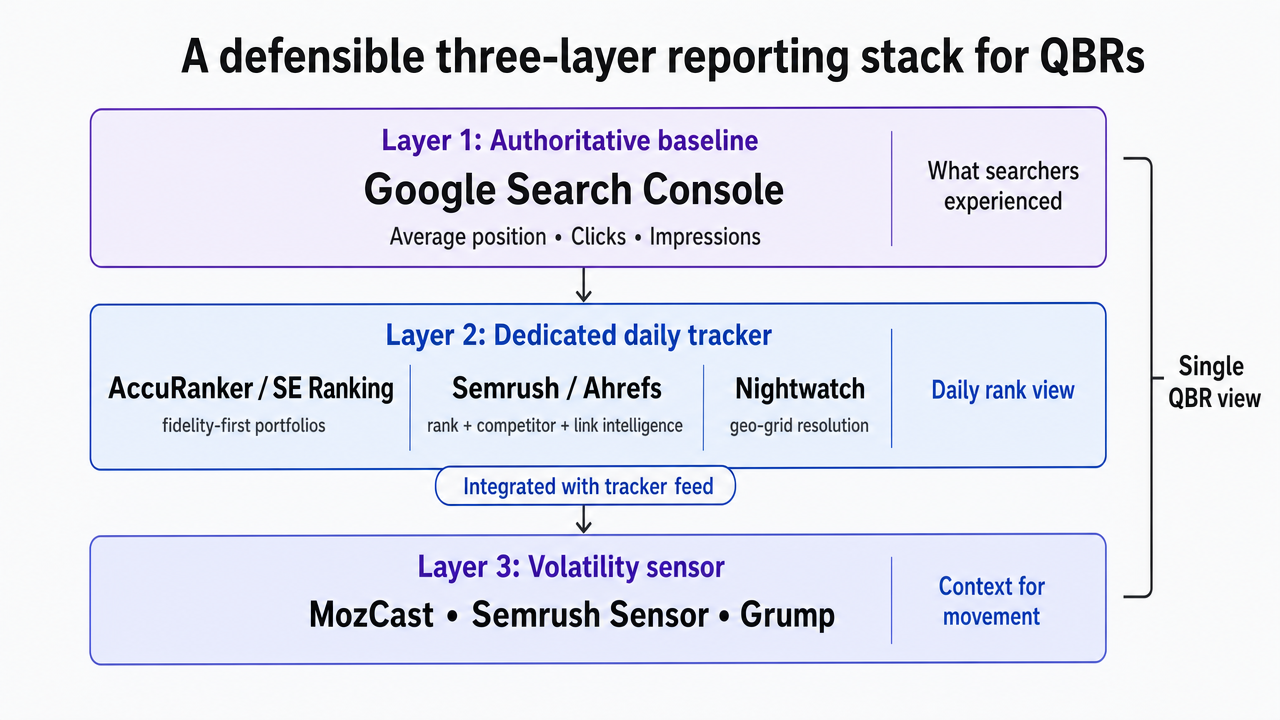 Visualize the three-layer reporting stack framework described in this section as a process/architecture infographic
Frequently Asked Questions
References
- 1.Best Rank Tracking Tools in 2026 (Accuracy Tested).
- 2.How to Track Keyword Ranking in Google Search Console.
- 3.Rank Trackers vs GSC Average Position.
- 4.Is Google Search Console Rank Tracking Data Accurate? - MonitLabs.
- 5.Rank Trackers Compared — And What Tracking Won’t Fix.
- 6.9 Best Rank Tracker Tools in 2026: Cheap, Daily, Accurate.
- 7.Top 10 Best Agency Rank Tracker Software of 2026.
- 8.Best Google Rank Checker Tools We Tested in 2026.
- 9.12 Best Rank Tracking Tools in 2026 (Compared).
- 10.June 2026 SERP Volatility Your Tracking Tools Missed.
- 11.How accurate is Google Search Console Ranking Data?.
- 12.Why & How to Track Google Algorithm Updates.
- 13.Google Search Console: How Accurate is the Average Position Metric?.
- 14.Best SEO Ranking Software for Agencies Delivering Client Results.