
Key Takeaways
- The real bottleneck in scaled article production is senior strategist judgment moving through review gates, not writer capacity — so throughput-per-strategist becomes the operating KPI that replaces articles-per-writer 16.
- AI absorbs four mechanical layers well — clustering, briefs, drafts, and variants — but angle, source vetting, expert input, and final judgment must stay with humans, since these are the signals Google's helpful content framework actually evaluates 1.
- Google does not penalize AI authorship itself; the correlation between AI content share and rank is near zero 8. What fails is unreviewed, mass-produced content, which shows initial ranking lift followed by a 48% decline as engagement catches up 3.
- Focus next on redesigning the operating model — standardized content types, WIP limits, three review gates, and refresh cycles — which in one documented case produced 5× output at roughly 50% lower cost without new headcount 14.
The binding constraint isn't writing capacity anymore
Most content marketing managers still plan article output the way it was planned a decade ago: articles per writer, per week. That math no longer describes the actual bottleneck. Nearly half of enterprise marketers report they lack a scalable content model, even as AI collapses the mechanical cost of producing a draft 10. When drafts are cheap, the queue backs up somewhere else — and that somewhere else is almost always a senior strategist's inbox.
The Content Marketing Institute's 2026 enterprise research reaches a similar conclusion from a different angle: team size no longer predicts content output. The teams that scale rely on documented workflows, centralized governance, and integrated tools rather than additional headcount 9. Volume follows the operating model, not the org chart.
What actually gates published, on-strategy SEO articles now is the flow of senior judgment through review, QA, and approval gates — angle, source vetting, expert quotes, final sign-off 16. A team of four can out-publish a team of ten when those gates are designed as a pipeline instead of a series of one-off heroics.
That reframe changes the metric worth tracking. The rest of this article treats throughput-per-strategist as the operating KPI, examines what AI can and cannot absorb inside that pipeline, and works through the evidence on where scaled article production actually breaks.
Throughput-per-strategist as the operating KPI
If team size no longer predicts output, the metric that replaces it is throughput-per-strategist: the number of published, on-brand, on-strategy assets a single senior strategist can shepherd through the pipeline per month 16. It is a capacity measure, not a productivity slogan. It counts finished, indexed, on-topic articles — not drafts, not queued briefs, not half-approved outlines waiting on a source quote.
The reframe matters because most content operations still budget in writer-hours. Writer-hours are now the cheapest input in the system. A 2026 case study documented a workflow shift in which article production dropped from 30–40 hours per asset to a consistent 15–20 hours, and the team doubled publishing frequency without adding staff 15. The compression came from consolidating keyword research, brief generation, and optimization into a unified workflow — mechanical work that used to sit on a strategist's desk waiting for attention between meetings.
That freed strategist time is the multiplier. When the 15–20 hours are reallocated toward angle, source vetting, and final judgment, one strategist can shepherd roughly two to three times the assets they used to. The exact ratio depends on the review architecture, but the direction is consistent across systems-focused operational research: throughput scales with how many decisions the strategist no longer has to repeat, not with how fast the writer types 11.
Tracking throughput-per-strategist forces two clarifying conversations. First, what counts as a published asset — the team has to define a content type and its exit criteria before it can count anything. Second, where a strategist's hours actually go this month — briefing, reviewing, sourcing, rewriting, or approving. Once those two questions have answers, the operating model becomes tunable. Every subsequent decision in this article — which layers AI absorbs, where review gates sit, how refresh cycles are scheduled — is a lever on that single number.
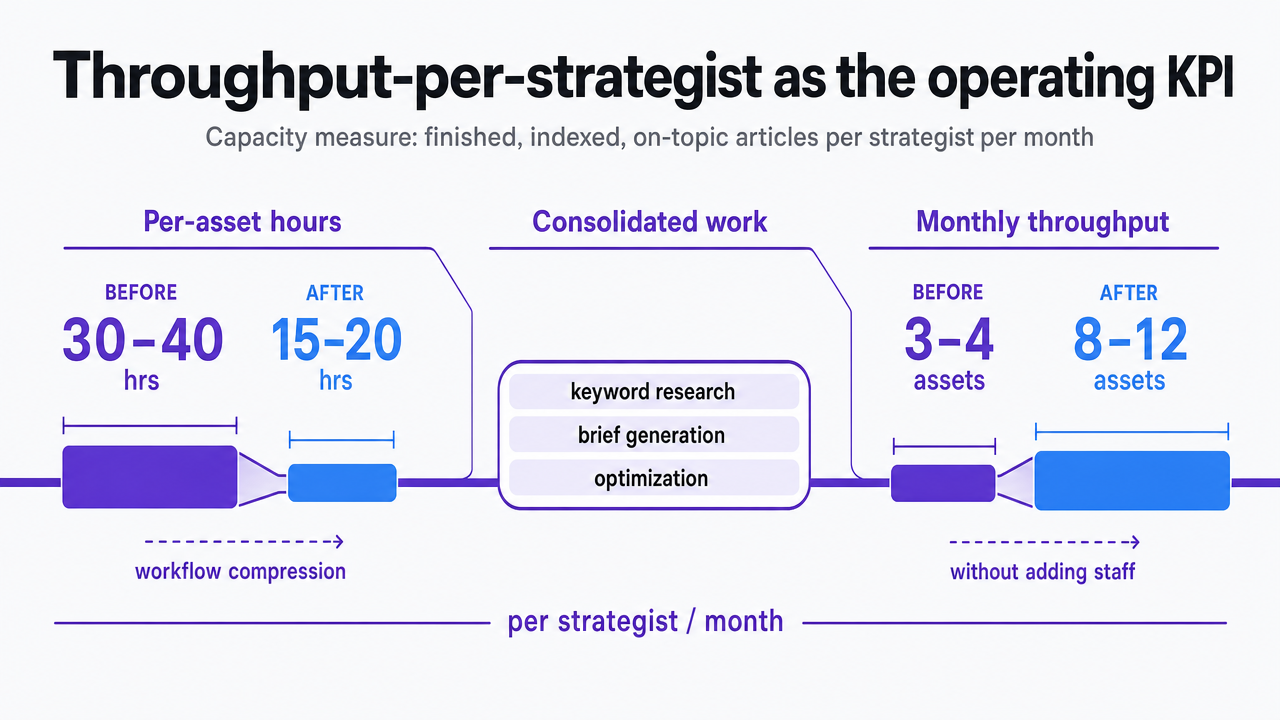 Visualize the per-asset hours compression and the resulting throughput shift, both cited in nearby prose (30–40 hours to 15–20 hours; 3–4 assets to 8–12 assets per strategist per month)
The AI-penalty myth, and what Google actually filters
What the 600,000-page data says about AI and rankings
The fear that Google downranks articles simply because they were drafted with AI is not supported by the largest empirical look at the question. Ahrefs analyzed 600,000 pages and found essentially no relationship between the share of AI-generated text on a page and where that page ranked in Google, with a correlation of roughly r ≈ 0.01 8. That number is statistically indistinguishable from zero. It means the proportion of AI text tells you almost nothing about rank.
The scope of that finding matters before content managers use it to justify workflow decisions. It measures pages as they exist in the wild, not a controlled A/B test of identical articles with different authorship. What the correlation captures is the population-level signal: across hundreds of thousands of URLs, AI authorship is not a predictor Google appears to be using as a standalone lever. Rankings correlate with the usual suspects — intent match, depth, link profile, engagement — not with a hidden authorship classifier.
That reframes the operating question. The risk in scaled article production is not that an editor forgot to hand-type a paragraph. It is whether the finished article meets the quality signals Google does evaluate. The next two sections describe what those signals look like in practice, and where scaled workflows most often fail them 5.
The failure mode: unreviewed, mass-produced pages
The pattern that gets teams into trouble is specific, and it shows up cleanly in the data. A 2026 academic analysis of AI-generated articles found an initial ranking lift of roughly 35% — the payoff of tight keyword coverage and clean on-page structure — followed by a 48% decline as user engagement caught up with the pages. The engagement signal driving the fall: a 68% bounce rate, well above what human-reviewed content in the same study produced 3.
That is the shape of the failure mode. Articles rank on structure, then lose position on behavior. Google's ranking systems observe how users interact with a result after the click, and pages that read as generic, thin, or off-angle bleed engagement fast. A 16-month Search Engine Land experiment tracked the same trajectory at the site level: AI-only content produced early traffic spikes, then plateaued or declined once the novelty of coverage stopped compensating for the absence of editorial direction 4.
Two implications follow for a content operation running lean. First, ranking on week one is not the KPI — retained rank at month six is. Second, the decline is not a Google penalty in the enforcement sense; it is the system doing exactly what it is designed to do when engagement signals disagree with initial relevance signals. That distinction matters when leadership asks whether AI-assisted articles are "safe." They are safe when the review architecture around them catches the failure modes that engagement data eventually exposes. Without that architecture, the rise-and-fall curve is the default outcome, not the exception.
The quality floor Google's March 2024 update enforces
Google's March 2024 update made the line explicit. The company reported the changes reduced low-quality, unoriginal content in search results by 45%, and expanded spam policies to name "scaled content abuse" as a distinct category — pages produced at volume mainly to rank, regardless of whether the production method is automated, manual, or hybrid 2. The trigger is not authorship. It is intent and utility.
The helpful content framework describes the positive side of that same line. It asks whether a page demonstrates first-hand expertise, provides original information, and satisfies the reader's actual question rather than restating what other pages already say 1. Read as an operating spec, those criteria translate into concrete review checkpoints: does the article have a defensible angle, a sourced claim, an expert input or original data point, and evidence that a human made judgment calls about what to include and exclude?
For a content manager scaling output, the quality floor is a design constraint, not a warning label. Every content type in the pipeline needs exit criteria that map to those checkpoints, and the review gate needs the authority to send an article back until they are met. That is the mechanism separating helpful scaled production from scaled content abuse — and it is the mechanism the following sections build out.
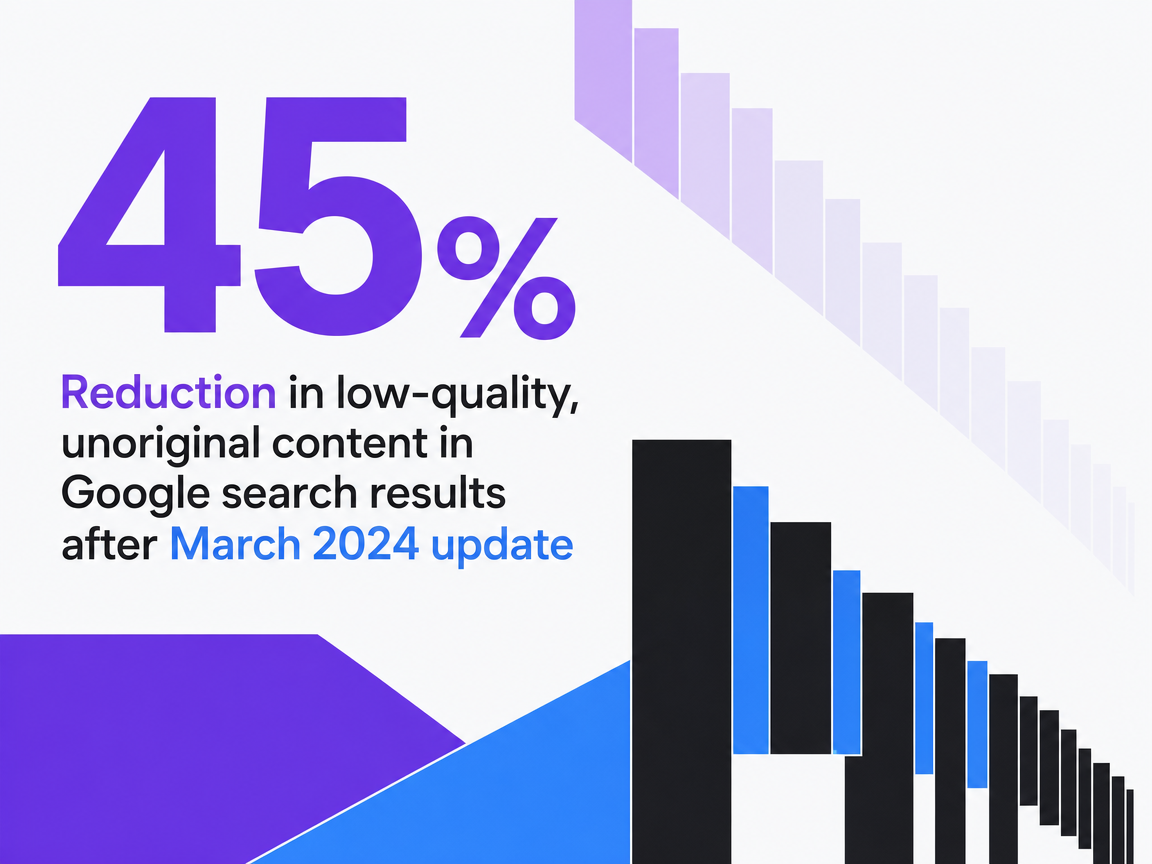 Reduction in low-quality, unoriginal content in Google search results after March 2024 update
Reduction in low-quality, unoriginal content in Google search results after March 2024 update
Accelerate SEO Article Workflow—Test at Full Scale
Experience end-to-end content production and publish real SEO articles without slowing your existing team.
The four layers AI can accelerate — and the four humans must own
AI-assisted layers: clustering, briefs, drafts, variants
Four layers of the article pipeline are mechanical enough that AI absorbs most of the load. The first is topical clustering — grouping keywords into related sets, mapping intent, and identifying which clusters the site already covers versus which have thin or missing pages. The second is brief generation: pulling the top-ranking pages for a target query, extracting the sub-topics they cover, and structuring an outline with H2s, questions to answer, and internal links to include. Both are pattern-recognition tasks that used to consume a strategist's morning and now run in minutes 7.
The third layer is drafting. A brief with a clear angle, sourced claims, and a defined structure produces a first draft that is roughly 70% of the way to a publishable article. The 2026 case study documenting the shift from 30–40 hours to 15–20 hours per asset attributes most of the compression to this consolidation — keyword research, brief, and initial draft moving through a unified workflow instead of three separate handoffs 15. Drafting is not where the strategist's judgment lives; it is where their judgment gets encoded into a structure someone or something else can execute against.
The fourth layer is variant production: meta descriptions, alternate headlines, internal link anchor text, image alt text, and repurposed formats for email or social. These are high-volume, low-stakes decisions that scale badly with manual attention and well with generation plus review 11. Together, the four layers represent the bulk of the hours a traditional article budget used to consume — and the bulk of the throughput gain when the operating model is redesigned around them.
Human-owned layers: angle, source vetting, expert input, final judgment
The layers AI cannot absorb without degrading the asset are the ones Google's helpful content framework actually evaluates. Angle comes first: the specific point of view that separates a defensible article from a competent restatement of what other pages already say. A strategist reading a brief decides what the article argues, what it refuses to include, and whose problem it solves. That decision cannot be delegated to a system that has no stake in the outcome 16.
Source vetting is the second. Claims in a scaled pipeline arrive from search results, prior articles, and generated drafts — and a meaningful share of them are wrong, outdated, or attributed to the wrong study. A human has to verify that a statistic exists, that the source said what the draft claims it said, and that the citation points to primary rather than secondary material. This is slow work, and it is the single most common gap in unreviewed AI content.
Expert input is the third layer — the quote, data point, or first-hand observation that makes an article demonstrably original rather than derivative. Google's guidance treats first-hand expertise as a distinguishing signal, and scaled pipelines that skip this step produce the thin, interchangeable pages the March 2024 update was designed to filter 1.
Final judgment closes the loop: the strategist reading the near-final draft against the content type's exit criteria and deciding whether it ships, gets revised, or gets killed. That authority is what converts a fast pipeline into a defensible one, and it is the single variable most correlated with whether scaled output holds its rankings past month three 5.
A four-layer operating model: strategy, production, distribution, feedback
Strategy layer: clusters, intent, and the intake gate
The strategy layer decides what gets built and, more importantly, what does not. Its job is to convert business priorities into a ranked backlog of topical clusters, each with a defined intent, target audience, and set of exit criteria that later gates can enforce 13. Without that upstream ranking, the production layer inherits every ad-hoc request that lands in a strategist's inbox, and throughput math falls apart before the first draft is even written.
The intake gate is where that discipline lives. Operational guidance for lean teams recommends defining a small number of allowed content types — typically three or four — each with a fixed structure, target intent, and approval checklist, and rejecting requests that fall outside those types by default 12. That constraint sounds narrow. In practice it is the mechanism that lets one strategist hold a coherent editorial line across dozens of assets a month.
Clustering sits behind the intake gate rather than at the top of it. Once the allowed content types are defined, AI-assisted clustering maps target queries into groups, flags overlap with existing pages, and surfaces gaps that map to a specific content type 7. The strategist's remaining work is judgment: which clusters are worth the shepherding hours this quarter, and which requests get sent back.
Production layer: standardized types, WIP limits, review gates
The production layer is where the throughput compression actually shows up on the calendar. Standardized content types give the pipeline its shape: each type has a template, a source-vetting checklist, a required expert input, and a defined review path. When the type is fixed, the strategist is not re-negotiating structure on every article — they are checking whether this specific draft meets criteria that were set once and reused forever 11.
Work-in-progress limits keep the pipeline from silting up. A single strategist can hold roughly six to ten articles in active review before quality degrades and cycle times spike; enforcing a WIP ceiling forces the team to finish before it starts, which is where cumulative throughput actually comes from 12. Articles waiting on a source quote or an SME edit sit in a defined holding column, not scattered across chat threads.
Review gates convert those templates and limits into a defensible pipeline. Three gates carry most of the load: a brief gate that locks angle and sources before drafting begins, a substance gate that verifies claims and expert input on the near-final draft, and a publish gate that checks the article against the content type's exit criteria 13. Each gate has authority to send the article back — that authority is what separates a fast pipeline from a leaky one.
The consolidated production layer is also where the hours compression documented earlier translates into a repeatable operating pattern rather than a one-off win, with keyword research, brief, draft, and optimization moving through a single workflow instead of three handoffs 15.
Distribution and feedback: refresh cycles that compound rankings
Distribution and feedback are where scaled SEO article production stops behaving like a one-time push and starts compounding. Variant production — alternate headlines, meta descriptions, internal link anchors, email and social repurposes — extends each shepherded asset across surfaces the strategist never has to touch again after the publish gate 11. Pillar articles feed cluster pages; cluster pages feed variants; the same core judgment gets amortized across a wider footprint.
The feedback loop closes the model. Enterprise research on high-performing content operations points to integrated analytics and documented workflows as the mechanism that distinguishes teams that scale from teams that plateau 9. In practice, that means query-level performance, engagement metrics, and ranking position roll back to the same backlog the strategy layer manages — not into a separate reporting deck no one acts on.
Refresh cycles are what convert that data into compounding rankings. Articles are scored on a defined cadence against three signals: rank drift, engagement drop, and topical staleness. Assets flagged on any of the three re-enter the pipeline as a refresh content type, with its own template and review path. This is where the durability problem observed in AI-only workflows gets structurally addressed: continuous editorial attention on the assets that need it, rather than a one-way publish-and-forget queue 4.
See How Leading Teams Scale SEO Content Without Expanding Staff
Request a walkthrough of unified AI-powered workflows proven to accelerate article production and search performance—eliminating bottlenecks, maintaining editorial standards, and supporting enterprise-scale content velocity.
The economics of the shift: 5× output at roughly half the cost
The operating-model changes described so far show up as two numbers on a budget line. A documented marketing operations transformation that redesigned intake, workflows, and governance as an interconnected system reported a 5× increase in operational output and roughly 50% cost reduction, without adding headcount 14. The gain did not come from writing faster. It came from removing repeated decisions across the pipeline and consolidating tooling so that strategist hours moved through review gates instead of piling up in front of them.
That top-line ratio is consistent with per-asset economics observed at the workflow level. When keyword research, brief generation, and initial drafting move through a unified process, per-article time drops from 30–40 hours to a consistent 15–20 hours, and publishing frequency roughly doubles at the same team size 15. The 5× case reflects what happens when that per-asset compression is combined with intake discipline, standardized content types, and variant production across surfaces — each layer compounding on the others.
Translated into throughput-per-strategist, the shift is concrete. A strategist previously shepherding three to four assets a month at 30–40 hours each moves into a range closer to eight to twelve, with the reclaimed hours reallocated to angle, source vetting, and final judgment rather than mechanical work. The cost side follows because the reduction lands on the most expensive input in the system: senior review time. Writer-hours were already the cheapest input; compressing strategist-hours is what drives the ~50% figure in the underlying case study 14.
The number leadership should be asked to fund, then, is not another writer seat. It is the redesign work — content type definitions, review gate authority, tool consolidation, feedback instrumentation — that converts the same team into a system with materially different economics 9.
What breaks first when teams try this without a review architecture
The failure pattern is predictable. Teams that add AI drafting to an existing workflow without redesigning the review gates see the same sequence: throughput spikes for six to eight weeks, then quality complaints arrive from sales and product, then engagement metrics slip, then rankings on the newest articles start drifting. The pipeline did not break because AI produced bad drafts. It broke because the strategist became a proofreader instead of an editor, and the work that used to happen at the brief stage — angle, source vetting, expert input — quietly stopped happening at all 16.
Three symptoms tend to surface first. Cycle times shorten but revision counts climb, because drafts arrive without a locked angle. Source citations appear in articles but point to secondary aggregators rather than primary studies, because no gate verified them. And the content calendar fills with topics that clear intake but do not map to a ranked cluster, because the intake gate never had exit criteria 13. Fixing any one of these in isolation does not hold. The review architecture is what makes throughput-per-strategist a durable number rather than a two-quarter spike 10.
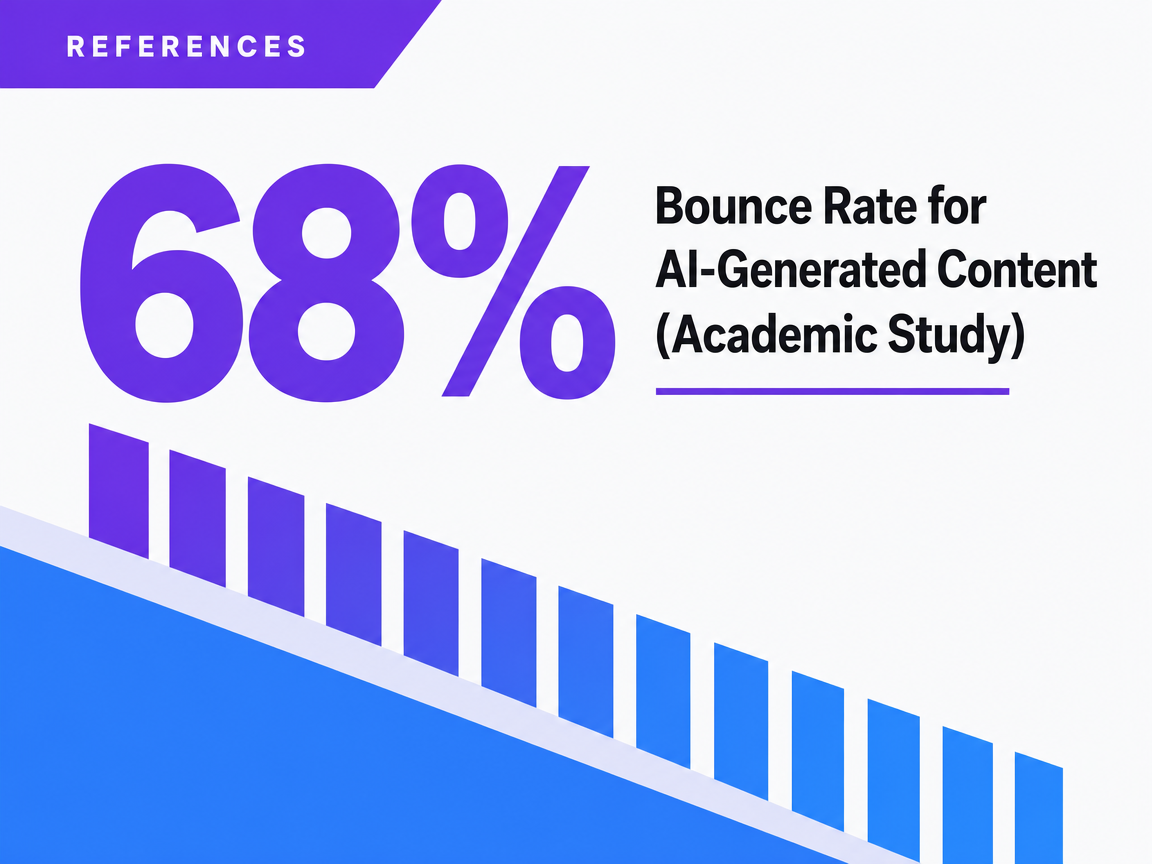 Bounce Rate for AI-Generated Content (Academic Study)
Bounce Rate for AI-Generated Content (Academic Study)
Frequently Asked Questions
References
- 1.Creating Helpful, Reliable, People-First Content.
- 2.New ways we're tackling spammy, low-quality content on Search.
- 3.AI-Based Automated Content Generation and its SEO Implications.
- 4.How AI-generated content performs in Google Search: A 16-month experiment.
- 5.Will AI Content Hurt Your SEO? The 2026 Evidence.
- 6.Impact of AI-Generated Content on Website Rankings and User Engagement.
- 7.How AI is Redefining Enterprise Content Operations.
- 8.AI-Generated Content & SEO: Industry Perspectives and Reality Check.
- 9.Enterprise Content and Marketing Trends: Insights for 2026.
- 10.How AI Enables Lean Content Teams to Scale Without Increasing Headcount.
- 11.How to Scale Marketing Without Adding Headcount.
- 12.How Small Teams Can Scale Marketing Without Hiring or Burning Out.
- 13.How to Scale Content Quality Without Scaling Your Headcount.
- 14.Scaling Marketing Operations 5× Without Scaling Headcount.
- 15.SEO Tool: 50% Faster Content Creation (2026 Case Study).
- 16.Growth in Content Marketing: How to Scale Without Hiring.