
Key Takeaways
- Semrush added AI Overview citation tracking to Position Tracking in late 2024, letting agencies flag triggers and cited domains without abandoning existing client projects or historical position graphs.
- SE Ranking stands out for native multi-engine AI visibility across ChatGPT, AI Mode, Gemini, and Perplexity, which matters when client buyers start research inside AI assistants rather than Google.
- Ahrefs Brand Radar AI treats citation presence as the primary measurement object rather than a bolt-on flag, pairing well with the vendor's 300,000-keyword Search Console CTR panel 12.
- Authoritas quantifies SERP feature push-down with pixel modeling, showing that an expanded Overview drops the top organic result over 1,200 pixels on average 16for defensible client budget conversations.
- AWR Cloud's AI Market Share metric aggregates query variants into topic-level share-of-voice, which fits verticals where clients care about buying-decision clusters rather than individual keyword positions.
- BrightEdge fits enterprise portfolios where share-of-voice is already a recognized KPI, but its licensing overhead outweighs marginal capability for smaller agencies running mid-market client rosters.
- Vectoron sits above the tracker stack as a reconciliation layer, joining trigger detection, citation status, and Search Console outcomes to remove analyst spreadsheet labor at portfolio scale 13.
The measurement gap agency leads already feel
Every agency head running a portfolio of 40 or more client domains has seen the same anomaly on last quarter's reports: average position holds steady, impressions tick up, and organic clicks drop anyway. The dashboard tells one story. Google Analytics tells another. Clients want to know which one is real.
The randomized field experiment behind that gap now has clean numbers. When researchers removed AI Overviews from a subset of queries and compared behavior against a control group, AI Overviews appeared on 42% of queries in the test set. On the queries where they appeared, outbound organic clicks fell by 38%, and zero-click searches rose from 54% to 72% 11. The strongest effect showed up when the Overview sat at the top of the page. Search satisfaction scores, notably, barely moved when the Overviews were removed.
That is a causal finding, not a correlation pulled from a keyword panel. It reframes the question agency leads should be asking their tool stack. The problem is not that rank tracking is broken. The problem is that a single position number no longer maps to a click outcome, and clients are reading dashboards that were built for a SERP that no longer exists.
The rest of this piece works through a three-layer rubric for evaluating what a 2026 rank tracker actually needs to detect, and applies it to the seven platforms worth putting on a shortlist. The goal is a defensible client narrative, not a longer feature list.
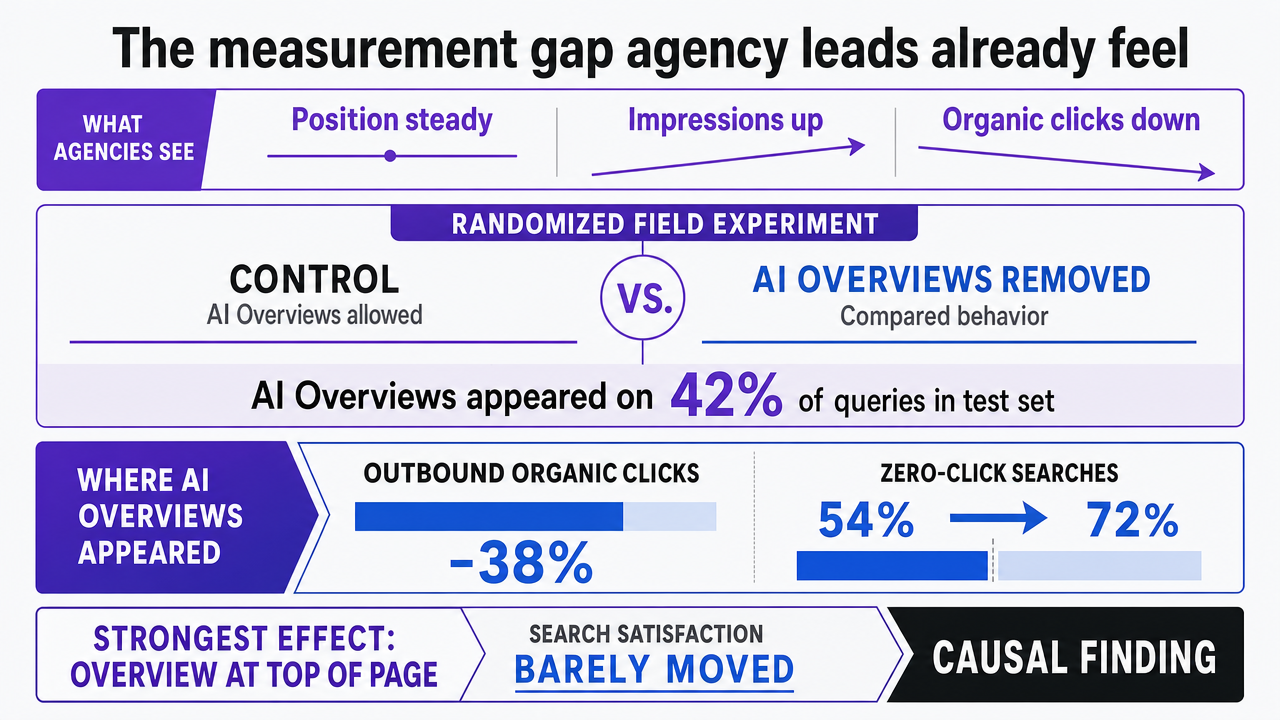 Visualize the causal finding from the randomized field experiment showing how AI Overviews affect click behavior, directly supporting this section's central data point
The three-layer rubric for evaluating any 2026 rank tracker
A rank tracker built for the current SERP has to answer three separate questions, not one. Did an AI Overview trigger on this query? If it did, was the client's domain cited inside the passage? And did any of that translate into a click that Search Console can confirm? Practitioners working through this problem now describe it as a three-layer stack rather than a single position number 13. Each layer catches a different failure mode, and any tool missing a layer will hand agencies a report that quietly disagrees with client analytics.
Layer 1: Trigger detection with real-browser rendering
Trigger detection means the tool fires a real browser session and logs whether an AI Overview appeared for a given query on a given day 4. API-only trackers that pull cached SERP HTML will miss most Overviews because the module renders client-side. For agencies running a 12,000-keyword footprint across a portfolio, the practical test is simple: run the same 200 queries in Chrome and in the tool, and check whether trigger rates match within a few percentage points. If they do not, the position numbers downstream are being calculated against the wrong SERP.
Layer 2: Citation and passage inclusion logging
Once a trigger is confirmed, the tool has to log which domains were cited inside the Overview and, ideally, which passage was pulled. This is the layer that separates AI-aware trackers from cosmetic add-ons. A rank tracker for AI Overviews, at minimum, monitors brand appearance, cited sources, and share of the Overview relative to competitors 10. Semrush added citation tracking to Position Tracking in late 2024, and BrightEdge and Authoritas now report citation presence and share of voice at the query level 4. Without this layer, a portfolio lead cannot tell a client whether they are being quoted or ignored.
Layer 3: Search Console outcome reconciliation
The third layer closes the loop. Trigger and citation data have to be joined against Search Console impressions and clicks so the report shows what actually happened, not just what the SERP looked like. This is the layer where rank tracking stops being a standalone product and becomes one input inside a broader measurement framework 13. In practice, that means a scheduled join between the tracker's daily Overview log and the Search Console API, keyed on query and date. Any tool that cannot export at that grain forces the reconciliation into a spreadsheet and breaks at portfolio scale.
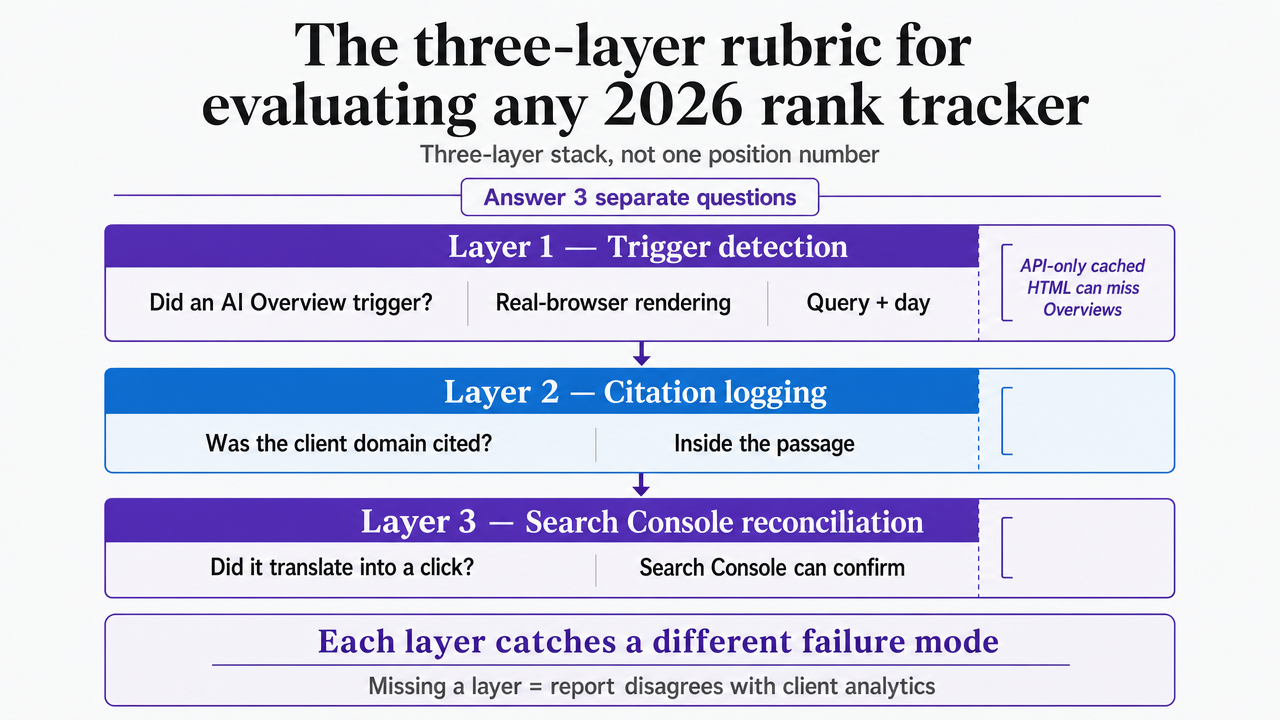 Process infographic visualizing the three-layer evaluation framework introduced in this section (trigger detection, citation logging, Search Console reconciliation)
Why legacy position reports now mislead client conversations
The mismatch between a legacy position report and client analytics is not a rounding error. It is a definitional problem. The report answers "where did we rank?" while the client is asking "what did that ranking earn us?" Those two questions used to have the same answer. They no longer do.
Across the twelve empirical studies compiled in one recent meta-analysis, every study measuring AI Overview impact on CTR found a decline, but the magnitude ranged from 15% at the low end to 89% at the high end depending on methodology, query type, and measurement window 2. Ahrefs' Search Console panel of roughly 300,000 keywords put the top-position drop at 58% 12. The Authoritas top-link analysis reached about 79% 2. Seer Interactive landed near 61% 2. Every one of those numbers is defensible inside its own scope. None of them is a universal benchmark an agency can drop into a client deck.
That spread is the reason a single vendor stat, cited without its measurement context, tends to blow up under client scrutiny. A finance client whose portfolio skews branded and transactional will not see a 58% drop. A health content publisher on informational queries may see worse. The one study of roughly 10,000 informational queries showed overall organic CTR falling from 1.41% to 0.64% where an Overview appeared 15, which is closer to a 55% relative decline on a very specific query mix.
The practical consequence for a portfolio lead is that the tracker's job description has changed. The report has to show which client queries triggered an Overview, whether the client was cited, and how the resulting impressions and clicks moved in Search Console. Anything less invites the quarterly call where average position improved, the client's revenue attribution to organic did not, and no one on the agency side can explain the gap. The seven tools evaluated next are graded against that rubric, not against how many keywords they can crawl per day.
Test SEO rank tracking workflows in real time
Validate your client reporting process with live rankings and real published data before making a commitment.
The seven tools worth evaluating in 2026
The shortlist below is graded against the three-layer rubric: trigger detection, citation logging, and Search Console reconciliation. Each entry answers what the tool measures that a legacy tracker misses, and where it fits in a portfolio stack running 10,000 to 200,000 tracked keywords. Pricing is noted only where the supplied research discloses it; the rest is flagged for demo verification.
Semrush: AI Overview citation tracking bolted onto position tracking
Semrush added AI Overview citation tracking to Position Tracking in late 2024, which brought the largest installed rank-tracking base into the AI-aware category without forcing agencies to change vendors 4. Independent tool tests confirm the platform now detects SERP features and AI Overviews and offers LLM visibility tracking as a separate module 8.
The practical value for a portfolio lead is continuity. If a 60-client roster already sits inside Semrush projects, turning on Overview detection avoids a data migration and keeps historical position graphs intact for client reporting. The gap is depth. Semrush treats Overview presence as a SERP feature flag rather than a citation share-of-voice product, so passage-level attribution and multi-engine coverage require add-ons or a second tool.
Pick Semrush as the base layer if the agency's existing keyword footprint is already there and the immediate goal is flagging which client queries trigger Overviews and whether the client is cited. Layer a specialist tool on top for ChatGPT, Perplexity, and Gemini visibility.
SE Ranking: Multi-engine AI visibility across ChatGPT, Perplexity, Gemini, and AI Mode
SE Ranking is the platform most consistently named across independent reviews for multi-engine AI visibility. Its tracker follows daily rankings alongside AI search visibility across ChatGPT, AI Overviews, AI Mode, Gemini, and Perplexity in a single project 8. A comparative review adds that it tracks visibility across AIOs, ChatGPT, Perplexity, and Gemini as a native feature rather than a paid add-on 5. SitePoint's roundup calls its AI Overviews Tracker one of the most accurate and actionable tools for monitoring presence in Google's AI-generated results 6.
For an agency with clients in legal, dental, or behavioral health verticals where prospects increasingly start research inside ChatGPT or Perplexity, the multi-engine coverage matters more than the underlying position graph. Share-of-voice inside a Perplexity answer is not a metric Semrush surfaces by default.
Pick SE Ranking when the portfolio spans clients whose buyers already use AI assistants for consideration research, and the reporting narrative needs to include citation presence beyond Google.
Ahrefs Brand Radar AI: Portfolio-scale citation monitoring
Ahrefs Brand Radar AI shows up in the 2026 shortlists as a dedicated AI Overview and brand-mention tracker rather than a bolt-on to the existing rank-tracking product 7. The distinction matters for portfolio buyers because Brand Radar treats citation presence as the primary object of measurement, not as a secondary flag on a position row.
Ahrefs also carries credibility on the underlying data question. The 58% top-position CTR figure widely cited in the industry comes from its 300,000-keyword Search Console panel 12, which means the vendor has direct visibility into the reconciliation gap between rank and click that agencies are trying to explain.
Pick Brand Radar AI for agencies whose clients care about brand-level share of the Overview rather than keyword-level position. It pairs naturally with an existing Ahrefs subscription and reduces the friction of exporting citation data alongside familiar backlink and content gap reports.
Authoritas: SERP feature push-down and AI Overview pixel modeling
Authoritas is one of the four platforms named by practitioners as offering real-browser AI Overview detection alongside Semrush, BrightEdge, and Advanced Web Ranking 4. Its distinguishing capability is pixel modeling of SERP feature push-down. The Authoritas SGE study found that when an Overview box is expanded, the top organic result drops over 1,200 pixels on average 16, and the tool operationalizes that measurement into client reports.
For a portfolio lead, this closes a specific gap in client conversations. "You rank third" and "you rank third but the third result is 1,400 pixels below the fold" produce very different budget decisions. Authoritas quantifies the second number.
Pick Authoritas when client reporting has to defend organic investment against paid search or paid social budgets. The pixel-level visibility argument gives portfolio leads a concrete number to attach to the phrase "below the fold," which otherwise reads as an excuse.
AWR Cloud: AI Market Share for topic-level share-of-voice
Advanced Web Ranking is the fourth platform practitioners flag for real-browser Overview detection 4, and its AI Market Share metric is designed to answer a topic-level question rather than a keyword-level one. The feature reports which brands dominate topic conversations across AI summaries, not just which pages rank for a given phrase 5.
That framing fits how agency clients actually think. A senior living operator does not care about position for one long-tail query; they care about whether they show up when a family member asks any variant of "assisted living near me with memory care." AWR's topic aggregation collapses those variants into a single share-of-voice number that translates cleanly into a client dashboard tile.
Pick AWR Cloud when the portfolio includes verticals with large query clusters around a small number of buying decisions, and the client reporting narrative is easier to defend at the topic level than the keyword level.
BrightEdge: Enterprise share-of-voice with AI Overview presence flags
BrightEdge sits in the enterprise tier of the four platforms named for real-browser AI Overview rendering and citation presence reporting 4. Its share-of-voice framework predates the AI Overview era, which means Overview presence flags plug into a reporting model that enterprise clients already recognize.
The tradeoff is scope. BrightEdge is priced and provisioned for in-house enterprise teams and larger agencies with dedicated analyst capacity, not for a 15-person shop running 40 mid-market clients. Pricing is not publicly disclosed in the supplied reviews and requires a demo conversation.
Pick BrightEdge when the agency's average client is a national brand with an existing enterprise SEO stack, and the reporting cadence includes quarterly executive reviews that already reference share-of-voice as a KPI. For smaller portfolios, the licensing overhead outweighs the marginal capability against Semrush plus a specialist AI tracker.
Vectoron: Execution-and-measurement layer above the trackers
Vectoron does not replace Semrush-class SERP monitoring. It sits above the tracker stack as a measurement and execution layer, joining trigger detection, citation status, and Search Console outcomes into a single reconciled view 13. The underlying argument is that rank tracking is not broken; it has become one input inside a broader measurement framework, and the reconciliation work that used to sit in analyst spreadsheets can run as scheduled automation instead 13.
For a portfolio lead, the practical difference shows up in reporting hours. A 40-client roster typically consumes 60 to 100 analyst hours a month reconciling tracker exports against Search Console. Automating that join at query and date grain returns those hours to strategy work.
Pick Vectoron when the bottleneck is not detection capability but the human labor of turning tracker outputs into client-ready narratives across content, SEO, PPC, and backlink channels inside one approval workflow.
Verify-in-demo comparison table for portfolio buyers
The seven entries above collapse into five decision columns that matter when a portfolio lead sits down for a vendor demo. Independent tool testing in 2026 confirms that trigger detection, citation logging, and multi-engine AI visibility now sit alongside daily desktop and mobile rank tracking as differentiating features rather than roadmap items 8. The table below is a starting shortlist, not a scorecard. Treat every cell as a question to run against a live account with client keywords loaded, not a claim to accept from a sales deck.
| Tool | AI Overview trigger detection | Citation logging | Multi-engine AI visibility | SERP feature share-of-voice | Pricing disclosure ||---|---|---|---|---|---|| Semrush | Yes (Position Tracking) 4| Yes (added late 2024) 4| LLM visibility as separate module 8| Yes | Public tiers || SE Ranking | Yes 8| Yes 6| ChatGPT, AI Mode, Gemini, Perplexity 8| Yes | Public tiers || Ahrefs Brand Radar AI | Yes 7| Primary object of measurement 7| Brand mention focus 7| Yes | Public tiers || Authoritas | Yes (real-browser) 4| Yes 4| Partial | Yes, with pixel push-down 16| Not publicly disclosed || AWR Cloud | Yes (real-browser) 4| Yes | AI Market Share topic metric 5| Yes | Public tiers || BrightEdge | Yes (real-browser) 4| Yes 4| Partial | Enterprise share-of-voice | Not publicly disclosed || Vectoron | Via connected trackers | Reconciled with Search Console 13| Via connected sources | Reconciled view | Public tier |
Five questions worth running in each demo:
- Does the tool render a real browser session and match Chrome trigger rates on a 200-query sample?
- Does citation logging expose the cited passage or only the domain?
- Which specific AI engines are covered natively versus through paid add-ons?
- Can share-of-voice be reported at the topic level, not just the keyword level?
- Can trigger and citation data export at query-and-date grain for a Search Console join?
Any tool that answers no to the fifth question pushes reconciliation back into a spreadsheet, which is where portfolio-scale reporting quietly breaks.
Reconciling tracker data with Search Console when rankings hold but clicks fall
The uncomfortable client call starts the same way. Average position improved from 4.2 to 3.8. Impressions rose 12%. Clicks dropped 22%. The client wants to know which agency to fire.
The behavioral evidence explains the gap. Pew's Google user data, reinterpreted through UCLA Anderson's analysis, shows users click traditional results only 8% of the time when an AI summary appears, compared with 15% without one, and abandon the session 26% of the time with a summary versus 16% without 17. Impressions can hold flat, or even rise, while the click yield on each impression collapses because the user resolved the query on the SERP. A rank tracker measuring only position will not see any of that.
The reconciliation move is mechanical. Pull the tracker's daily Overview trigger log and citation status, then join it against the Search Console API on query and date. Segment the resulting table into four buckets:
- Overview triggered and client cited
- Overview triggered and not cited
- No Overview but ranking held
- No Overview with ranking movement
Each bucket has a different client narrative. The first two explain most of the click loss on queries where position looks stable. The randomized field experiment behind the current baseline showed zero-click searches rising from 54% to 72% on triggered queries 11, which is the number worth attaching to the second bucket in a quarterly review. Portfolio leads who run this join weekly stop being surprised by client calls. They arrive with the segmentation already built.
See How Leading Agencies Centralize SEO Rank Tracking and AI Insights
Connect with our team to explore unified rank tracking, AI-driven SERP analysis, and workflow automation tailored for agencies managing high-volume, multi-client SEO programs.
If you manage multi-client portfolios: pricing AI visibility as a line item
Audience scope shift: this section is written for the portfolio lead who bills across 40 or more client domains and now has to decide whether AI visibility tracking sits inside the existing SEO retainer or breaks out as its own line item.
The case for breaking it out is straightforward. AI Overview detection, citation logging, and multi-engine visibility across ChatGPT, Perplexity, Gemini, and AI Mode are distinct capabilities from daily position tracking, and independent 2026 tool tests treat them as separate feature categories rather than roadmap extensions 8. The vendor cost sits on top of the base tracker subscription, the analyst hours needed to reconcile citation data against Search Console are net-new, and the reporting artifact the client receives is a different document.
A workable line-item structure has three components:
- A per-domain AI visibility subscription that covers Overview trigger detection and citation logging at the query grain 4.
- An analyst reconciliation fee scaled to tracked keyword volume, since the Search Console join is the labor that turns detection data into a client narrative 13.
- An optional multi-engine visibility tier for clients whose buyers research inside AI assistants, since native coverage across ChatGPT, Perplexity, and Gemini is not universal across the shortlist 5.
Pricing the tier against a defensible outcome matters more than the sticker number. Clients whose triggered-query volume exceeds 40% of their tracked footprint are the ones who need it; clients whose queries skew branded and transactional often do not. Segment the roster before quoting.
A 90-day rollout plan for adding an AI visibility layer without disrupting client reporting
The failure mode when agencies add an AI visibility layer mid-quarter is predictable: two dashboards disagree, the client asks which one to believe, and the reporting narrative loses credibility for a full cycle. A staged 90-day rollout keeps the legacy position graph intact while the new detection and reconciliation data ramp behind it.
Days 1 through 30 are detection-only. Turn on AI Overview trigger logging across the full portfolio inside the existing tracker or a specialist add-on that fires real-browser sessions 4. Do not surface the data in client decks yet. Use the first month to measure baseline trigger rates per client, segment the roster by triggered-query share, and identify the accounts where Overview presence exceeds 40% of tracked keywords.
Days 31 through 60 add citation logging and the Search Console join. Build the query-and-date export from the tracker, schedule the reconciliation against the Search Console API, and produce an internal-only version of the four-bucket segmentation covering triggered-and-cited, triggered-and-not-cited, no-trigger-with-hold, and no-trigger-with-movement 13. Run it against two prior quarters of client data so the narrative has a comparison window.
Days 61 through 90 introduce the reconciled view into client reporting. Lead with the segmentation, keep the legacy position graph as a secondary tile, and price the AI visibility line item only for the client cohort whose triggered-query share justifies it.
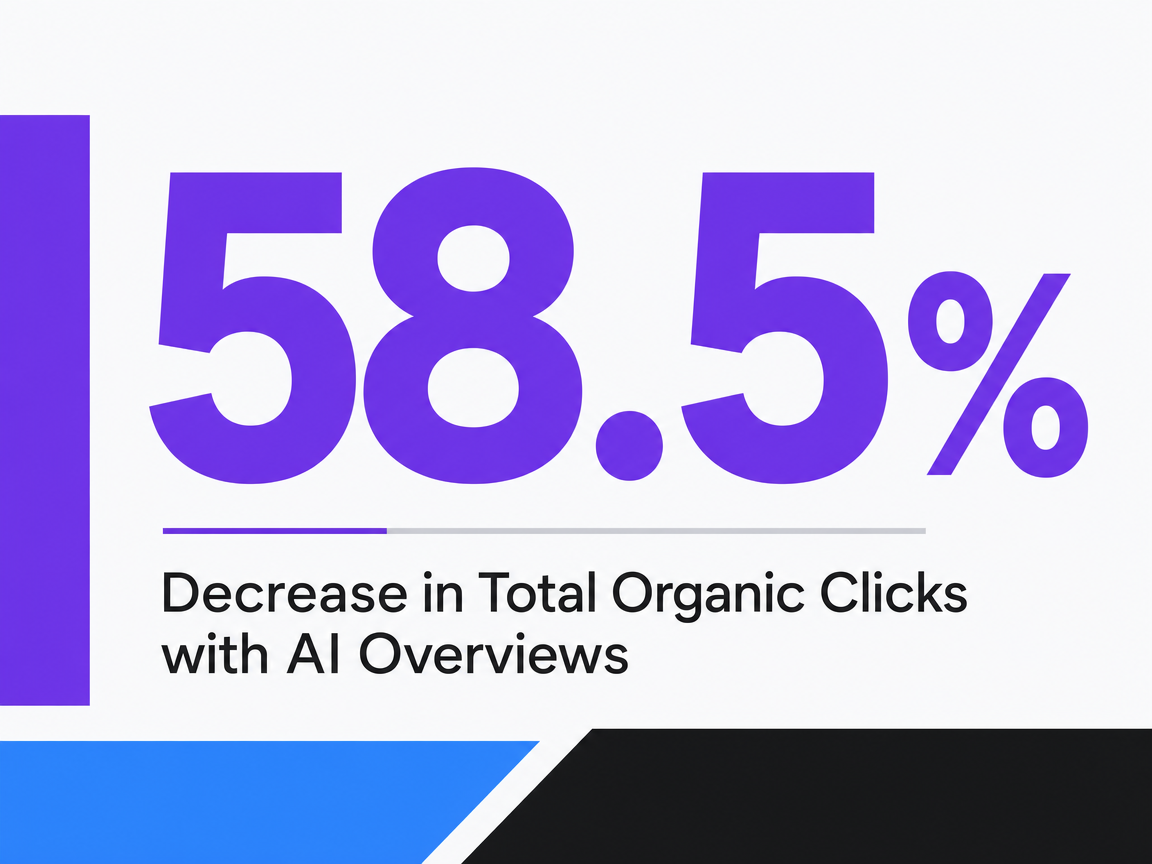 Decrease in Total Organic Clicks with AI Overviews
Decrease in Total Organic Clicks with AI Overviews
Frequently Asked Questions
References
- 1.Google AI Overviews & CTR: How to Fight Back.
- 2.Google AI Overviews Are Crushing CTRs: What 12 Studies Say.
- 3.Frequently Asked Questions.
- 4.AI overview SEO rank tracking: what actually works in 2025.
- 5.Awr Cloud.
- 6.Best Google AI Overviews Trackers: 10 Tools To Choose From.
- 7.12+ Best AI Overview Rank Tracking Software Options.
- 8.10 SERP Rank Tracking Tools Tested for 2026.
- 9.What Google Changed and Why Rank Trackers (and Pageviews) Are Taking a Hit.
- 10.15 Best AI Overviews Rank Tracking Tools (2026).
- 11.Study Confirms Google AI Overviews Cut Organic Clicks 38%.
- 12.New Research: Google's AI Overviews Now Cost Websites 58% of Their Clicks.
- 13.Solving the AI Overviews SEO Rank Tracking Problem.
- 14.Eye Tracking Study – Enquiro/Did-It/Strategic Results (Search Engine Land PDF).
- 15.Google’s AI Search and the CTR Shake-Up Across Sectors.
- 16.Google SGE: Study Reveals Potential Disruption for Brands & SEO.
- 17.Large Language Models Are Pushing the Web Toward Zero Clicks.