
Key Takeaways
- Position data alone no longer defends a retainer; ranking reports must connect SERP movement to leads and revenue, or the renewal conversation is already compromised 8.
- Every shortlist should pass five criteria: data fidelity, integration depth, AI reliability, reporting throughput, and first-party reconciliation with GSC and GA4 9.
- Ahrefs, Semrush, and SE Ranking cover the rank data source layer, but none of them closes the loop between position and pipeline on their own 8.
- Multi-location books need a separate local pack layer such as Local Falcon or BrightLocal, because national rank trackers miss the block-by-block variance clients actually see 10.
- Revenue attribution layers — call tracking, CRM connectors, and unified platforms like Vectoron — turn position changes into booked leads and defensible dollar figures in the monthly report 8.
- Reporting automation through AgencyAnalytics, Looker Studio, or Vectoron recovers more than ten hours per account per month once a book crosses roughly 50 accounts 8.
- Cost per account and accounts per manager decide margin; tier three unified stacks push the ceiling to 45–60 accounts per manager versus 15–20 on manual reporting 8.
- Multi-location stacks require per-location attribution rather than blended sitewide numbers, since regional-level modeling produces measurably more accurate impact estimates 2.
- The next quarterly tool review should test three questions: reconciliation without spreadsheets, position-to-revenue traceability, and current accounts-per-manager ratio against the documented ceiling 9.
Why position data alone no longer defends a retainer
Google's own documentation states that its ranking systems evaluate hundreds of billions of pages using many page-level and site-wide signals that shift continuously, including the March 2024 integration of the helpful content system into core ranking 1. A single position number, pulled on a single day from a single tool, cannot narrate that complexity to a client who is asking why the retainer renewed.
Agency leaders are running into the consequence in renewal conversations. A keyword climbed from position 8 to position 4, and the client asks what it produced. If the answer stops at the position, the retainer is exposed. The 2026 tools review of five SEO reporting platforms frames this shift directly: modern reporting is judged on whether rankings can be tied to leads and revenue, not on how many keywords sit in a dashboard 8.
The reporting guide most agencies quietly reference goes further, arguing that monthly SEO reports should carry 8–12 outcome-oriented KPIs and that impressions or raw rank counts drift toward vanity when they arrive without business context 11. That is the working definition of ranking report software worth paying for: it survives the question that follows the position change.
The five-criterion scorecard every shortlist should pass
Before any tool enters a shortlist, it should be measured against five criteria drawn from an evaluation framework built for agency rank tracking 9. The criteria are narrow on purpose: they filter out platforms that produce impressive dashboards but collapse the moment a client compares them to Search Console.
Data fidelity. : Rank data has to match what the client sees when they check a query themselves. Modeled positions, cached SERPs, and outdated location settings introduce drift. The Vectoron evaluation framework treats reconciliation with first-party sources as the non-negotiable step: rank tracker output must be checked against Google Search Console and GA4 before it reaches a client, because modeled positions and analytics data routinely diverge for the same URLs 9. A tool that cannot expose its methodology or refresh cadence fails this criterion.
Integration depth. : The platform must connect to GSC, GA4, and at minimum a call tracking or CRM system. Without that pipe, the reporting layer cannot move past position data into pipeline data.
AI reliability. : AI-generated summaries, forecasts, and anomaly flags are now standard. They are also a liability when unverified. The same evaluation framework warns that unverified AI-derived metrics erode client trust when they cannot be benchmarked against authoritative analytics 9. A tool that will not show its work does not belong on the shortlist.
Reporting throughput. : The measurable output is reports per account manager per week, and the ceiling on accounts one person can service before quality drops. This is the criterion that determines margin.
First-party reconciliation. : Distinct from data fidelity: reconciliation is the workflow, not the input. Does the platform surface the delta between its own numbers and GSC clicks or GA4 sessions, or does it force analysts to reconcile in a spreadsheet? Tools that automate the diff earn their place. Tools that hide it cost billable hours every month.
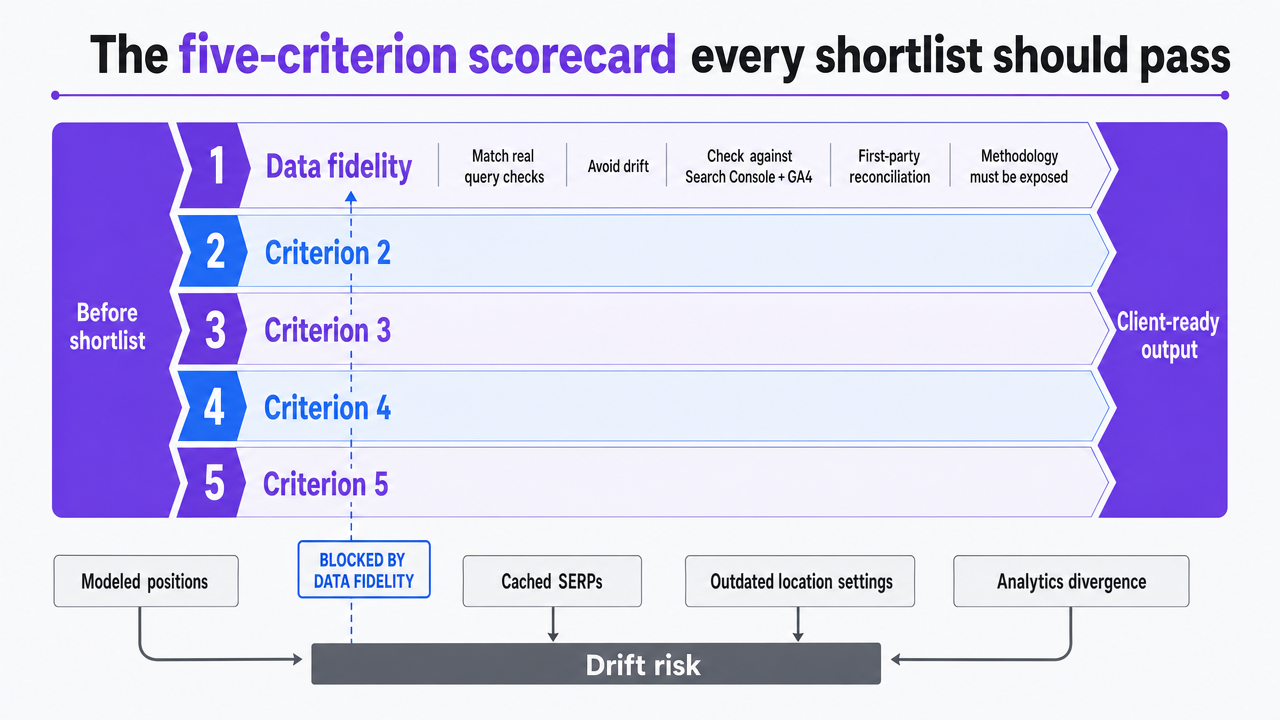 Visualize the five evaluation criteria as a scorecard framework directly cited in this section, giving readers a scannable reference for the shortlist test
Category one: rank data sources that survive client scrutiny
The base layer of any reporting stack is the rank data itself. Everything downstream — dashboards, revenue attribution, cadence — inherits whatever error lives in this input. Three tools dominate the category agency SEO leaders actually shortlist, and each earns its place on different grounds.
Ahrefs. Strongest on link-adjacent context and SERP feature tracking. Its Rank Tracker exposes position changes alongside SERP volatility indicators, which matters when a client asks whether a drop reflects a site issue or an algorithm shift Google itself describes as continuous across page-level and site-wide signals 1. Ahrefs is the safer choice when the client roster leans toward competitive commercial queries where SERP features (People Also Ask, video carousels, AI overviews) reshape click distribution more than raw position. It is referenced in the 2026 local and multi-location reporting stack as one of the two default organic rank trackers agencies pair with local pack tools 10.
Semrush. Broader in coverage across paid, PR, and content workflows, which matters when the account team is already producing cross-channel reports and needs one authentication layer instead of three. Position Tracking supports segmentation by device, location, and tag, and it is the second default organic rank tracker named in the 2026 multi-location reporting stack 10. For agencies whose retainers include paid search alongside SEO, Semrush reduces the number of tabs a manager holds open during a reporting week.
SE Ranking. The pragmatic option when the throughput criterion outweighs feature depth. The 2026 SEO tracking guide names it alongside Ahrefs and Semrush as an acceptable weekly rank tracking tool and explicitly recommends weekly rank monitoring paired with monthly ROI-focused reporting 11. Per-project pricing structure tends to make it the cheaper input line when a book of business runs deep on smaller accounts.
None of these three tools, on their own, closes the loop between position and pipeline. That is not a criticism — it is a category boundary. The 2026 tools review makes the point directly: rank trackers that stop at position data are being displaced in agency stacks by platforms that connect SERP performance to leads and revenue 8. The rank data source is the foundation, not the report.
The operator decision at this layer is narrower than most vendor comparisons suggest. Agencies weighing Ahrefs against Semrush are usually weighing existing team fluency, contract terms, and the shape of the client roster — not data quality gaps large enough to matter after reconciliation with Search Console. The heavier question is what sits on top of the rank data, and that is where the next three categories decide margin.
Test Real-Time SEO Ranking Reports Risk-Free
See actual client ranking data and report performance trends using your own live campaigns before committing.
Category two: local pack coverage as a separate P&L
Agencies serving multi-location clients — dental groups, home services franchises, senior living operators, regional law firms — are running a different business inside the same retainer line. Local pack rankings vary block by block, and traditional organic rank trackers built for national queries do not capture that geographic variance. The 2026 multi-location strategy guide is direct about it: local pack rankings shift by geographic position and are not captured by traditional rank trackers, which is why the local reporting stack requires dedicated tooling 10.
Local Falcon. Grid-based rank tracking that pings the local pack from dozens or hundreds of coordinates around a location, producing a heatmap rather than a single position number. This is the tool that answers the client question a national rank tracker cannot: where inside the service area is the business actually winning, and where is it invisible three blocks from the front door.
BrightLocal. Broader local SEO reporting suite that pairs local pack ranking with citation scoring, review monitoring, and GBP insights in one workspace. The 2026 guide names it alongside Local Falcon as a default local pack layer and pairs both with Ahrefs or Semrush for organic tracking 10. For agencies servicing 20+ locations under one brand, the citation and review modules reduce the number of separate subscriptions the account team logs into during a reporting week.
The reporting cadence is where this category becomes a separate P&L rather than a footnote. The 2026 multi-location guide maps each metric to a recommended tool and frequency: GBP Insights and local pack rank checks run weekly, review velocity and call tracking data feed weekly dashboards, and citation health, organic rank movement, and GA4 location-page performance consolidate into monthly reports 10. The weekly-monthly split matches the broader SEO tracking guidance that rank data should be monitored weekly while ROI-oriented KPIs report monthly 11.
The operator consequence is straightforward. An agency running local pack tracking off a national rank tool is producing reports the client's own phone data will contradict. A location can hold position 3 in a national tracker's simulated view and appear nowhere in the pack from a strip mall two miles east. When that gap surfaces in a QBR, the retainer is already losing.
Agencies with any meaningful multi-location book should budget the local pack layer as a separate line, not fold it into the organic rank tracker subscription. The math changes in the operator economics section, and the reporting workflow that makes it defensible sits in the next two categories.
Category three: revenue attribution layers that connect positions to pipeline
The attribution layer is where the retainer conversation actually gets won or lost. Rank data explains SERP position. Analytics explain sessions and conversions. Neither, on its own, tells the client what the last quarter of organic work produced in booked revenue — and that is the number the CFO reads.
Two categories of tooling sit on top of the rank data source to close that gap. The first is analytics and attribution platforms that ingest GSC clicks, GA4 events, and CRM or call tracking data so a keyword move can be traced to a form fill, a qualified call, or a closed opportunity. The second is unified execution platforms that pair the same integrations with an approval workflow, so the reporting output and the follow-up work sit in one governed loop.
CallRail and CallTrackingMetrics. The default call attribution layer for service verticals where the phone still closes the sale — legal, dental, home services, senior living. Dynamic number insertion ties an organic session to a specific inbound call, and call scoring turns that call into a qualified lead flag the client's ops team recognizes. The 2026 multi-location reporting stack names call tracking as a weekly data feed alongside GBP Insights and local pack rank checks 10. Without this layer, agencies reporting on service-business clients are guessing at the conversion count that matters most.
HubSpot, Salesforce, and native CRM connectors. The pipeline layer. When rank tracker data, GSC clicks, and GA4 sessions land in a CRM alongside opportunity stage and deal value, the monthly report can name a dollar figure attached to organic. The 2026 reporting tools review is direct about the shift: modern SEO reporting platforms are being judged on cross-channel dashboards and CRM integration, not on keyword coverage 8.
Vectoron. A unified AI execution platform that pairs rank tracking and reporting with specialist strategists for content, SEO, PPC, backlinks, social, and call intelligence in one approval workflow. Under the five-criterion scorecard, its argument is on integration depth and reporting throughput: rank data reconciles against GSC and GA4 before it reaches a client, and account managers save more than ten hours per account per month through automated reporting workflows 8, 9. Agencies with 40+ accounts and a mixed service-vertical roster are the profile that should shortlist it.
The measurement standard the attribution layer should aspire to comes from outside SEO. IAB/MRC retail media guidelines require transparency, empirically supported attribution windows, and disclosed methodology as baseline conditions for defensible ROI reporting 4. Organic reporting rarely meets that bar. Agencies that build the attribution layer to those standards — documented lookback windows, disclosed data sources, reconciled inputs — hold retainers longer than agencies that ship position screenshots with a revenue narrative attached in the executive summary.
Category four: reporting automation that scales past 50 accounts
Reporting throughput is the criterion that decides whether a book of business scales or hires. Once an agency crosses roughly 50 accounts, the manual production of monthly decks becomes the operational bottleneck: not the rank data, not the attribution logic, but the hours an account manager spends assembling a report each client will glance at for four minutes.
The 2026 SEO reporting tools review quantifies the ceiling. In its comparison of five agency-focused platforms, automated reporting workflows deliver more than ten hours per account manager per month in recovered time — hours that were previously spent pulling screenshots, reconciling numbers across tabs, and rewriting narrative sections in a template 8. Across a 60-account book, that is 600 hours per month, or roughly three full-time equivalents held on staff to produce documents no one on the client side reads end-to-end.
Three tools carry the category for agencies at that scale.
AgencyAnalytics. White-label reporting with more than 75 integrations, scheduled delivery, and per-client dashboards. The strength is breadth of connectors; the operator consequence is that the reconciliation between rank tracker output, GSC clicks, and GA4 sessions still lives with the account manager unless the agency builds custom logic on top 9. Best fit for agencies where reporting volume outweighs analytical depth.
Looker Studio with connector layers (Supermetrics, Windsor.ai). The technical option. Full flexibility on data joins, custom calculations, and blended metrics. The cost is engineering time: someone on staff has to own the template library and the connector renewals. Agencies with a dedicated analytics engineer run this stack profitably. Agencies without one accumulate template debt.
Vectoron. Pairs rank tracking, GSC and GA4 reconciliation, and call intelligence with an approval workflow that surfaces the report and the recommended next actions in one governed loop. The throughput argument sits on the ten-plus hours per account per month figure that defines the category ceiling 8, applied against the reconciliation-first principle the evaluation framework requires 9. The trade-off is opinionation: the workflow assumes a specific reporting cadence and KPI shape rather than accommodating every legacy template.
The measurable output of this category is not report volume. It is the ratio of accounts to managers before quality drops — the number that lands in the operator economics section next.
See How Real-Time Ranking Reports Streamline Client ROI Proof
Discover how automated SEO ranking reports with live data can reduce reporting hours and deliver client-facing ROI insights at scale. Speak with our team to benchmark your current process against leading agency workflows.
Operator economics: cost per account and accounts per manager
The two numbers that decide whether an SEO book of business earns margin are cost per account per month and accounts per manager. Every other tooling decision is downstream of those.
Three stack tiers cover most agency configurations. Tier one is a standalone rank tracker with GSC and GA4 pulled manually into a slide deck. Tier two adds a dedicated local pack tool and a reporting automation layer on top. Tier three consolidates rank tracking, reconciliation, attribution, and workflow into a unified execution platform. Pricing varies enough by contract and account count that specific dollar figures cannot be quoted without inventing them, but the shape of the math holds across agencies.
| Stack tier | Tooling cost per account | Analyst hours per account per month | Accounts per manager (ceiling before quality drops) |
|---|---|---|---|
| Tier 1: standalone rank tracker + manual reporting | Low (rank tracker seat allocated across accounts) | 12–15 hours (manual pulls, spreadsheet reconciliation, deck assembly) | 15–20 |
| Tier 2: rank tracker + local pack tool + reporting automation | Medium (three subscriptions layered) | 4–6 hours (automation absorbs report assembly; reconciliation still partly manual) | 30–40 |
| Tier 3: unified execution platform with reconciled rank, attribution, and workflow | Higher per-account seat, fewer overlapping subscriptions | Under 4 hours (10+ hours per account recovered vs. tier 1 baseline) | 45–60 |
The ten-plus hour figure per account per month is drawn from the 2026 comparison of agency-focused reporting platforms, which quantified the time recovered when automated workflows replace manual report production 8. Applied across a 60-account book, the tier three configuration frees roughly three full-time equivalents relative to the tier one baseline.
The trap in this math is treating tooling cost as the primary lever. It is the smaller line. The larger line is the manager headcount required to hold the accounts-per-manager ratio at a defensible quality level, and that ratio moves most when reconciliation and reporting throughput are engineered together rather than bolted on 9. Agency heads reviewing next year's stack should model the two numbers side by side before renewing any single tool.
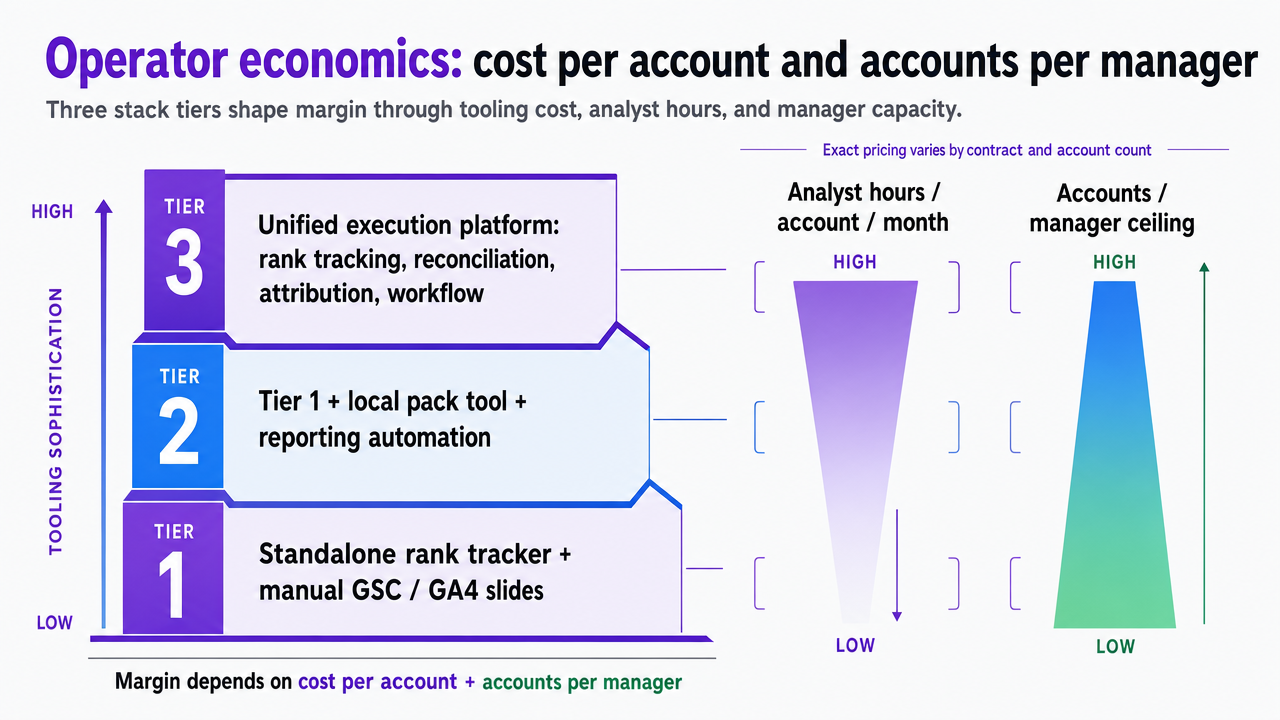 Reinforce the three-tier stack comparison table in this section by presenting the accounts-per-manager ceiling and analyst hours per account as a visual tier ladder, matching the numbers cited in the prose
If a book of business is multi-location: adjusting the stack
The stack shape changes when the book leans heavily on multi-location clients — dental groups, home services franchises, senior living operators, regional legal networks. The base categories still apply, but the weighting shifts and the reporting cadence tightens.
Two adjustments carry most of the difference. First, the local pack layer moves from optional to primary. A national rank tracker producing simulated positions for a 40-location dental group will contradict what each office manager sees on their own phone, and that contradiction surfaces in QBRs before the account team can defend it. Grid-based tools and local SEO suites are the input line, not the polish 10. Second, attribution has to run per location rather than blended sitewide. Nielsen's MMM research on regional versus national modeling found that regional-level data produced measurably more accurate marketing impact estimates across the 19 Japanese models analyzed 2, and the operator translation is direct: a blended sitewide ROI number hides which locations are earning the retainer and which are dragging the average.
The reporting cadence follows suit. GBP insights, local pack rank checks, review velocity, and call tracking feed weekly dashboards per location; citation health, organic rank movement, and GA4 location-page performance consolidate monthly 10. Agency heads pricing this book should model per-location tooling cost rather than per-account, because a single 40-location client can consume more reporting throughput than fifteen single-site accounts combined.
A decision framework for the next quarterly tool review
The next stack review does not need another feature grid. It needs three questions answered in order, with the current tooling failing or passing each one before the next is asked.
- One: does the rank data reconcile against Google Search Console and GA4 without an analyst rebuilding the join in a spreadsheet? If reconciliation lives in a manual workflow, the reported numbers will drift from what the client sees, and the retainer conversation is already compromised 9.
- Two: can a position change be traced to a booked lead, a qualified call, or a closed opportunity inside the same reporting surface? IAB/MRC guidelines set the bar for defensible attribution — disclosed methodology, documented lookback windows, empirically supported models 4. Organic reporting should be held to the same standard.
- Three: what is the current accounts-per-manager ratio, and where does it sit relative to the tier three ceiling of roughly 45–60 accounts documented against the ten-plus hour recovery figure 8?
Two failures out of three means the stack is the bottleneck, not the headcount. Vectoron is one option to shortlist against that diagnostic.
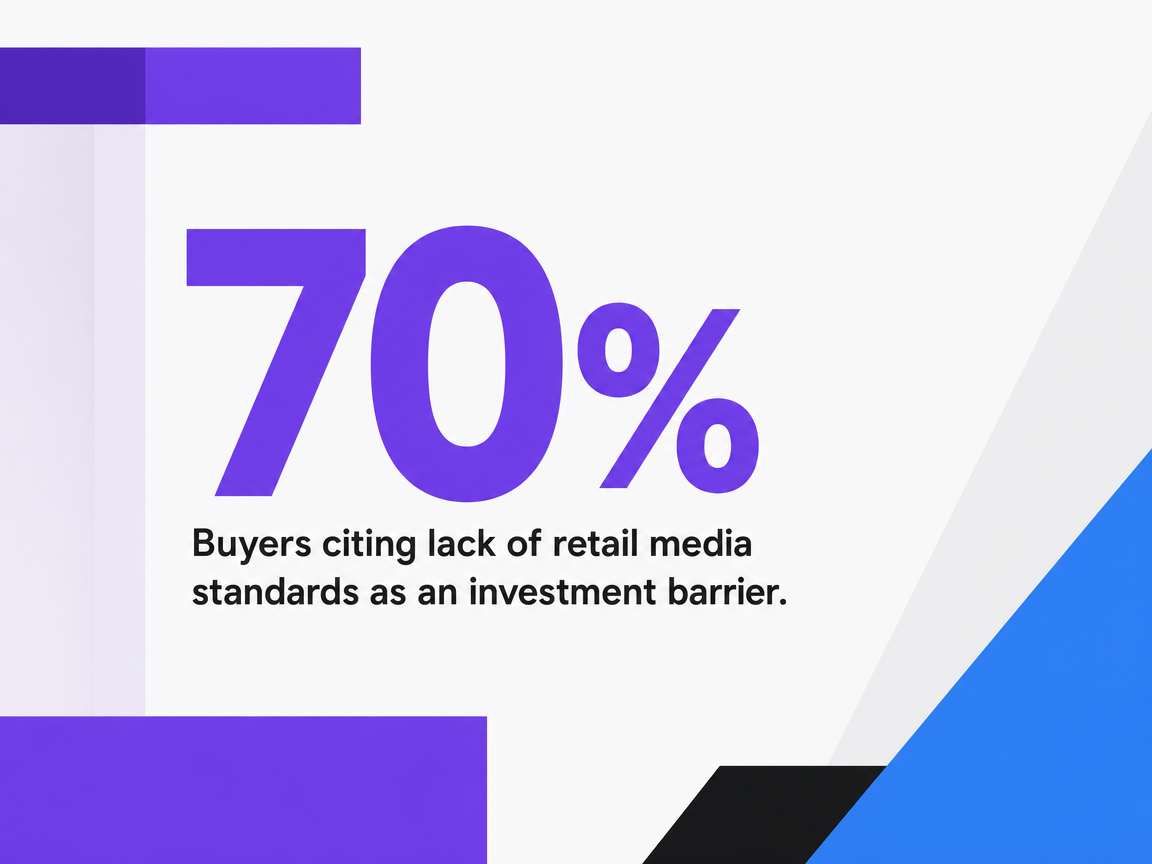 Buyers citing lack of retail media standards as an investment barrier
Buyers citing lack of retail media standards as an investment barrier
Frequently Asked Questions
References
- 1.A Guide to Google Search ranking systems.
- 2.Granular data drives better accuracy in your market predictions.
- 3.Marketing mix modeling best practices: Understanding why ....
- 4.IAB/MRC Retail Media Measurement Guidelines.
- 5.IAB-Europe\_Retail-Media-Measurement-Standards-2024.pdf.
- 6.MRC Viewable Ad Impression Measurement Guidelines.
- 7.MRC Digital Audience-Based Measurement Standards.
- 8.5 SEO Reporting Tools That Prove Revenue (2026 Review).
- 9.Seo rank tracking software evaluation for maximizing client ROI.
- 10.Local SEO Multi-Location: Complete Strategy Guide.
- 11.SEO Tracking: Metrics, Tools & Reporting Guide.