
Key Takeaways
- Profound leads multi-engine AI visibility work with agent analytics and citation tracking across ChatGPT, Perplexity, Gemini, and AI Overviews, earning its slot on accounts where GEO reporting is the retainer's headline 3, 4.
- Peec AI wins on competitive citation benchmarking and share-of-voice reporting against named rivals, though adoption still trails incumbents with only 8 practitioner mentions versus 73 for Ahrefs 7.
- Rankscale AI delivers query-level position tracking against curated prompt sets, fitting clients who sell into narrow, high-intent research queries where aggregate mention counts would miss the point 4.
- AIClicks is architected natively for generative answer engines rather than bolted onto SEO infrastructure, reporting in vocabulary that brand and comms stakeholders already use 3.
- Semrush AI Toolkit is rated the most complete AI search visibility platform in 2026 comparative testing and enters agency workflows without new procurement, appearing on 61 practitioner dashboards 3, 7.
- Ahrefs Brand Radar sits atop practitioner adoption with 73 mentions, extending an existing backlink and content graph into AI mention tracking without asking analysts to learn a new data model 7, 3.
- BrightEdge and seoClarity fit enterprise-agency rosters with governance and reporting depth built for tens of thousands of tracked terms, but rarely pencil out on mid-market accounts 12.
- Vectoron represents the execution-integrated archetype, wiring visibility diagnostics to content, SEO, and backlink production in one approval-routed workflow to solve throughput without adding a specialist per account 12.
Why the AI Visibility Stack Split Into Three Camps
The tool market for AI visibility did not consolidate in 2026. It fractured. Vendors that started as monitoring startups, incumbent SEO suites that added AI modules, and platforms that bind diagnostics to production now compete for the same agency line item, and each solves a different piece of the delivery problem.
The 2025 SEOFOMO practitioner survey captured the split in real time: agencies reported running AI visibility work through Ahrefs, Google Analytics 4, and Semrush far more often than through AI-native entrants like Profound or Peec.ai, even as those newer platforms drew growing mentions 7. Vendor catalogs published the same year listed dozens of GEO monitoring and content platforms, from Superlines and Rankscale.ai to Kai, ALLMO.ai, Scrunch, and SEOMonitor, each mapped to monitoring, content, or hybrid roles 1.
Three functional camps have emerged from that noise:
- AI-native monitors track prompt-level share of voice and citations inside answer engines 4.
- Extended SEO suites layer AI overview tracking and brand mention analytics onto existing keyword infrastructure 3.
- Execution-integrated platforms connect visibility diagnostics to content, SEO, and backlink production in a single approval-routed workflow 12.
For a Head of SEO running a client roster, the question is not which tool wins. It is which combination of camps produces reportable results without adding a specialist per account.
The Measurement Gap Agencies Are Selling Into
Two numbers from McKinsey's October 2025 research define the commercial opportunity in AI visibility. Forty-four percent of AI-powered search users now say generative engines are their primary and preferred source of insight, ahead of the 31 percent who still name traditional search. Only 16 percent of brands systematically track AI search performance 8. The demand curve has moved. The measurement infrastructure has not.
For a Head of SEO, that gap is the entire pricing argument for a GEO retainer. Client executives are watching their own buying committees switch from Google to ChatGPT, Perplexity, and Gemini for early-stage research, then arriving in Monday meetings asking why the brand does not appear in AI answers. The agencies that can produce a defensible visibility baseline, a competitive benchmark, and a monthly delta report own that conversation before an in-house hire is even scoped.
The 16 percent figure also sets a ceiling on how long the arbitrage lasts. Once tracking becomes standard, GEO reporting shifts from differentiator to table stakes, and margin compresses toward traditional SEO economics. The window to productize AI visibility as a premium line item is measured in quarters, not years, and it favors agencies that move before their client roster starts asking for it by name.
How Practitioners Actually Track AI Visibility Today
The tooling gap between what agencies say they want and what they actually run is wider than most vendor decks admit. In the September 2025 SEOFOMO practitioner survey on AI search optimization, respondents named Ahrefs 73 times, Google Analytics 4 64 times, and Semrush 61 times when describing their AI visibility dashboards. Profound drew 14 mentions, Peec.ai drew 8, and Otterly drew 5 7.
The ratio matters more than the raw counts. Incumbent SEO platforms show up roughly five to nine times more often than the AI-native monitors that trade press ranks as category leaders. Two forces explain the gap:
- Existing seats are already paid for and already integrated into client reporting, so extending them to AI Overview tracking and brand mention analytics carries almost no procurement friction.
- AI-native tools require a separate contract, a separate login, and a separate line in the client invoice, which slows adoption even when the underlying data is better.
For a Head of SEO, the practical read is that most portfolio work still runs through the tools the team already knows. The strategic question is which accounts justify a second, purpose-built layer on top of the incumbent stack, and which do not.
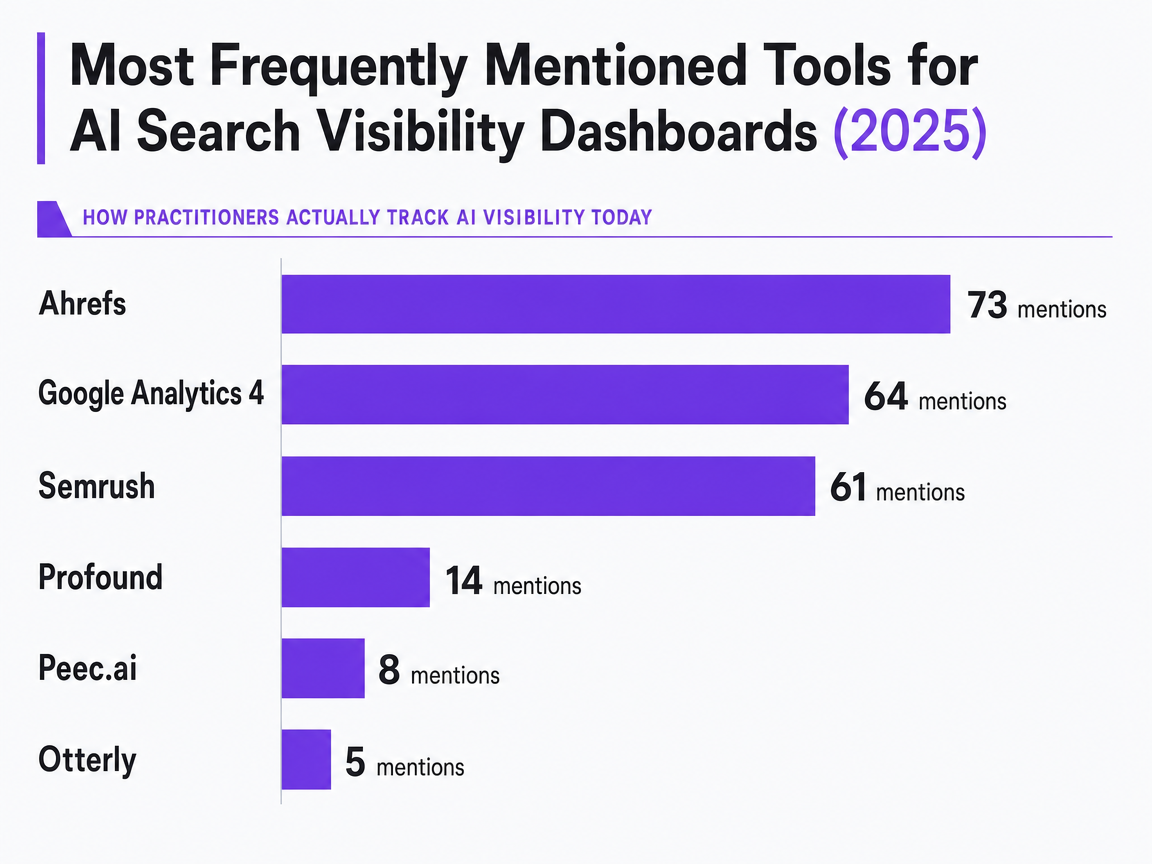 Most Frequently Mentioned Tools for AI Search Visibility Dashboards (2025)
A breakdown of tools mentioned by practitioners in a 2025 survey on AI search optimization, showing the relative popularity of different platforms for visibility tracking and reporting.
The Three Archetypes, Mapped
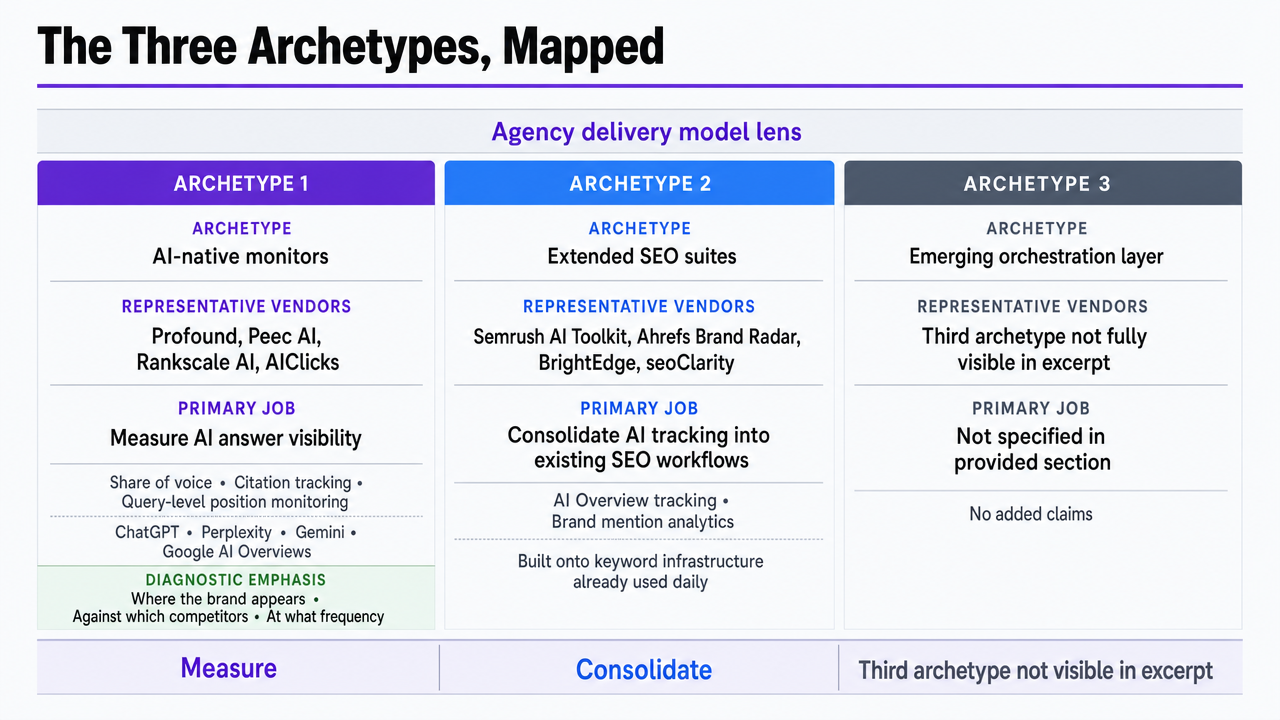
A cleaner way to read the 2026 market is to stop ranking individual products and start sorting them by the job they do inside an agency delivery model. Three archetypes now cover almost every serious vendor on a Head of SEO's shortlist.
AI-native monitors exist to measure. Profound, Peec AI, Rankscale AI, and AIClicks were built for prompt-level share of voice, citation tracking, and query-level position monitoring inside ChatGPT, Perplexity, Gemini, and Google's AI Overviews 4, 3. Their primary job is diagnostic: tell an agency where a client brand appears in AI answers, against which competitors, at what frequency.
Extended SEO suites exist to consolidate. Semrush AI Toolkit, Ahrefs Brand Radar, BrightEdge, and seoClarity added AI Overview tracking and brand mention analytics onto keyword infrastructure that agency teams already run daily 3, 12. Their job is coverage inside a seat an agency has already paid for, with reporting that folds into existing client deliverables.
Execution-integrated platforms exist to close the loop. This category unifies AI visibility diagnostics with content, SEO, and backlink execution in an approval-routed workflow, framed for agencies scaling client rosters without adding a specialist per account 12. Their job is throughput: turn a citation gap or share-of-voice deficit into approved, published work without a separate production stack.
An infographic mapping the three columns side by side, with representative tools and the primary job-to-be-done under each, is the single artifact worth pinning to an internal stack memo. It reframes the buying question from "which tool is best" to "which two or three archetypes belong in the same portfolio."
Test AI-driven optimization workflows in real scenarios
Experience full-scale AI visibility optimization on your live content with measurable outcomes before committing.
AI-Native Monitors: Prompt-Level Share of Voice
Profound
Profound is the tool most often named when GEO practitioners describe multi-engine visibility work at agency scale. Industry reviews position it as a standout 2025 entrant in AI search analytics, and a leading choice for agency and enterprise teams that need to track brand presence across ChatGPT, Perplexity, Gemini, and Google's AI Overviews from one console 3, 4.
Its differentiating job inside a delivery model is agent analytics paired with multi-engine tracking. Profound reports which prompts trigger a brand mention, which competitors appear in the same answer set, and how citation share moves week over week 4. For a Head of SEO, that translates into a defensible baseline report and a monthly delta a client executive can read without translation.
The trade-off is procurement. Profound sits outside an incumbent SEO seat, so it enters the roster as a net-new line item. Agencies typically justify it on the two or three accounts where AI visibility is the retainer's headline deliverable, not on every book of business.
Peec AI
Peec AI competes in the same category but wins on a narrower job: citation monitoring and competitive benchmarking. GEO practitioner guides credit it with a strong reputation for share-of-voice reporting against named competitors, which is the exact artifact agency strategists need when a client asks why a rival keeps surfacing in ChatGPT answers 4.
Adoption still trails the incumbents. The 2025 SEOFOMO practitioner survey recorded eight mentions of Peec.ai for AI visibility dashboards, against 73 for Ahrefs and 61 for Semrush 7. That ratio is the operational tell. Peec produces the cleanest competitive citation reporting in the category, but it does not yet enter agencies through existing procurement rails.
The practical fit is a targeted layer on accounts where competitive positioning inside AI answers is the client's stated pain, rather than a portfolio-wide rollout. Its output slots into an executive dashboard without a data engineer, which is what earns it a seat next to an incumbent suite.
Rankscale AI
Rankscale AI narrows further. GEO expert guides describe it as a query-level position tracker inside AI answer engines, meaning it reports where a brand ranks against specific prompts rather than aggregating into a single share-of-voice score 4. Vendor catalogs also list it among the more visible monitoring entrants in the 2025 GEO landscape 1.
The job it does well is diagnostic depth on a defined prompt set. An agency strategist can hand Rankscale a hundred client-relevant queries and get back position data granular enough to inform an editorial brief or a schema fix.
The limit is scale. Query-level tracking is only useful if the prompt list is curated and maintained, which adds analyst hours. Rankscale earns its slot on accounts where the client sells into narrow, high-intent research queries and a coarse mention count would miss the point.
AIClicks
AIClicks is the entry in this camp that reviewers most explicitly frame as purpose-built for AI answers rather than bolted onto a legacy SEO codebase. The 2026 AIToolRush comparative review calls it a GEO platform built specifically for generative answer engines, positioning it against extended SEO suites that added AI modules to keyword infrastructure 3.
The job it targets is native GEO analytics without SEO framing baggage. Metrics, dashboards, and workflows are structured around prompts, citations, and answer coverage rather than keywords and SERP positions.
For a Head of SEO, that architectural choice matters when the client team includes brand, comms, or research leaders who read AI visibility as a communications KPI, not a technical SEO output. AIClicks reports in the vocabulary those stakeholders already use, which shortens the reporting conversation and reduces translation work inside the account team.
Extended SEO Suites: Bolt-On Coverage With Incumbent Data
Semrush AI Toolkit
Semrush's AI Toolkit is the extended-suite entry that 2026 reviewers rate most aggressively. AIToolRush's comparative testing calls it the most complete AI search visibility platform in 2026, crediting its engine coverage and citation analytics for closing much of the functional gap with purpose-built GEO monitors 3. Practitioner adoption backs the vendor claim: the 2025 SEOFOMO survey logged 61 Semrush mentions when respondents described their AI visibility dashboards, placing it third behind Ahrefs and Google Analytics 4 7.
The job it does inside an agency is scale without new procurement. Account teams already run Semrush for keyword, technical, and competitor work, so AI Overview tracking and brand mention analytics flow into existing client reports without a second contract or a second login. For a Head of SEO, that turns AI visibility from a pilot line item into a default deliverable across the roster.
Ahrefs Brand Radar
Ahrefs sits at the top of the practitioner adoption curve for AI visibility work. The 2025 SEOFOMO survey recorded 73 Ahrefs mentions when respondents named tools they use to track AI search performance, more than any other platform in the field 7. Brand Radar is the module 2026 reviewers cite specifically for AI search visibility, positioned alongside Semrush AI SEO Toolkit and purpose-built entrants in comparative rankings 3.
The delivery advantage is the same one that put Ahrefs on 73 dashboards: the backlink and content graph is already the source of truth for most agency SEO teams. Brand Radar extends that graph into AI mention tracking without asking analysts to learn a new data model, which is why it enters client accounts faster than any AI-native monitor in the category.
BrightEdge and seoClarity
BrightEdge and seoClarity target the enterprise-agency end of the extended-suite market. Agency-focused guides list both alongside Semrush AI Toolkit as core AI visibility options for teams managing enterprise client rosters, with reporting depth and governance features that suit large in-house partnerships 12.
The job they do well is enterprise reporting scale. Both platforms were built to run tens of thousands of tracked terms across brand portfolios, and their AI Overview and answer-engine modules inherit that infrastructure. For a Head of SEO on an enterprise book, that means AI visibility metrics land inside the same weekly executive dashboard clients already read, with role-based access and audit trails procurement teams expect.
The trade-off is fit for smaller rosters. Enterprise contracts and implementation timelines make BrightEdge and seoClarity difficult to justify on mid-market accounts, where an AI-native monitor plus an incumbent seat covers the same reporting need at lower total cost.
Execution-Integrated Platforms: Diagnostics Wired to Production
The Category Problem
Monitoring tells an agency where the citation gap sits. It does not close the gap. That work still runs through a separate content stack, a separate SEO audit tool, a separate outreach team, and a separate approval chain, with each handoff introducing lag between the diagnostic and the published fix.
McKinsey's GEO framework makes the handoff problem explicit. The four recommended moves describe an execution loop, not a dashboard 2:
- Run a diagnostic.
- Expand content into influential third-party sources.
- Optimize content structure for LLMs.
- Build GEO as a cross-functional capability.
Digital Ink's synthesis of the same framework reinforces that GEO performance depends on tying diagnostics to content, structure, and organizational workflow rather than treating visibility as a reporting output 2.
Execution-integrated platforms are the archetype that tries to collapse that loop into one approval-routed workflow, and Vectoron is the entry agency guides currently name in the category 12.
Vectoron
Vectoron is positioned in 2026 agency guides as the execution-integrated entry that unifies AI visibility diagnostics with AI-powered content, SEO, and backlink execution inside a single approval-routed workflow 12. The same guide frames the design choice against standalone monitors: Profound and Peec AI lead the AI-native monitoring category with prompt-level share-of-voice benchmarking, while Vectoron's category solves for delivery capacity by wiring those diagnostics to production output 12.
The job it targets inside an agency is throughput without headcount. A citation gap surfaced in a diagnostic becomes a ranked recommendation, and the content, on-page, or backlink work needed to close it is queued for human sign-off before execution 12. For a Head of SEO managing a client roster, that shortens the distance between a monthly visibility report and the published work that moves next month's numbers, without adding a specialist per account.
The category trade-off is scope. An execution-integrated platform is not a replacement for a purpose-built AI-native monitor on accounts where prompt-level share of voice against named competitors is the primary deliverable. It sits alongside one, absorbing the diagnostic output into a production pipeline the agency already governs.
See How Leading Agencies Streamline AI Visibility Optimization in 2026
Request a tailored walkthrough of unified AI optimization workflows that cut manual effort, improve reporting accuracy, and enable seamless oversight across all client accounts.
If You Manage a Multi-Client Roster: The Delivery-Economics Model
Scope shift: this section is written for Heads of SEO carrying portfolio P&L, not for single-account operators. The economics of adding AI visibility work change once the decision runs across a client roster rather than a single retainer.
The choice reduces to three cost shapes:
- Extending an incumbent SEO suite adds AI Overview and brand mention modules to seats an agency already pays for, which spreads across every account without a new per-client fee.
- An AI-native monitor enters as a discrete subscription, typically justified on the accounts where prompt-level share of voice is the retainer's headline deliverable 4.
- A GEO specialist FTE loads fully burdened salary against the roster and only pencils out once enough accounts carry a GEO line item to absorb it.
The sensitivity model a Head of SEO can build on the back of an envelope uses three variables:
S : Fully loaded specialist cost per year.
N : Number of accounts on the roster.
M : Monitoring subscription cost per account per year (left as a placeholder because no source in the supplied research states pricing for named platforms).
| Delivery model | Annual cost shape | Break-even signal |
|---|---|---|
| Extended SEO suite (incumbent) | Included in existing seat | Default across all N accounts |
| AI-native monitor (added layer) | M × accounts carrying GEO line item | Client retainer premium > M per account |
| GEO specialist FTE | S per year | Combined GEO retainer premium across N > S |
Execution-integrated platforms sit alongside this model rather than inside it, because they trade specialist headcount for approval-routed production capacity across the roster 12. The read for a Head of SEO is straightforward: default to the incumbent suite as the baseline, layer an AI-native monitor on the accounts that pay for prompt-level reporting, and evaluate an execution layer once the diagnostic-to-production handoff becomes the constraint on margin.
How Agencies Are Productizing GEO in 2026
The measurement gap did not go unnoticed by agency holding companies. Media and PR shops from Jellyfish to WPP's Burson have already responded by launching proprietary tools that rank and analyze brand visibility in AI search results, treating GEO as a productizable service line rather than a research project 9. That move signals where the category is heading: agencies that wait for a category-leading vendor to consolidate the market will find the reporting layer already claimed by competitors selling it as a branded deliverable.
The productization pattern breaks into three shapes:
- Some agencies license an AI-native monitor and wrap it in a branded dashboard and monthly narrative.
- Others build a thin proprietary scoring layer on top of practitioner staples like Ahrefs, GA4, and Semrush, which the 2025 SEOFOMO survey confirms are already running inside most client accounts 7.
- A smaller cohort adopts an execution-integrated platform and sells the diagnostic-to-published-fix cycle as the retainer's core value, positioning capacity rather than reporting as the differentiator 12.
For a Head of SEO, the read is that GEO is being packaged now, with or without an internal decision. The choice is whether the agency's version ships this quarter or after the client asks who else offers it.
Building the Stack: A Decision Path for Heads of SEO
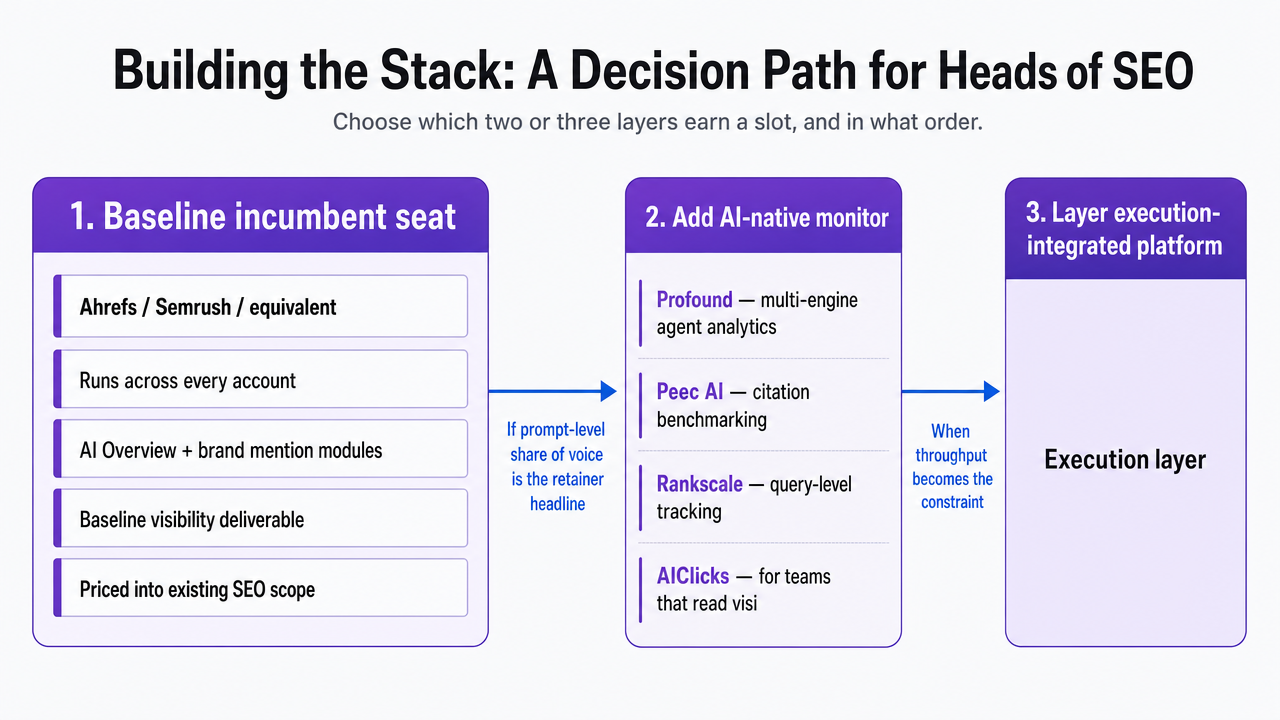
The stack question resolves cleanly once the three archetypes are separated. A Head of SEO does not pick one winner. The task is deciding which two or three layers earn a slot inside the portfolio, and in what order.
- Start with the incumbent seat. Ahrefs, Semrush, or an equivalent already runs across every account, and its AI Overview and brand mention modules extend to the full roster without new procurement 7. That layer becomes the baseline visibility deliverable on every retainer, priced into existing SEO scope rather than sold as a separate line.
- Add an AI-native monitor on the accounts where prompt-level share of voice against named competitors is the retainer's headline. Profound for multi-engine agent analytics, Peec AI for citation benchmarking, Rankscale for query-level tracking, AIClicks when the client team reads visibility as a communications KPI 3, 4. One purpose-built monitor per qualifying account, not one across the book.
- Layer an execution-integrated platform once the constraint on margin shifts from diagnostic quality to production throughput 12. That is the sequencing signal: when monthly reports flag gaps faster than the team can ship approved fixes, the missing piece is capacity, not measurement.
Frequently Asked Questions
References
- 1.AI Tools 2025: The Ultimate Report for AI SEO & GEO Platforms.
- 2.How AI-Driven Search Is Reshaping Brand Visibility and SEO.
- 3.Best AI Search Visibility Tools in 2026 (Tested & Ranked).
- 4.Best AI Search Visibility Tools 2025 for GEO Experts.
- 5.Beyond Google: Why LLM SEO Is the New Battleground for Brand Visibility.
- 6.How LLMs Are Changing SEO & Marketing Strategy.
- 7.The State of AI Search Optimization - 2025 Edition.
- 8.New front door to the internet: Winning in the age of AI search.
- 9.In Graphic Detail: How AI search is changing brand visibility.
- 10.How Generative AI is Reshaping Search Visibility in 2025.
- 11.AI SEO Statistics 2025 | AI Search Trends & LLM Visibility.
- 12.Best AI Search Visibility Optimization Tool for Agencies Guide.