
Key Takeaways
- Topic selection is a pipeline-allocation decision, not keyword research. Every proposed topic should pass one gate: if it ranked in the top three tomorrow, would it create a sales conversation? 11
- Distribute a 20-topic quarter across intent tiers rather than search volume, since transactional queries convert at 8–15% versus 1–3% for informational — a 3–4x gap 3.
- B2B plans need a procurement layer most guides skip: ROI calculators, security and compliance pages, implementation guides, and vendor-evaluation checklists that unblock late-stage deals 6.
- Grade topics against pipeline using Forrester's touch analysis — opportunity influence, stage progression, and cluster contribution — not rankings screenshots, and retire topics with no CRM presence regardless of traffic 14.
The pipeline test every proposed topic should have to pass
The CMO wants pipeline attribution. Sales wants a post about a competitor. The content calendar wants ten new titles by Friday. Somewhere in that pressure, topic selection stops being a strategy exercise and starts being a queue of requests.
That is the wrong frame. SEO topic selection is a pipeline-allocation decision. Every slot in a quarterly plan is a bet on where organic search can produce sales conversations, and every bet has an opportunity cost. Treating the decision as keyword research — pull a list, sort by volume, filter by difficulty — is what produces calendars full of traffic that never converts.
A simpler gate belongs at the front of the process. Before a topic enters the plan, it should have to answer one question: if the page ranked in the top three tomorrow, would it create a sales conversation? 11 The question is deliberately blunt. It disqualifies most trend commentary, most generic definitions, and most competitor-name posts that lack a comparison angle. It also protects the informational topics that genuinely extend a converting cluster, because those do eventually create conversations through the pages they feed.
What follows is a method for building the plan around that test — a portfolio model weighted by intent, a scoring rubric a manager can defend in a spreadsheet, and a measurement approach that ties topic decisions to opportunities rather than rankings screenshots.
Treat topic selection as portfolio allocation, not keyword research
Why intent distribution should decide production capacity
Search volume and buyer readiness are inversely correlated, and that single fact should reorganize how a content team spends its writing hours.
A 2026 analysis of query distribution and conversion behavior 3 estimated that informational queries account for 55–60% of all searches, navigational for 10–15%, commercial for 15–20%, and transactional for 10–15%. The same analysis measured conversion rates of 1–3% on informational queries and 8–15% on transactional ones — a 3–4x gap between the largest slice of search volume and the smallest slice that actually produces buying signals 3. Commercial-investigation queries sit in the middle, closer to transactional than informational in conversion behavior 3.
Read that gap as a capacity instruction, not a keyword insight. If a team allocates production hours in proportion to search volume, roughly six of every ten posts will target queries that convert at 1–3%. If a team allocates in proportion to conversion probability, the ratio flips. The right answer is neither extreme, but the default should lean toward the smaller, denser end of the intent spectrum where a ranked page has a defensible chance of producing a sales conversation.
An HR-tech content manager weighing 'what is an applicant tracking system' against 'greenhouse vs. lever' is not choosing between two topics of equal weight. The first sits in the 55–60% volume bucket at a 1–3% conversion floor. The second sits in the 15–20% commercial bucket at three to four times the conversion rate 3. Both can belong in a plan. Only one earns its slot on conversion math alone.
Production capacity is finite. Distribute it against where opportunities live, then backfill informational coverage where it demonstrably feeds a converting cluster.
A defensible default split for a 20-topic quarter
A quarterly plan of 20 topics is a useful working unit — small enough to defend line by line, large enough to cover more than one revenue theme. The question is how those 20 slots get distributed across intent tiers.
A defensible default, grounded in the conversion-rate deltas above 3 and the procurement extension of the B2B funnel 6, looks like this:
- 4 transactional topics. Pricing pages, category and solution pages, direct-comparison pages against named competitors, and free-trial or demo landing pages. These are the shortest path from a ranked SERP to a sales conversation.
- 6 commercial-investigation topics. 'Best' lists in the buyer's category, alternatives pages, integration pages, use-case pages, and evaluation-criteria explainers. Commercial intent is the goldmine for B2B because searchers are actively shortlisting 7.
- 8 informational topics that extend converting clusters. Explainers, how-to guides, and problem-framing pieces that internally link into the transactional and commercial pages above. Informational content earns its place when it feeds a cluster, not when it stands alone.
- 2 procurement-support topics. ROI calculators, security and compliance pages, implementation guides, or vendor-evaluation checklists. These unblock late-stage deals stuck in formal purchasing review 6.
The split is a starting point, not a rule. A category with weak transactional SERPs and heavy AI Overview coverage may push more capacity into commercial-investigation and procurement. A brand with no existing bottom-of-funnel coverage should skew heavier on transactional and comparison work for the first two quarters, then rebalance 16. What matters is that the ratio is written down and defended, so the plan does not silently drift toward the 55–60% volume bucket where conversion goes to die 3.
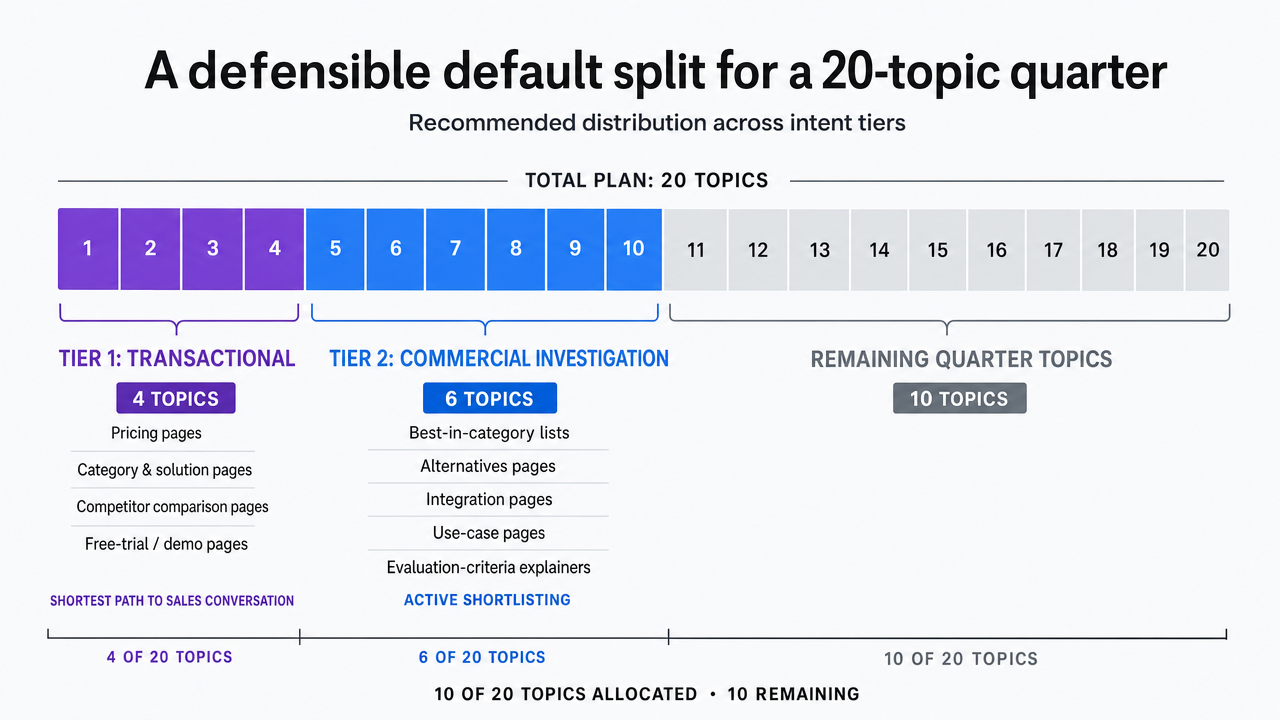 Visualize the recommended distribution of a 20-topic quarterly plan across intent tiers, directly supporting the section's cited allocation model
Working backward from revenue themes, not keyword lists
The intent split answers how much capacity goes where. Revenue themes answer which specific topics fill those slots.
A pipeline-driving plan starts from four questions about the business, not from a keyword tool: which products or services drive the most revenue, which industries close fastest, which use cases have the shortest sales cycle, and which competitors show up most often in lost-deal notes 17. The answers become the themes. The keywords are downstream artifacts.
A cybersecurity vendor whose fastest-closing segment is mid-market financial services should not be picking topics from a generic 'cybersecurity' keyword export. The theme is 'compliance-driven security for mid-market fintech.' From there, the transactional slots become pages on specific regulations the product addresses. The commercial slots become comparison pages against the two vendors that dominate that segment. The informational slots become explainers on the compliance workflows those buyers own — pieces that link into the comparison and solution pages above.
This ordering matters because it prevents the most common failure mode in topic planning: a calendar of well-optimized posts that share a subject but not a buyer. Themes tied to revenue drivers keep the plan concentrated. Concentration is what makes content marketing an efficiency lever as channels multiply 15. Broad coverage across every adjacent topic looks productive on a spreadsheet and reliably underperforms in the CRM.
The sales conversation test and what it disqualifies
One gating question, three outcomes
The test is one sentence: if this page ranked in the top three tomorrow, would it create a sales conversation? 11 Everything else — search volume, difficulty score, cluster label — is secondary evidence, not the verdict.
A proposed topic clears the gate in one of three ways. Ship it when the answer is a clear yes: a comparison page against a named competitor, a use-case page tied to a fast-closing segment, a pricing or ROI page that a buyer would search after a demo. Reshape it when the topic touches a real buyer question but the current framing would not produce a conversation — a generic 'what is X' that could become 'what is X for mid-market fintech compliance teams,' or a broad category post that could be narrowed to a specific integration. Cut it when reshaping cannot get it to yes: the query is upstream of any buying signal, the SERP is dominated by publisher content, or the topic exists only because a stakeholder asked for it.
The value of a single question is that it stops debate. A topic either produces a plausible sales conversation at rank three, or it does not.
What the test cuts: trend pieces, generic definitions, hollow competitor posts
Three categories fail the test almost every time.
Trend commentary — 'the state of X in 2026,' 'what Y means for marketers' — draws early-funnel readers who are not shortlisting vendors. It sits in the 55–60% informational bucket that converts at 1–3% 3, and its SERP is usually crowded with publisher and analyst brands whose named-source authority is hard to displace 4. A cybersecurity vendor writing 'the state of zero trust' will lose to analyst firms and generate zero opportunities.
Generic definitions — 'what is an applicant tracking system,' 'what is content marketing' — fail the test unless they demonstrably feed a converting cluster. Ranked in isolation, they attract students, job seekers, and curious peers.
Hollow competitor posts — 'thoughts on Greenhouse,' 'the rise of Lever' — carry a competitor's brand without offering the comparison a buyer actually searches for. The commercial goldmine is 'Greenhouse vs. Lever,' 'Greenhouse alternatives,' or 'Greenhouse pricing for 500-employee companies' 7. Rename the topic to the comparison a shortlisting buyer would type, or drop it.
Test data-backed SEO topic selection in practice
Validate pipeline-driven content topics with live publishing and real-time performance tracking during your trial.
A scoring rubric a manager can apply on Monday
The portfolio split decides how many slots go to each intent tier. The sales conversation test decides whether a proposed topic clears the gate. A scoring rubric is what turns the remaining shortlist into a defensible ranked list — the artifact a content manager brings to a planning meeting so the debate stops being about opinions.
Five criteria carry most of the weight, scored 1 to 5, with a suggested weighting that reflects the evidence in this article.
- Intent tier (weight: 25%). Transactional and commercial-investigation topics score 4–5; informational topics that extend a converting cluster score 3; standalone informational topics score 1–2. The weighting reflects the 3–4x conversion gap between informational and transactional queries 3.
- Revenue-theme fit (weight: 25%). A topic tied to a top-revenue product, a fast-closing segment, or a recurring lost-deal objection scores 4–5. A topic adjacent to the category but not tied to a specific revenue driver scores 2. Off-theme topics score 1 17.
- Cluster contribution (weight: 15%). Topics that internally link into a transactional or commercial page score higher than topics that stand alone. A pillar-supporting explainer with three or more downstream links to converting pages scores 4–5.
- Competitive gap (weight: 15%). Score the SERP realistically. A page 3–5 opportunity where the top results are thin, outdated, or misaligned with the buyer scores 4–5. A SERP dominated by analyst firms, publishers, or entrenched named sources scores 1–2 4.
- AI-answer resilience (weight: 20%). Topics whose value depends on proprietary data, first-party research, comparison depth, or account-specific proof score 4–5, because they resist compression into an AI Overview. Topics that a language model can summarize from public sources in two sentences score 1–2 4.
Multiply each score by its weight, sum for a composite between 1 and 5, and rank the shortlist. Topics scoring below 3.0 do not enter the plan without a written brand rationale. Topics scoring 4.0 and above take the transactional and commercial slots first. The rubric is not a formula that removes judgment — it is a record of the judgment, so the next quarterly review has something concrete to argue against.
Mapping intent to page format, proof, and CTA
The intent-to-format-to-CTA map, extended for B2B procurement
A scored topic still has to become a page. The scoring rubric decides which ideas earn a slot. The intent-to-format map decides what that slot actually looks like — the shape of the page, the proof it needs to carry, and the action it should ask for.
Search intent dictates page format, level of proof, and CTA in tight combinations 8. Mismatched pairings — a comparison query answered with a definitional explainer, a pricing query answered with a gated whitepaper — waste ranked positions. A working map looks like this:
- Informational intent → explainer guide or how-to → proof by method, framework, or original data → CTA to a newsletter, a related cluster page, or a downloadable worksheet 8.
- Commercial-investigation intent → comparison page, alternatives page, 'best' list, or use-case page → proof by side-by-side criteria, customer segment fit, and named outcomes → CTA to a demo, a scoping call, or a scorecard the buyer can share internally 8.
- Transactional intent → pricing page, category or solution page, or free-trial landing page → proof by concrete deliverables, timelines, and named customers → CTA to start a trial, book a demo, or request a quote 8.
- Procurement intent → ROI calculator, security and compliance page, implementation guide, or vendor-evaluation checklist → proof by documented process, certifications, reference architecture, and migration timelines → CTA to request a security review, download an RFP template, or schedule a technical scoping call 6.
The procurement row is what separates B2B topic planning from the generic four-intent model. The other three rows exist in every intent guide. The fourth is where late-stage deals stall or close.
The procurement layer most B2B guides skip
Most B2B SEO guides stop at the decision stage. The B2B buying process does not. After a shortlisted vendor is chosen, a formal procurement process begins — security review, legal review, finance sign-off, and cross-functional stakeholder approval 6. Topics that support that stage rarely rank for high-volume queries, but they do resolve the searches a champion runs when a deal is stuck.
Four page types carry most of the weight. An ROI calculator gives the internal champion a defensible number to bring to finance. A security and compliance page answers the questions a CISO or procurement lead will file before signing. An implementation guide shows what the first 90 days look like, which shortens legal and IT review by removing surprises. A vendor-evaluation checklist — sometimes framed as an RFP template — hands the buyer the criteria they need to justify the choice internally 17.
These pages will not top a traffic dashboard. They will show up in the assisted-conversion column, on late-stage deals where a sales rep says the buyer 'shared our compliance page with their security team.' Two procurement-support slots in a 20-topic quarter is a small allocation with disproportionate influence on deals already in the pipeline.
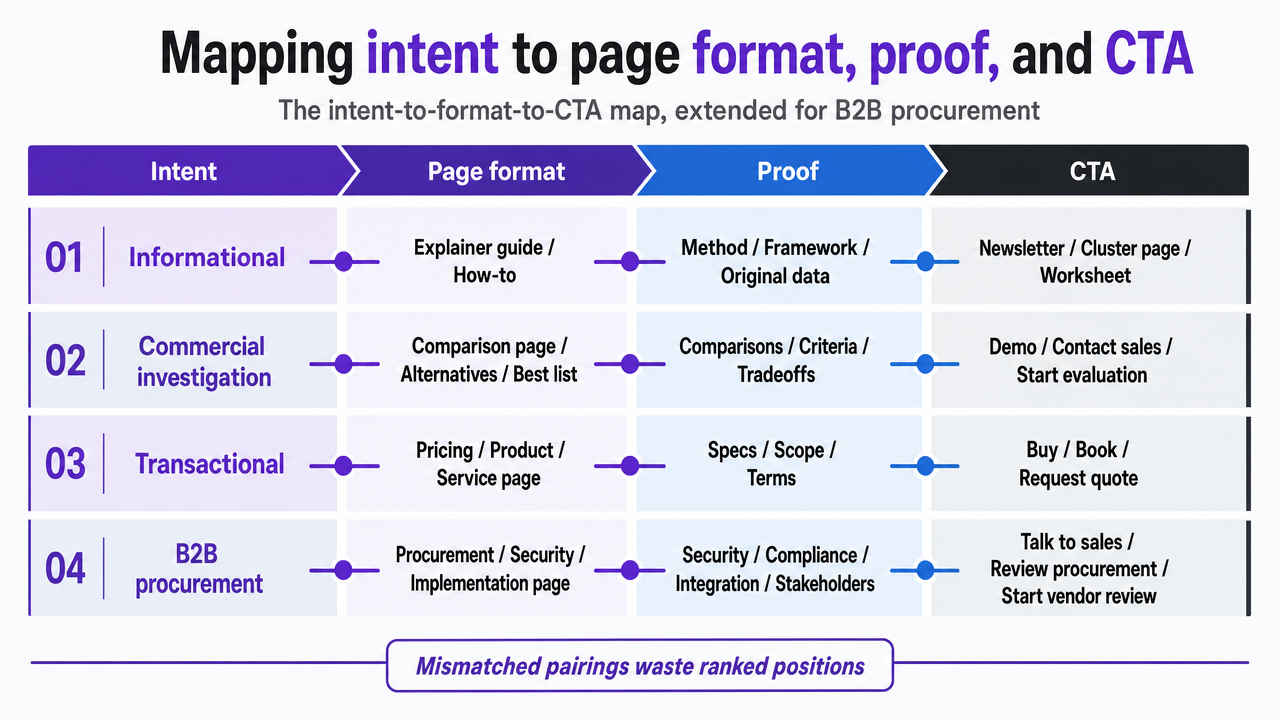 Visualize the four-row intent-to-format-to-proof-to-CTA framework cited in the section, including the B2B procurement extension
Choosing topics for a SERP with AI Overviews and named-source mentions
The SERP that a 2022 topic plan was written against no longer exists. AI Overviews now compress explainer content into a summary that appears above the organic results, and the unit of editorial authority has shifted from the dofollow link to the named-source mention 4. Both changes push the same conclusion: informational topics that a language model can answer from public sources in two sentences no longer produce clicks, and topics whose value depends on public consensus no longer produce brand lift.
Two rules follow for topic selection.
Weight the plan toward topics AI Overviews cannot cleanly answer. A query like 'what is SOC 2' will be summarized above the fold, and the click-through to any single vendor page will shrink 5. A query like 'SOC 2 controls for multi-tenant SaaS handling PHI' resists compression because the answer depends on account-specific proof, first-party frameworks, and named customer examples. The scoring rubric's AI-answer resilience criterion is how this rule enters the plan; the practical version is to favor topics with proprietary data, comparison depth, or segment specificity over topics that summarize public knowledge.
Choose topics that earn named-source mentions, not just links. When authority accrues to brands cited by name in AI answers and analyst content 4, a topic is worth writing when the brand can plausibly become the reference source — original research, a proprietary benchmark, a defined framework with a name buyers repeat. That is a higher bar than 'we can rank for it.' It disqualifies the me-too explainer and rewards the piece competitors cite when they cannot avoid the subject.
See How Leading Teams Prioritize SEO Topics That Move Pipeline Metrics
Connect with our team to access data-driven frameworks for SEO topic selection, designed for agencies and enterprise brands focused on measurable business outcomes.
Measuring topic decisions against pipeline, not rankings
A topic plan that cannot be graded against pipeline is a topic plan that gets cut in the next budget cycle. Rankings screenshots and traffic charts are the artifacts a content team defends itself with when the CMO asks a harder question, and the harder question is coming — because 42% of total B2B pipeline includes marketing touchpoints in the buying process 2, and the CMO wants to know which of those touchpoints came from search and which topics produced them.
Forrester's six-step touch analysis is the measurement framework that fits the topic-selection method in this guide 14. Rather than crediting a single last-touch page, touch analysis tracks how specific content assets influence opportunity creation, progression, and closed-won revenue across the buying journey 14. Applied to SEO, it means tagging each published page with its intent tier, revenue theme, and cluster role, then reading the CRM to see which tagged pages appear on won deals, which appear on stalled deals, and which never appear at all.
Three measurements matter more than the rest. Opportunity influence — the percentage of won opportunities where a topic's page appeared in the buyer's session history — grades whether a topic actually produces sales conversations, which is the sales conversation test moved from prediction to record 11. Stage progression — whether pages accelerate deals from stage to stage — grades the procurement and commercial-investigation slots that will never look impressive on a traffic dashboard 14. Cluster contribution — whether informational pages feed sessions that end on transactional pages — grades the eight informational slots in the quarterly split, because informational content earns its allocation by supporting a converting cluster or not at all.
Read those three numbers each quarter and the next planning meeting stops being a debate about opinions. Topics with high opportunity influence get more capacity. Topics with none get retired, regardless of traffic.
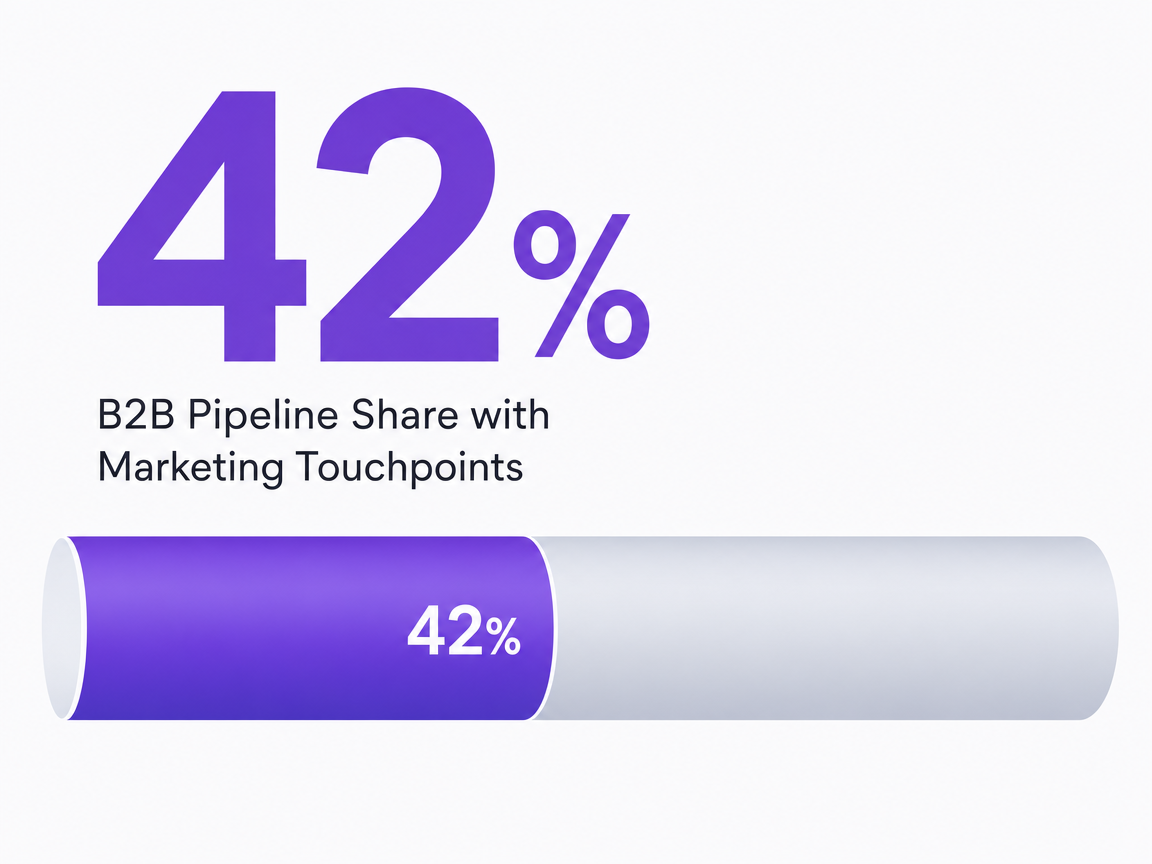 B2B Pipeline Share with Marketing Touchpoints
B2B Pipeline Share with Marketing Touchpoints
A sidebar on format extension: short video as demand capture
One note on format before the FAQ. The topic-selection method above assumes a written page as the output, but the same intent-tier logic extends to video. Recent YouTube analytics commentary has documented that 90-to-180-second explainer videos targeting specific buyer questions are outperforming long-form expertise for early-demand acquisition 10. That performance gap matters most for the eight informational slots in the quarterly split. A written explainer that feeds a converting cluster can be paired with a short video answering the same question — same topic brief, same intent tier, second surface. Commercial and transactional slots stay written; the proof they carry does not compress into 180 seconds.
Frequently Asked Questions
References
- 1.B2B Content Strategy That Drives Demand.
- 2.B2B Campaign ROI Benchmarks: 2024.
- 3.How Search Engines Understand Buyer Intent and Why Your SEO Strategy Needs to Evolve.
- 4.15 B2B SEO Trends for 2025.
- 5.15 B2B SEO Trends Reshaping 2025 Pipeline.
- 6.Search Intent Mapping for B2B: From Awareness to Procurement.
- 7.How to Map, Target, Rank for Entire B2B Buyer's Journey.
- 8.Search Intent Types in SEO: A Practical Guide (2026).
- 9.What is search intent?.
- 10.What These Trends Mean For....
- 11.Aeo: Optimising For The....
- 12.How B2B SEO and Content Marketing Work Together.
- 13.Making B2B Content Marketing Work.
- 14.Measure Content Impact Through Touch Analysis.
- 15.Brief: Marketing And Media Efficiency Outcomes Drive Content Marketing.
- 16.B2B SEO Strategy to Capture Demand and Drive Pipeline.
- 17.SEO for B2B: How to Build Organic Growth That Drives Pipeline.
- 18.Content marketing roi statistics and benchmarks for 2025 ....