
Key Takeaways
- Keyword and intent intelligence now clusters queries by buyer stage rather than string similarity, but strategists must still sign off before briefs to catch intent misclassification 2.
- Technical audit automation replaces the largest share of billable hours by ranking crawl findings by likely revenue impact, provided strategists trust the output instead of re-auditing it 1.
- Content optimization is where AI compounds analyst output most directly, with peer-reviewed evidence of 35–70% organic traffic lift when brief and draft approval gates hold 1.
- GEO and AI-search visibility is a chargeable retainer expansion because only 16% of brands track AI-answer performance and leaders trail traditional SEO by 20–50% 8.
- Reporting automation converts month-end assembly hours into interpretation time, generalizing to a 5–15% marketing productivity gain when strategists still approve every client narrative 10.
- Unified execution platforms consolidate production, approvals, and CRM-aware reporting behind one workflow, trading per-layer diagnostic depth for eliminated reconciliation seams across the stack 12.
Why the Scale Problem Is a Workflow Problem, Not a Tool Problem
Agency SEO delivery does not break because analysts lack tools. It breaks at the seams between them. A senior strategist running twelve retainers spends more time reconciling exports from a rank tracker, a crawler, a content grader, and a reporting dashboard than interpreting what any single output means for a client's pipeline. Every new AI feature added to that stack promises time savings, but the reconciliation tax quietly grows in the background.
The market has read this signal clearly. Enterprise SEO platforms represented USD 4.38 billion in 2024 and are projected to reach USD 12.5 billion by 2032 at a 14% compound annual growth rate, driven by demand for consolidated capabilities across keyword research, technical auditing, content optimization, analytics, and workflow governance 5. That trajectory does not describe agencies buying more point tools. It describes buyers moving budget toward platforms that reduce handoffs.
The implication for a Head of SEO is architectural rather than tactical. AI has matured unevenly across the six workflow layers most agencies operate: intent modeling, technical audits, content optimization, GEO and AI-search visibility, reporting, and unified execution. In some layers, AI now compounds analyst output several times over. In others, it still requires a strategist to convert output into a defensible recommendation. Choosing correctly across those layers, rather than chasing the newest feature in any one of them, is what determines whether a team can add accounts without adding headcount. The six categories that follow are evaluated through that lens.
The Six Workflow Layers AI Now Touches
Keyword and Intent Intelligence: From Volume Lists to Buyer-Stage Clusters
Keyword research was the first SEO layer to feel commoditized and the first to be rebuilt by machine learning. The shift is not that AI produces longer keyword lists. It is that natural language processing and clustering models now group queries by semantic intent and buyer stage rather than by string similarity, which changes what an analyst does with the output 2.
For a Head of SEO running a portfolio of retainers, the practical gain sits in the handoff to content. A traditional workflow expects the strategist to sort a 4,000-row export into topic clusters, tag each cluster by funnel position, and write briefs. Modern intent-clustering tools using ML/NLP techniques compress the first two steps into minutes and expose the trade-offs between semantic accuracy and interpretability that the strategist still has to arbitrate 2. Black-box clusters that look tidy on screen sometimes collapse mid-funnel comparison queries with bottom-funnel transactional ones, and only a human reviewing SERP intent can catch that.
The pipeline-first framing used by category-leading platforms ties keyword clusters to buyer stages and ICP attributes rather than search volume alone 12. That mapping is what turns a keyword universe into a delivery plan a strategist can defend to a client: which clusters feed new pages, which feed refreshes, which feed programmatic templates, and which are noise.
The layer is mature enough that no agency should be paying senior analyst rates for manual keyword sorting. It is not mature enough to run without oversight. Intent misclassification at the cluster level propagates into every downstream brief, so the correct operating posture is AI-drafted clusters with a strategist sign-off before any content brief is generated. That single control point is what preserves quality as account counts grow.
Technical Audit Automation: Reclaiming Hours from Crawl Analysis
Technical SEO is where AI has quietly replaced the largest number of billable hours. A quarterly site audit that once required a senior analyst to work through a 50,000-URL crawl, cross-reference log files, and hand-annotate a findings deck now runs against automated audit modules that flag crawlability issues, indexation drift, Core Web Vitals regressions, and schema errors on a rolling basis. Peer-reviewed evaluation of AI-powered SEO reports that automated technical audits improve website health and crawlability while reducing the manual workload traditionally required to surface those issues 1.
The operational effect on delivery is direct. Instead of a strategist spending eight to twelve hours per client per quarter assembling audit findings, the automation layer produces a prioritized queue continuously, and the strategist spends their hours on interpretation and remediation sequencing. The underlying capability is not new. Data-mining approaches to site activity analysis, trend analysis, and automated visits analysis have been embedded in enterprise SEO analytics modules for over a decade 3. What AI adds is the ability to rank findings by likely revenue impact rather than by raw error count, which is exactly the judgment call a junior analyst used to make poorly.
The constraint on this layer is not the tool. It is the strategist's willingness to accept ranked outputs without re-deriving them. Forrester's foundational finding, still relevant, is that automation tools work best for organizations with dedicated in-house resources able to convert data into decisions 7. Agencies that fail to trust the automation end up paying twice: once for the tool and once for the analyst hours spent re-auditing what the tool already surfaced.
The right delivery posture is to treat the crawler output as the strategist's starting document, not a second opinion, and to route remediation tickets straight into a dev queue with approval controls.
Content Optimization: Where AI Compounds Analyst Output Most Directly
Content optimization is the layer where the productivity math changes most visibly. A 2025 peer-reviewed study of AI-tool adoption across marketing teams reports that AI-enhanced SEO drives a 35–70% lift in organic traffic while improving ranking stability, content relevance, and workload reduction 1. The scope matters: this is a study of teams that adopted AI tooling in their content and optimization workflows, not a market-wide guarantee, and the range reflects variation in account maturity, content baseline, and vertical. Read as a bounded finding, it still frames the largest single upside available to an agency shifting production toward AI-assisted execution.
The mechanism is well documented. NLP-driven optimization models score drafts against semantic coverage, entity completeness, and query alignment rather than keyword density, and they surface gaps against the top-ranking SERP set at the level of concepts, not phrases 2. For a strategist, this converts content briefs from three-hour research documents into review artifacts. The AI produces the entity map, the query intent breakdown, and the outline. The strategist edits for angle, source selection, and voice.
McKinsey's broader productivity work sizes the addressable gain across the marketing function at 5–15% of total marketing spend from generative AI, with SEO optimization named explicitly as a use case where gen AI supports content creation and technical components 10. Those two data points, one narrow and one broad, bracket the honest range: content optimization is the layer where the compounding is real, and it is also the layer where an unedited AI draft is most likely to produce shallow, undifferentiated pages that damage a client's E-E-A-T posture.
The delivery discipline that separates traffic-lifting teams from content-farm teams is approval gating at the brief stage and again at the draft stage. AI accelerates production; the strategist protects the differentiation. Agencies that skip either gate report the traffic lift briefly and then watch it erode as algorithm updates penalize thin coverage 1.
GEO and AI-Search Visibility: The Tracking Gap Agencies Can Sell Into
Generative Engine Optimization is the newest layer in the stack and the one with the widest capability gap between what clients need and what most agencies measure. McKinsey's 2025 analysis of AI-powered search finds that only 16% of brands systematically track their performance in AI-generated answers, while GEO performance for industry leaders lags their traditional SEO performance by 20 to 50% 8. Set against Forrester's finding that 85% of enterprise marketers plan to employ organic SEO strategies in the coming year, the disparity is the clearest service-line opportunity in the current SEO market 7.
The tooling here is early. Emerging platforms monitor citation frequency and sentiment across LLM-based engines, track which sources AI overviews pull from, and score content for the structural features that make it more likely to be quoted:
- clear definitional passages
- direct answer formats
- explicit entity relationships
McKinsey's guidance is to stand up cross-functional teams with GEO-specific KPIs rather than folding AI-search visibility into existing rank-tracking reports, since the mechanics of citation and inclusion differ from blue-link ranking 8.
For a Head of SEO, the go-to-market implication is direct. GEO monitoring is a chargeable add-on line that most competitors are not yet selling, and it justifies a discovery conversation with every existing retainer client. The technical work behind it is not exotic: it is a subset of entity SEO, structured content, and citation tracking that the agency is already partially doing. What is missing is the measurement layer.
The risk of standing this up too quickly is claiming attribution the tools cannot yet deliver. LLM citation windows shift week to week, sample sizes for query panels remain small, and no vendor has stable share-of-voice metrics equivalent to traditional rank tracking. Agencies that sell GEO reporting should scope it as leading-indicator monitoring with directional confidence, not as a ranked deliverable. Done that way, it opens a new retainer expansion path without exposing the agency to attribution disputes.
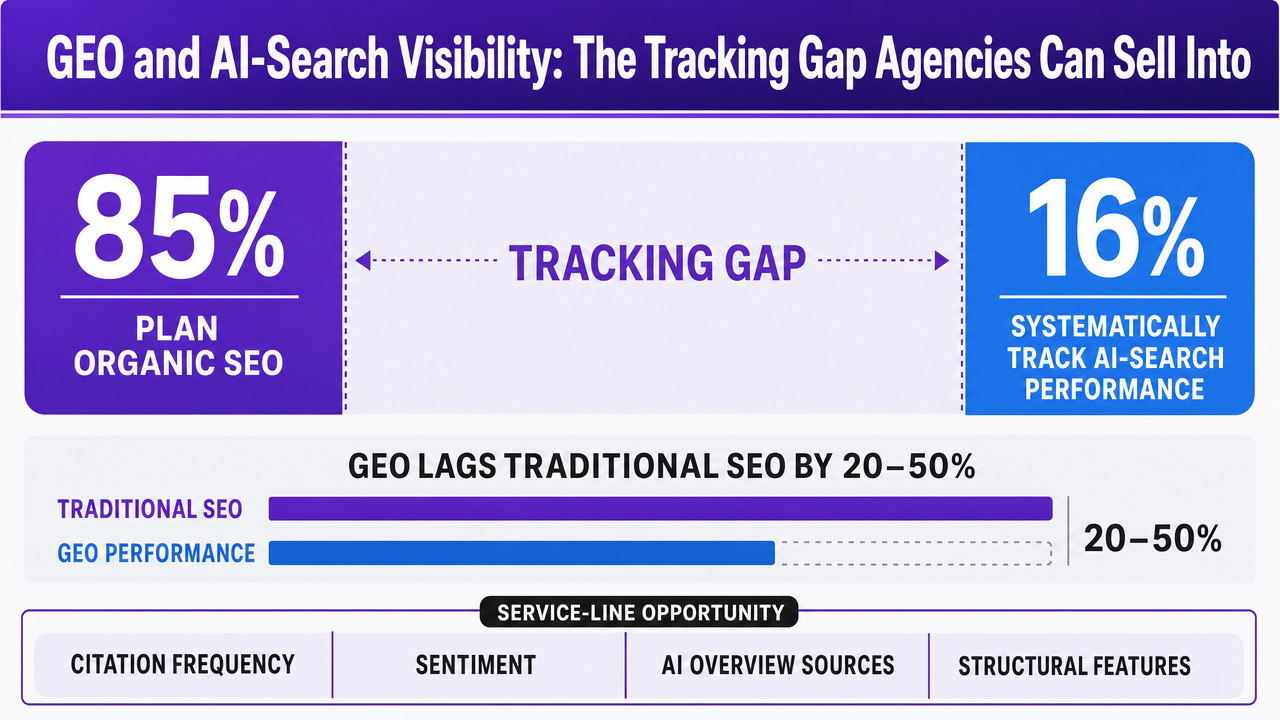 Visualize the McKinsey finding that only 16% of brands systematically track AI-search performance, contrasted against the 85% of enterprise marketers planning organic SEO — the exact tracking gap this section describes as a service-line opportunity
Reporting Automation: The Analyst-Hour Recovery Layer
Reporting is the least glamorous layer in the SEO stack and the one where AI produces the cleanest margin gain. In a typical agency, month-end reporting consumes strategist hours that could otherwise go to interpretation, remediation, and client strategy calls. Standardized, AI-generated reports collapse that time by pulling from GSC, GA4, rank tracking, and CRM sources into a governed template that a strategist reviews rather than assembles 13.
The economics of this layer generalize enough to warrant a compact view. The table below uses sourced ranges only and treats hours per client per month as variables H, since exact figures depend on account complexity, reporting cadence, and stack maturity.
| Workflow layer | Manual baseline | AI-assisted execution | Sourced bound ||---|---|---|---|| Reporting assembly | H hours | H × (1 − 0.05 to 0.15) | Marketing function productivity gain of 5–15% 10|| Technical audit synthesis | H hours | Materially reduced manual workload | Workload reduction finding 1|| Content brief production | H hours | Materially reduced manual workload | Workload reduction finding 1|
The table generalizes agency delivery economics. Actual hours reclaimed depend on account mix, integration depth between the reporting layer and CRM, and how much of the strategist's time was previously spent on formatting versus interpretation. Agencies with immature stacks tend to see gains at the upper end of the sourced range because the reporting bottleneck is more severe 13.
The operational payoff is that reclaimed hours convert into either additional accounts per strategist or higher-touch strategy time on existing accounts, and the choice between those is a delivery-model decision, not a tool decision. Data-mining foundations underlying enterprise SEO analytics modules already handle the aggregation logic; the AI layer sits on top, generating narrative commentary that a strategist edits 3.
The governance requirement is that a strategist signs off on every client report before delivery. Automated commentary that misreads a traffic dip as a positive trend, or attributes a conversion lift to the wrong channel, damages retention faster than any reporting delay ever did. Approval gating is what keeps this layer from becoming a liability.
Unified Execution Platforms: Consolidating Production Behind Approval Gates
The sixth layer is not a tool category but an architectural response to the previous five. Unified execution platforms consolidate diagnostics, content production, link signals, and CRM-aware reporting inside a single workflow with human approval gates at each handoff 12. The premise is that most of the reconciliation tax an agency pays comes from moving data and drafts between point tools, and that the largest available margin gain is eliminating those seams rather than optimizing any single layer further.
The market data supports the direction of travel. The enterprise SEO platform segment grew to USD 4.38 billion in 2024 and is projected to reach USD 12.5 billion by 2032 at a 14% CAGR, with a second research firm reporting an independent double-digit growth estimate confirming the consensus 5, 6. MarTech's platform guide notes that generative AI is now the dominant force shaping feature development across the 16 leading platforms it profiles, with consolidation of content, technical, and reporting capabilities inside single vendors accelerating 4.
The operational distinction that matters for a Head of SEO is not whether a platform advertises AI features. It is whether the platform ships work under approval controls. A unified platform that auto-publishes content, auto-implements schema changes, or auto-adjusts internal links without a strategist checkpoint transfers risk from the tool vendor to the agency's retention numbers. A platform that routes every recommendation through a review queue, with the strategic reasoning attached, preserves the judgment layer that Forrester identified as the binding constraint on automation ROI 7.
The trade-off is depth. Unified platforms rarely match the diagnostic depth of best-in-class point tools in any single layer. What they trade that depth for is a single production surface, one reporting model, and one approval log, which is where the strategist hours reclaimed in the reporting layer actually compound into additional account capacity. Whether that trade is the right one is the architecture decision the next section takes up.
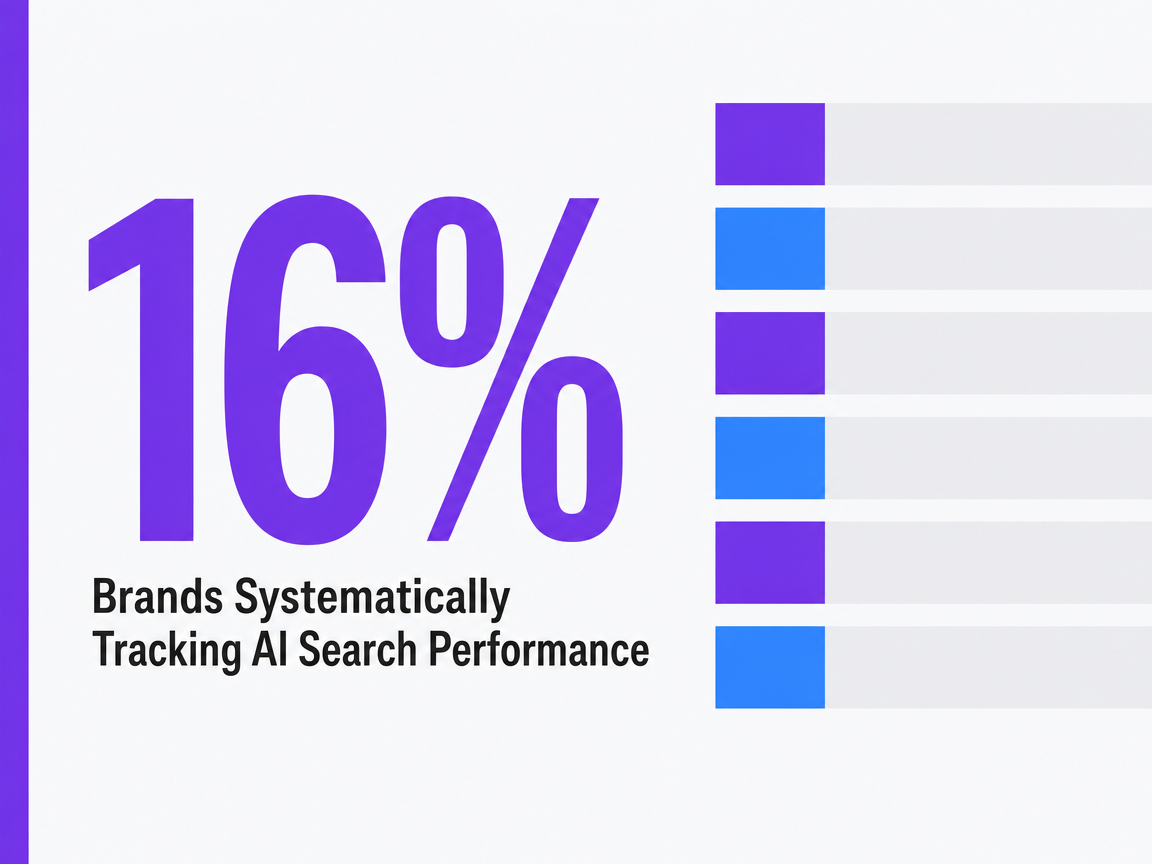 Brands Systematically Tracking AI Search Performance
Brands Systematically Tracking AI Search Performance
Test AI-driven SEO execution workflows risk-free
Experience hands-on delivery of optimized content and scalable SEO outputs for your clients, no commitment required.
Stitched Stack or Unified Execution: The Architecture Decision
The decision between a stitched stack and a unified execution platform is not primarily about features. It is about where the agency wants its reconciliation tax to live. A stitched stack keeps diagnostic depth at each layer, since best-in-class point tools tend to outperform generalist platforms on any single capability that MarTech's platform guide benchmarks 4. The cost is analyst hours spent moving data, drafts, and findings across tools, and a reporting layer that never quite tells one story.
A unified execution platform inverts that trade. Diagnostic depth in any single layer is usually shallower, but production, approvals, and CRM-aware reporting run on one surface, which is where the analyst hours reclaimed at the reporting layer actually convert into additional account capacity 12. Forrester's finding that automation ROI depends on in-house strategic capacity applies with more force in a unified model, because the strategist's judgment now sits at every approval gate rather than at every tool boundary 7.
The defensible read for most Heads of SEO managing 15 to 75 accounts is hybrid. Retain a specialist crawler and a specialist keyword tool where diagnostic depth is non-negotiable, and consolidate content production, GEO monitoring, and reporting onto a unified platform with approval gating. That architecture protects strategist hours where AI compounds output and preserves judgment where it does not.
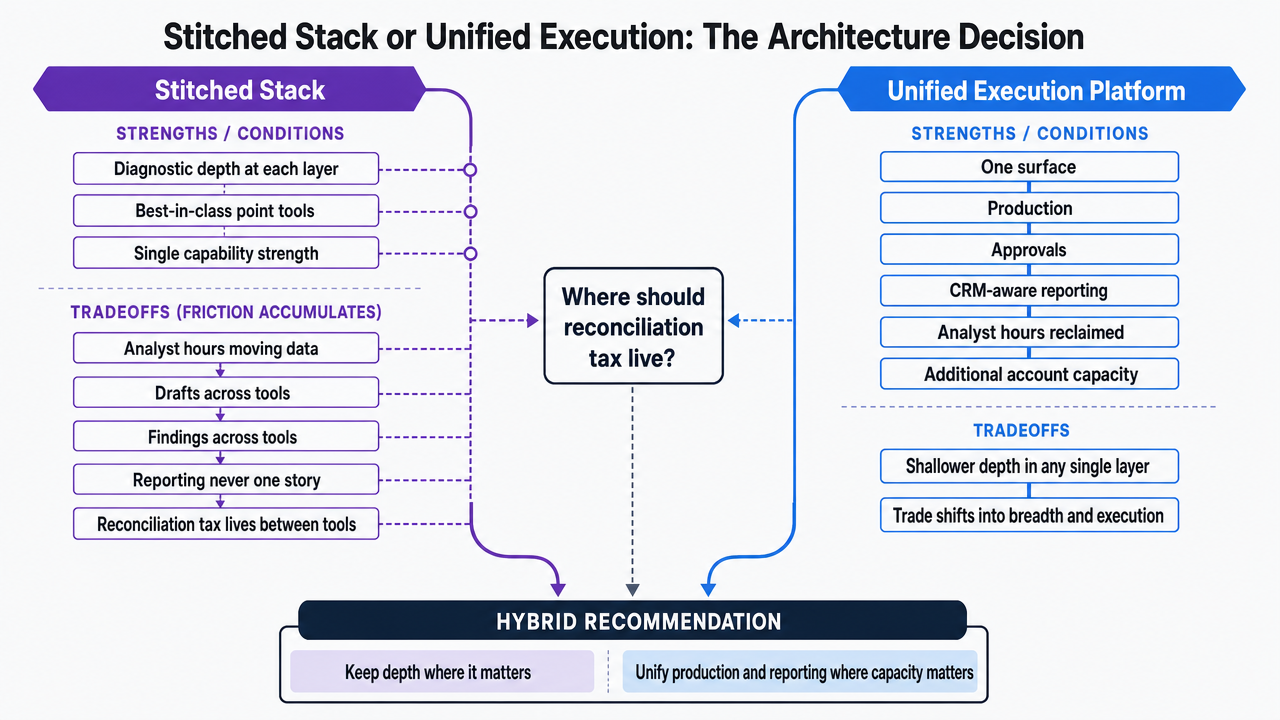 Visualize the comparison framework this section presents between a stitched stack of point tools and a unified execution platform, including the hybrid recommendation
If You Manage a Multi-Location or Franchise Client Portfolio
Multi-location and franchise portfolios change the stack calculus. A single client can carry 40, 200, or 800 location pages, each with its own NAP data, review velocity, service menu variance, and local intent signals. The reconciliation tax scales linearly with locations, not clients, which is why agencies serving franchise systems tend to hit delivery-margin walls earlier than those running single-site retainers.
The AI layers that pay off first in this context are technical audit automation and content optimization at scale. Rolling crawl-based audits flag location-page indexation drift and schema errors across thousands of URLs without adding analyst hours 1. NLP-driven optimization models handle the templated-yet-differentiated content problem that manual production cannot solve profitably, generating location variants that vary on entities and local proof points rather than swapped city names 2.
Reporting consolidation matters even more here. A franchise client expects roll-up dashboards plus location-level drill-downs, and manual assembly of that view is where strategist hours disappear fastest. Unified execution platforms with CRM-aware reporting collapse that build into a template review rather than a monthly rebuild 12, 13. For portfolios above 100 locations, the stitched-stack option stops penciling out.
See How Leading Agencies Use AI to Multiply SEO Output Without Adding Headcount
Discuss with our team how enterprise agencies are leveraging AI-driven SEO automation to increase content velocity, maintain quality oversight, and deliver measurable results for multiple clients in parallel.
A Defensible Stack Recommendation for Heads of SEO
The stack that pencils out for most agencies running 15 to 75 accounts keeps two specialist tools and consolidates the rest. A specialist crawler holds the technical layer, where diagnostic depth on log files, rendering, and indexation still separates a defensible audit from a superficial one. A specialist keyword and SERP tool holds the intent layer, where black-box clusters from generalist platforms have not yet earned strategist trust 2.
Everything downstream—content optimization, GEO monitoring, reporting, and cross-channel handoffs—consolidates onto a unified execution platform with approval gates at each production step 12. That is where the analyst hours reclaimed at the reporting layer stop leaking back into reconciliation work and start converting into additional account capacity. It is also where Forrester's binding constraint on automation ROI, in-house strategic capacity, gets its highest leverage: the strategist sits at every approval queue rather than at every tool export 7.
Heads of SEO evaluating this architecture against their current stack should price the decision in reclaimed strategist hours per month, not in software line items. Platforms like Vectoron are built for that consolidation math.
Frequently Asked Questions
References
- 1.A Study on AI-Powered SEO Optimization.
- 2.Insights into Search Engine Optimization using Natural Language Processing and Machine Learning.
- 3.Application of Data Mining Algorithms in Web Analytics and SEO.
- 4.Enterprise SEO Platforms: A Marketer’s Guide.
- 5.Enterprise SEO Platforms Market Size, Share and Forecast 2024–2032.
- 6.Enterprise SEO Platforms Market Research Report.
- 7.Forrester Research Publishes 1st Report On Enterprise SEO Automation Tools.
- 8.New front door to the internet: Winning in the age of AI search.
- 9.Marketing and sales soar with generative AI.
- 10.The economic potential of generative AI: The next productivity frontier.
- 11.State of Marketing 2024.
- 12.Best Enterprise SEO Tools for Driving Pipeline Growth Fast.
- 13.Automated SEO Report Strategies to Scale Agency Work Efficiently.