
Key Takeaways
- Ahrefs or Semrush anchors the research layer, absorbing four to eight hours of keyword and competitor work per new account while feeding briefs, gap analyses, and pitch decks.
- Screaming Frog covers audits up to 500,000 URLs within a lean tooling budget, while Botify or Lumar earn their cost only when portfolios include multi-million URL or log-file clients.
- AccuRanker or SE Ranking removes a full day of weekly rank pulls across 40 accounts, but only when API feeds push data directly into the reporting layer without manual screenshots.
- Surfer suits distributed writers producing high volumes of scored briefs, while seoClarity Content Fusion fits agencies already standardized on that enterprise platform for tracking and audits.
- Looker Studio plus AgencyAnalytics automates client-ready PDFs and dashboards, eliminating the four to six hours per account per month strategists otherwise lose to manual report assembly.
- Vectoron adds the AI execution layer that the other five lack, removing production hours across content drafts, outreach, and reporting narratives through approval-gated workflows 20.
Why agencies buy tools by hours removed, not features
The enterprise SEO platforms segment was valued at USD 4.38 billion in 2024 and is projected to reach USD 12.5 billion by 2032, a 14% CAGR 1. This growth signifies agencies and in-house teams prioritizing capacity. While broader SEO software estimates vary widely, ranging from USD 41 billion in 2025 3 to USD 86 billion in the same year 6, a Head of SEO should view these figures as directional and focus on how a license reduces delivery time.
The critical evaluation metric for agencies is hours removed per account. Feature sets across leading platforms like Ahrefs, Semrush, Conductor, and BrightEdge are often similar, making feature-based comparisons less decisive. The key factor influencing profit margins is how much specialist labor a tool can absorb before a client-ready deliverable is produced. One buyer guide emphasizes that platforms should be judged on
"hours removed per account, not feature parity, since workflow absorption now decides ROI more than crawl depth or keyword database size"
10.
Enterprise users account for over 54% of global SEO software spending 2, which explains why vendors prioritize governance, integrations, and throughput over novice usability. For an agency managing 15 to 80 accounts, the renewal question is not simply "is this the best tool." Instead, it focuses on which part of the delivery process the license streamlines, how many hours it saves strategists monthly, and how that saving scales with a 20% increase in client accounts. The following six-layer breakdown analyzes each tool primarily as a labor-saving item and secondarily as a capability.
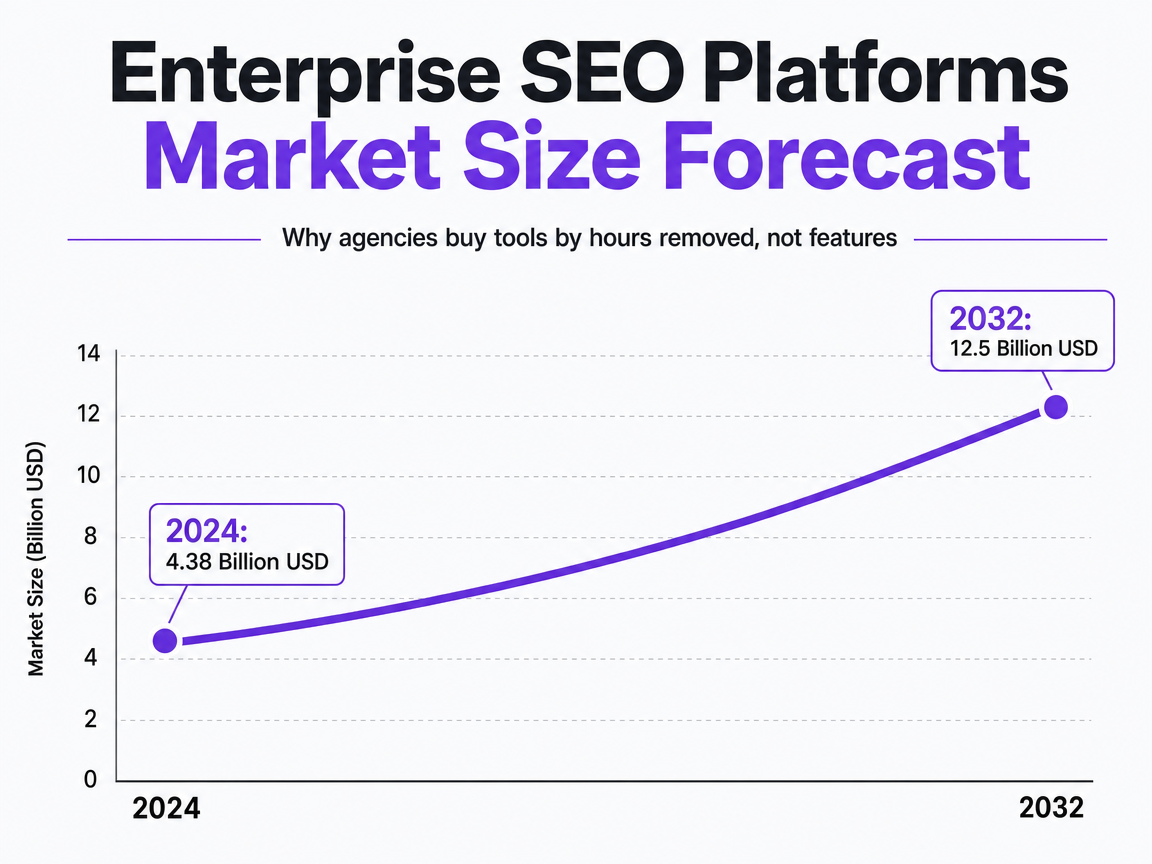 Enterprise SEO Platforms Market Size Forecast
The enterprise SEO platforms market was valued at USD 4.38 billion in 2024 and is anticipated to reach USD 12.5 billion by 2032.
The six-layer delivery stack
A robust agency stack for 2026 comprises six functional layers, each designed to absorb specific types of delivery hours. This framework is crucial because analytic tools describe work, while execution tools produce it, yet both are often priced similarly 10.
- The research suite (e.g., Ahrefs or Semrush) eliminates hours spent on keyword and competitor research, forming the foundation for briefs, gap analyses, and pitch decks.
- The technical crawler layer addresses audit hours: Screaming Frog for sites up to 500,000 URLs, and Botify or Lumar for millions of URLs or routine log-file analysis.
- Rank trackers (e.g., AccuRanker, SE Ranking) reduce reporting preparation by automating weekly rank pulls across all clients.
- Content optimization tools (e.g., Surfer, seoClarity Content Fusion) compress brief-to-draft time, quickly generating scored outlines.
- The reporting and BI layer (e.g., Looker Studio, AgencyAnalytics) automates deck assembly by integrating GSC, GA4, and rank data into scheduled, client-ready PDFs 16.
- The sixth layer, AI execution, removes production hours for content drafting, link outreach, and reporting narratives, an area where many agencies still lose margin because the other five layers primarily describe work rather than performing it 20.
Each subsequent section evaluates tools based on the specific strategist hours they save and how these savings compound across multiple accounts.
Research suite: Ahrefs or Semrush as the keyword and competitor spine
The research suite is foundational, feeding keyword universes, competitor gap analyses, SERP feature tracking, and backlink intelligence into briefs, pitch decks, and quarterly reviews. Selecting the wrong primary tool can lead to duplicated exports and data reconciliation issues for strategists.
Ahrefs and Semrush are the primary choices for agencies managing 15 to 80 accounts. A 2026 comparison notes both are
"broad, not deepest,"
which is ideal for the research layer 15. An agency needs a comprehensive dataset that answers most client questions without requiring strategists to use multiple tools. Ahrefs Enterprise, starting at $14,990 per year 14, sets the benchmark for a mid-market agency stack, comparable to Semrush Enterprise once seats and API access are negotiated.The time-saving benefits are clear: a senior strategist manually conducting keyword and competitor research for a new account can spend four to eight hours before the first brief is ready. Across monthly pitches, quarterly gap refreshes, and client-requested competitor analyses, the research suite significantly reduces recurring analyst time. One guide highlights that
"the strongest agency stacks in 2026 combine an all-in-one research platform, a white-label reporting dashboard, and a category-specific tool for local SEO or outreach"
9, positioning the research platform as the indispensable core.
The choice between Ahrefs and Semrush often depends on workflow. Ahrefs is preferred by agencies where link intelligence and content gap analysis are central to their delivery model. Semrush is favored when paid-organic overlap, position tracking, and site audit workflows are integrated into weekly routines. Running both is inefficient due to approximately 70% overlap in keyword and competitor data, eroding license ROI. A single suite, negotiated at an enterprise tier with API access for downstream reporting, is the most effective approach.
Technical crawler: Screaming Frog for audit throughput, Botify or Lumar for scale
The crawler layer is where audit hours accumulate rapidly, and an inappropriate tool choice can limit a technical strategist's capacity. Two distinct tiers address the needs of agencies with 15 to 80 accounts, solving different problems.
Screaming Frog, a desktop application, remains the standard for sites up to approximately 500,000 URLs. It handles routine audit tasks for onboarding, quarterly reviews, and post-migration QA, such as identifying broken links, redirect chains, canonical mismatches, schema coverage, and hreflang integrity. An agency stack review places it within a lean $250 to $500 per month tooling budget, alongside a research suite, rank tracker, and reporting layer 12. At this price point, it significantly offsets the eight to twelve hours a mid-level strategist would otherwise spend manually compiling audit exports per client per quarter.
For sites exceeding one million URLs, requiring log-file crawls, or JavaScript-heavy templates needing rendered crawls at scale, enterprise solutions like Botify and Lumar become necessary. Botify typically costs $30,000 to $100,000+ per year for mid-market clients 14, with high-end enterprise contracts reaching $100,000 to $400,000 18. This cost difference is not about features but about addressing bottlenecks related to crawl scale, log-file ingestion, and cross-team workflow governance 14.
The decision to upgrade is specific: if two or three accounts in the portfolio require weekly scheduled runs, log-file differentials, or rendered crawls that Screaming Frog cannot complete overnight, an enterprise crawler is justified for those accounts. Otherwise, the desktop tool suffices. Investing in Botify or Lumar for a portfolio dominated by sites under 100,000 URLs increases costs without significantly improving strategist utilization.
Test paid SEO workflows with real client projects
Evaluate platform impact on client SEO delivery with live campaigns before making a long-term commitment.
Rank tracker: AccuRanker or SE Ranking for weekly pulls across the portfolio
Rank tracking is a layer where small, frequent time losses can accumulate significantly. A strategist manually pulling weekly ranks for 40 accounts can lose a full day per cycle to exports, deduplication, and formatting before any analysis begins. A dedicated rank tracker eliminates this recurring burden.
AccuRanker and SE Ranking are the two reliable options for a 2026 agency stack. Both are included in the $250 to $500 per month budget that covers a research suite, crawler, tracker, and reporting layer for mid-sized client lists 12. The choice between them is driven by workflow, not accuracy. AccuRanker is preferred when daily refresh rates and API integration with the reporting layer are critical, even if the cost per keyword is higher. SE Ranking is suitable when the tracker also needs to serve as a light audit and competitor tool for smaller accounts where a full research suite would be excessive.
The hours-removed test is straightforward for this layer: a tracker either automates scheduled rank pulls, SERP feature flags, and share-of-voice deltas into the reporting layer without manual intervention, or it doesn't. If weekly client reports still require manual screenshots from the tracker UI, the license is not fulfilling its purpose. Agencies that use APIs to feed Looker Studio directly 16 fully automate the rank-reporting workflow, ensuring it scales linearly with client growth. This single integration decision provides compounding returns.
Content optimization: Surfer and seoClarity Content Fusion for brief-to-draft compression
Content optimization tools streamline the process of brief writing and SERP analysis into a single, scored output. The time savings here, though not immediately apparent, compound rapidly because every account consistently generates content briefs.
Surfer is a popular choice for agencies employing freelance or in-house writers who need a scored outline before drafting. A 2026 comparison describes it as
"AI-driven on-page content optimization for content-led teams," providing "fast, data-backed content briefs that scale; easy for writers and agencies to adopt"
15. The ease of adoption is crucial for agencies, determining whether the tool genuinely replaces the strategist's half-day manual SERP analysis or simply becomes an additional step. Surfer excels because writers without SEO training can produce a scored draft against target terms from day one.
seoClarity Content Fusion is suitable for a different scenario. The same 2026 review positions Content Fusion as an AI-assisted optimization layer within a broader enterprise platform 15. This makes it ideal for agencies whose largest accounts already use seoClarity for rank tracking, site audits, and share-of-voice reporting. When the research suite and reporting layer already integrate seoClarity data, adding Content Fusion consolidates the brief-scoring workflow into a familiar environment. This reduces switching costs and allows the license to absorb brief-preparation hours without needing to reconcile a second data source.
The decision between these tools is workflow-driven. Surfer is best for content operations with distributed writers producing high volumes of mid-funnel briefs across many accounts. Content Fusion is preferred when an enterprise platform is already the system of record, and brief preparation is the last content workflow step still handled separately.
Reporting and BI: Looker Studio plus AgencyAnalytics for client-ready PDFs
The reporting layer is where the efficiencies (or inefficiencies) of the other five licenses become apparent. Every export from the research suite, crawler, tracker, and content tool must be integrated into a client-ready deliverable on a consistent schedule. The time strategists spend manually combining these exports represents a significant drain on profit margins. One agency stack review specifically recommends the combination of
"Semrush and Ahrefs for comprehensive features, alongside specialized tools such as Screaming Frog for technical audits, Google Search Console for site health, and Looker Studio or Agency Analytics for robust reporting"
16.
Looker Studio is valuable as a free, API-native platform that integrates GSC, GA4, and rank tracker data into templated client dashboards. While there's an initial investment in design and connector logic, this cost is amortized across all subsequent accounts. AgencyAnalytics complements Looker Studio when white-label PDF delivery, automated client emails, and multi-account rollup views are prioritized over dashboard flexibility. They are complementary: Looker Studio for analyst views and cross-client benchmarking, and AgencyAnalytics for branded monthly PDFs delivered to clients without strategist intervention.
The hours-removed test for this layer is straightforward. Either the monthly reporting cycle is automated with strategists reviewing exceptions, or strategists spend significant time manually assembling screenshots at month-end. Agencies still in the latter mode are dedicating four to six hours per account per month to report production, which, for 40 accounts, equates to a full-time reporting role hidden within strategist utilization.
See How Leading Agencies Use Paid SEO Tools to Scale Results—Without Expanding Headcount
Connect with our team for a tailored walkthrough of AI-powered workflows that streamline multi-client SEO delivery, optimize resource allocation, and maintain high content and strategy standards across every account.
AI execution: Vectoron for production hours across content, links, and reporting
While the first five layers describe the work, the sixth layer actively performs it. This distinction is where many agency stacks lose margin, as a fully licensed research suite, crawler, tracker, content scorer, and reporting dashboard can still leave strategists with an empty draft document, an unmanaged outreach queue, and a reporting narrative to write from scratch. A 2026 buyer framework highlights that at scale, the primary limitation is
"execution throughput per approved decision, not keyword database size"
11.Vectoron fills this gap as an AI execution platform, coordinating six specialist AI strategists—content, SEO, PPC, backlinks, social, and call intelligence—through a Command Center approval workflow. A review of eight platforms explicitly positions Vectoron as
"AI execution (approval-gated)" that "replaces production hours across content, links, and reporting"
for agencies managing 15 to 80 accounts 20. The approval-first model is crucial for agencies, preserving the human judgment layer that a Head of SEO cannot delegate: nothing is published, sent, or changed on a client site without strategist sign-off.The hours-removed calculation for this layer differs from the others. A research suite saves research hours once per brief, and a crawler saves audit hours once per quarter. AI execution, however, saves production hours on every deliverable—every article draft, every outreach sequence, every monthly reporting narrative—across every account, every month. One selection guide asserts that
"only execution platforms close the production gap"
between analytical recommendations and actual deliverables 10. This gap explains why most agencies still bill for content production even with automated research and reporting layers.
The criteria for adopting this sixth layer are consistent with the others: how many strategist hours does the license save per account per month, and does the approval workflow maintain sufficient governance to ensure quality as throughput increases? Agencies that still rely on manual specialist labor for every draft, link pitch, and monthly report are absorbing production hours that the other five layers were not designed to eliminate.
Stack cost bands and the consolidation math
The economics of an SEO stack shift the perspective from a single agency's tools to a Head of SEO evaluating three realistic portfolio scenarios. The cost disparity between these tiers is often underestimated in renewal discussions. Enterprise starting points serve as anchors:
- Ahrefs Enterprise at $14,990 per year
- Conductor at approximately $25,000+ per year
- BrightEdge at roughly $40,000+ per year
- Botify at $30,000 to $100,000+ per year 14
High-end Botify contracts can reach $100,000 to $400,000 18, and Conductor's upper range extends to $250,000 18. This represents a two-order-of-magnitude difference within the same general category.
Three scenarios encompass the typical range for agencies managing 15 to 80 accounts:
| Scenario | Anchor licenses | Annualized cost band | Best-fit portfolio |
|---|---|---|---|
| Lean | One research suite, Screaming Frog, one rank tracker, reporting layer | $3,000-$6,000/yr 12 | 15-30 accounts, sub-500K URL sites |
| Mid-market | Ahrefs Enterprise + rank tracker + AgencyAnalytics + content optimizer | $14,990/yr anchor + ~$5-10K 14 | 30-60 accounts, mixed technical complexity |
| Enterprise | Conductor or BrightEdge + Botify or Lumar + reporting/BI | $65,000-$500,000+/yr 14, 18 | 60-80+ accounts, multiple large-crawl clients |
Consolidation economics depend on three variables:
Accounts served (A) : The number of client accounts managed by the agency.
Average hours removed per account per month (H) : The strategist hours a license absorbs per account each month.
Fully loaded specialist cost per hour (C) : The all-in hourly cost of the specialist whose time is being saved.
A license is justified when A x H x C exceeds its annualized cost, plus integration and adoption overhead. The lean stack becomes viable at 15 accounts if H is even two hours per account per month. The enterprise stack requires a significant increase in either account count (A) or per-account complexity (H) to justify the investment, or it must unlock accounts the agency couldn't otherwise service. Upgrading from mid-market to enterprise without a corresponding increase in these factors can lead to unused licenses and reduced profit margins.
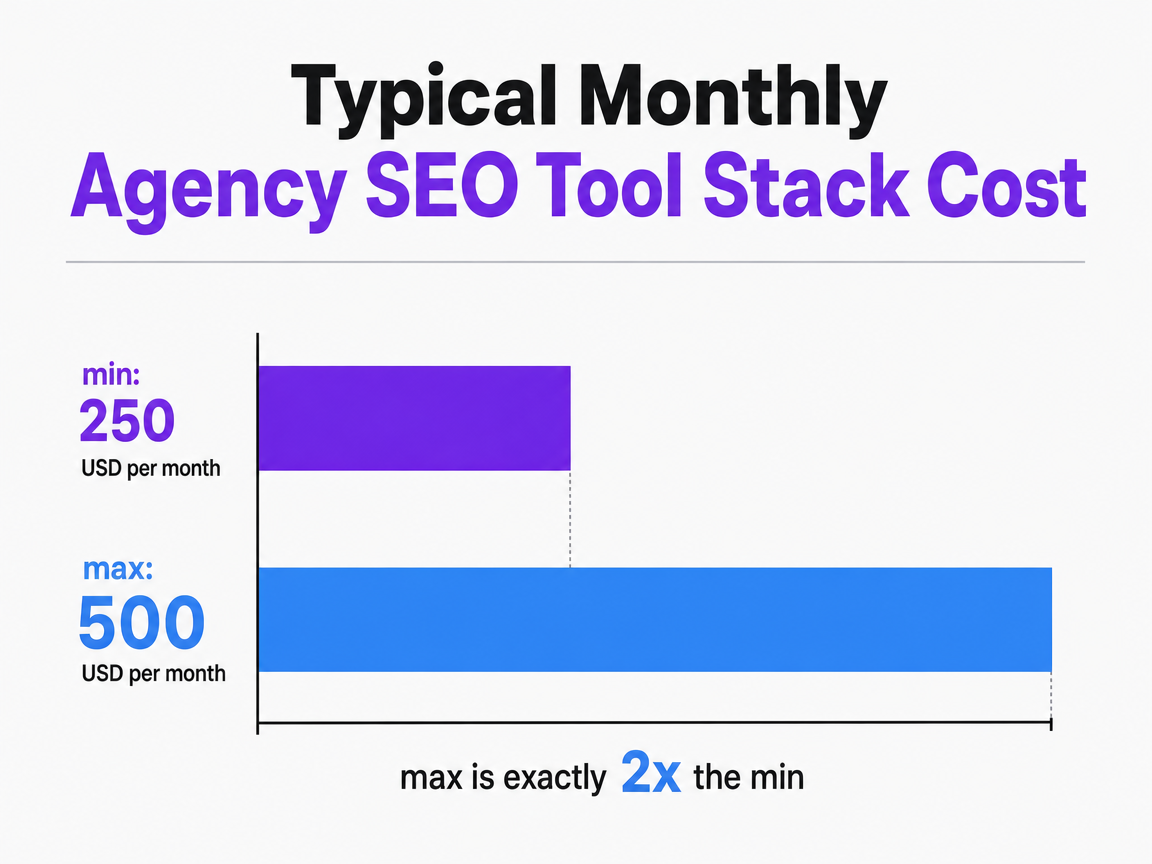 Typical Monthly Agency SEO Tool Stack Cost
A lean, capable agency SEO tool stack costs roughly $250 to $500 a month depending on client count.
How to decide what to consolidate versus keep specialized
The question of consolidation isn't whether one platform can do everything, but whether the marginal time saved by a specialized tool outweighs the time lost by managing two separate systems. MarTech's guidance on stack governance presents a clear choice: agencies can either
"build your stack in one of two ways: Use an all-in-one SEO suite… or use a mix of specialized tools for different use cases"
8. Both approaches are valid. What is not advisable is combining an all-in-one suite with every specialized tool it partially replaces.
At the license level, the decision involves a two-part test:
- Does the specialized tool save hours that the suite cannot, at a depth relevant to the agency's billing model? Screaming Frog, for instance, complements a research suite because desktop-scale crawl diagnostics are a distinct service not offered by Ahrefs or Semrush. Conversely, a second content optimization tool alongside seoClarity Content Fusion is redundant due to near 100% workflow overlap.
- Does the specialized tool integrate seamlessly into the reporting layer, or does it require strategists to manually reconcile exports? If integration relies on CSV downloads, the tool merely shifts labor rather than eliminating it.
Consolidation is effective at the research and content layers, where suite depth is sufficient for most accounts. Specialization is justified for the technical crawl layer in portfolios with large-URL clients, and at the AI execution layer, where production hours differ from analytical hours and are not addressed by research suites 10.
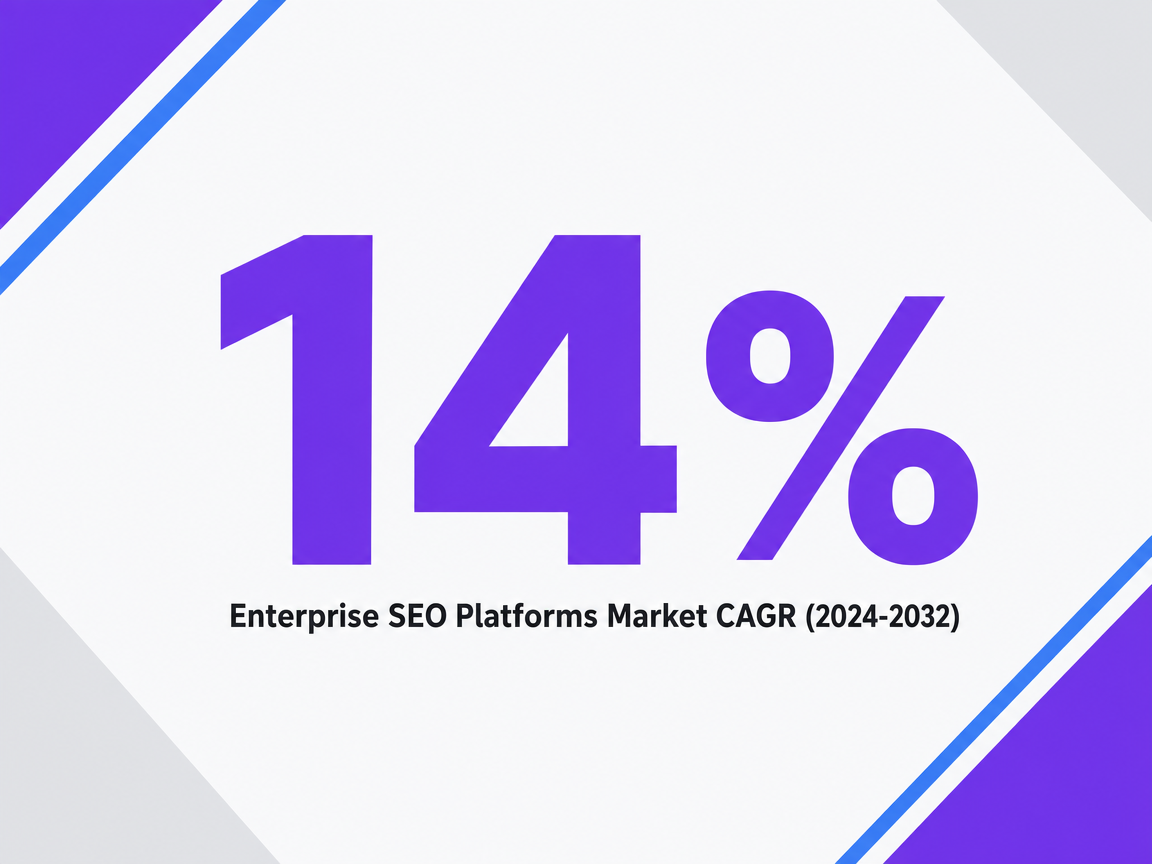 Enterprise SEO Platforms Market CAGR (2024-2032)
Enterprise SEO Platforms Market CAGR (2024-2032)
Frequently Asked Questions
References
- 1.Enterprise SEO Platforms Market Size, Share and Forecast 2032.
- 2.SEO Software Market Size & Share 2025-2034.
- 3.SEO Software Market Size, Competitors & Forecast to 2030.
- 4.SEO Software Market Size Worth USD 265.91 Bn by 2034.
- 5.SEO Software Market Size, Share & Forecast 2026-2034.
- 6.SEO Software Market Size to Hit USD 311.02 Billion by 2035.
- 7.Enterprise SEO Platforms: A Marketer’s Guide (MarTech Intelligence Report).
- 8.Enterprise tech stack & governance for multi-location SEO.
- 9.SEO Tools for Agencies: 2026 Guide to the Best Stack.
- 10.Enterprise SEO Tool Selection Guide to Maximize Delivery Hours Removed.
- 11.Best Enterprise SEO Software Guide for Scalable SEO Operations.
- 12.Best SEO Software for Agencies (2026): The Stack We Use.
- 13.The State of Marketing Technology 2024.
- 14.Best Enterprise SEO Tools in 2026 Compared - Konabayev.
- 15.Best Enterprise SEO Tools 2026 : Comparison, Pricing, Free Tiers.
- 16.Best SEO Tools For Agencies: Top Solutions To Boost Your Clients ....
- 17.Top Enterprise SEO Platforms Companies & How to Compare Them 2026.
- 18.Enterprise SEO Platforms: Compare the 5 Best Tools 2026.
- 19.Best Enterprise SEO Tools & Platforms (2026 Full Review).
- 20.Seo software for agency teams to boost client results fast.